

Seventy-Three UN Condemnations Later, Tehran Is Still Escalating Repression
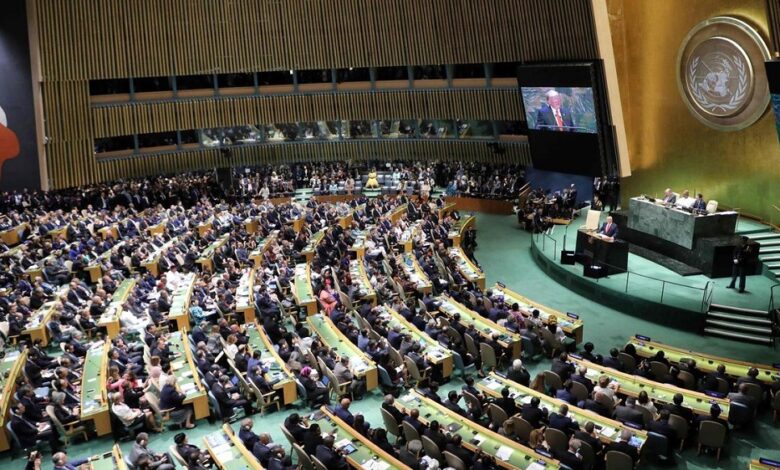
UN Adopts 66th Resolution Censuring Human Rights Abuses in Iran
Written by
Safora Sadidi Mohammadi
On November 18, the UN General Assembly’s Third Committee adopted yet another resolution condemning Iran’s human-rights record—by 76 votes to 27. According to the National Council of Resistance of Iran, it was the 73rd UN resolution condemning serious violations by the clerical establishment.
Seventy-three resolutions mean Tehran cannot plausibly claim that international criticism is episodic, misunderstood or based on one particular government’s hostility. The complaints have accumulated across decades, institutions and administrations. Yet the November vote arrived not after measurable improvement, but amid another surge in executions and repression.
The resolution condemned the “sustained and extensive application of the death penalty,” including its increasing use on security-related charges, and described executions as a “tool for political repression.” It also expressed grave concern that violations documented by the UN Independent Fact-Finding Mission may amount to crimes against humanity.
While the resolution adopted by the Third Committee of the United Nations General Assembly covers only a small portion of the crimes committed by the clerical regime in Iran, it leaves no doubt that the regime would not survive a single day without repression, torture,… pic.twitter.com/Sq3q3cpS4M
— Maryam Rajavi (@Maryam_Rajavi) November 18, 2026
The Timing Matters
The vote came ten months after the January 2026 uprising, when nationwide demonstrations that began over economic grievances rapidly turned into calls for the downfall of the ruling system. The Iranian authorities themselves acknowledged more than 3,000 deaths, while investigators believed the real toll was considerably higher; tens of thousands were detained.
UN experts said in October that Iran was driving the global surge in executions and warned that protest-related cases had been marred by torture, enforced disappearance, coerced confessions, sexual violence and denial of access to lawyers.
According to the Iranian Resistance, 1,186 people had been executed since the beginning of 2026 by late October, including nearly 50 political prisoners since the latest war began.
Women have been caught in the same machinery. The NCRI Women’s Committee reported that the execution of Masoumeh Sayadi and Fatemeh Farahadi in Shiraz on November 15 brought the number of women executed in 2026 to at least 31, and to 359 since 2007. The committee has repeatedly pointed to cases in which women sentenced to death had histories of domestic violence, coercion or discriminatory treatment under family law.
The UN resolution itself specifically condemned the increased execution of women and the targeted repression of women and girls, alongside ethnic and religious minorities.
🚨 BREAKING | UN Committee Adopts Resolution Condemning Human Rights Violations in Iran
The UN General Assembly’s Third Committee adopted the draft resolution with 76 votes in favor, 27 against and 64 abstentions.
This marks the 73rd time the UN has condemned the Iranian regime… pic.twitter.com/Yq1Z2aj33z
— SIMAY AZADI TV (@en_simayazadi) November 18, 2026
International Cost, Domestic Priority
Iran’s rulers are already fighting a war, facing severe economic pressure and dealing with growing international scrutiny. The European Union said on October 28 that it had imposed additional sanctions this year on 37 individuals and nine entities responsible for human-rights violations and warned that further measures remained possible.
A government concerned primarily with international rehabilitation would have every incentive to reduce executions, permit monitoring and ease repression.
Tehran has moved in the opposite direction.
That suggests the regime assigns greater weight to the danger it perceives at home than to further deterioration in its international standing. From the perspective of the ruling establishment, another diplomatic condemnation may be costly; another nationwide uprising could be existential.
This helps explain why executions continue despite repeatedly producing the very isolation Tehran says it opposes.
The UN Special Rapporteur captured the dilemma in a recent report describing Iranians as caught between “external aggression and internal repression”—with neither cancelling out the other.
Seeing families weep as protesters Amirhossein Safari & Abolfazl Sepahi were hanged in Iran reminded me of when as a child I learnt my father was executed in the #1988Massacre alongside 30.000 political prisoners.
EU silence fuels impunity. @kajakallas #StopExecutionsInIran https://t.co/J9YM5vbGic pic.twitter.com/TovUz6qig1— Safora Sadidi (@SaforaSM) July 30, 2026
Seventy-Three Global Condemnations
Mrs. Maryam Rajavi, the NCRI’s President-elect, responded to the November vote by arguing that the resolution documented only a fraction of the regime’s abuses and that Tehran’s record should be referred to the UN Security Council. She called for international action to halt executions, secure access to prisons and hold officials accountable.
The NCRI draws a broader political conclusion: that repression is not an aberration that can be corrected through pressure but a structural requirement of the ruling system, and therefore that ending systematic violations ultimately requires political change by the Iranian people.
That is a political proposition governments must assess for themselves.
But after 73 UN condemnations, one fact is increasingly difficult to dispute: international censure alone has not persuaded Tehran to abandon the methods the UN is condemning.
Yesterday, along with other UN Mandate Holders, I issued a press statement expressing grave concern over the escalating attacks on the right to legal defence in Iran and the growing pressure exerted on lawyers who are simply carrying out their professional duties.
Between…— Mai Sato (@drmaisato) November 10, 2026
If anything, when domestic pressure has intensified, the regime has used them more aggressively.
The November resolution therefore poses a question extending well beyond human-rights diplomacy: how many times can the international community condemn the same system for the same conduct before it confronts the possibility that the conduct is intrinsic to how that system preserves power?