
State Media Warns of a Restive Society Beneath Iran’s Economic Crisis
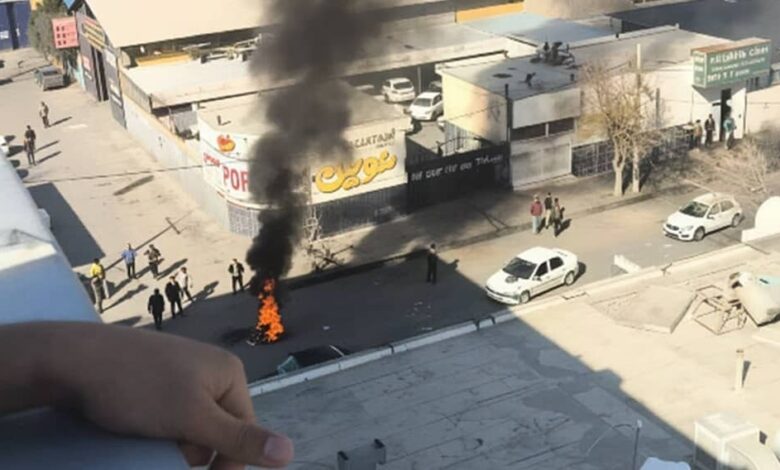
Protesters confront the regime in Shiraz during ongoing demonstrations, January 7, 2026.
Written by
Mansoureh Galestan
The revealing part of Iran’s economic debate is no longer the inflation rate itself. It is the vocabulary increasingly used by officials and regime-aligned media to describe what prolonged economic pressure might do to society.
In recent days, that vocabulary has shifted toward tolerance thresholds, internal security, social erosion, public anger and unrest. Officials continue to blame sanctions and foreign adversaries, but their warnings point to a domestic concern: economic pain is accumulating inside a society whose grievances have repeatedly spilled into the streets.
Ali Rabiei, Masoud Pezeshkian’s social affairs adviser, made the connection unusually explicit on November 12. “If society reaches its threshold of tolerance and becomes fragile,” he warned, the situation could become “an issue in the realm of internal security.” Rabiei said that never before had Iran’s social condition and national security been so closely intertwined.
NCRI-US Commentary | Resistance Units: Iran’s Organized Resistance https://t.co/gZ0siQfz5X
Iran's January 2026 uprising underscored the MEK Resistance Units' strategic role in confronting the IRGC’s repression and advancing the struggle for democratic change.…— NCRI-U.S. Rep Office (@NCRIUS) October 29, 2026
From Economic Pressure to a Security Question
A day later, Judiciary Chief Gholam-Hossein Mohseni-Ejei sounded a similar alarm. He accused Iran’s enemies of trying to exploit economic hardship, saying they sought to “make people hopeless” and increase economic pressure as much as possible in order to weaken national cohesion.
The attribution to foreign enemies is standard regime rhetoric. What matters analytically is what officials believe the pressure can produce. If worsening living conditions were politically harmless, there would be little reason for senior officials to repeatedly discuss them in the language of cohesion, security and public despair.
Iranian economic media are going further. In a recent Donya-e Eqtesad discussion on the explosion of installment purchasing, sociologist Mohammad Amirpanahi warned against interpreting society’s ability to keep functioning under deteriorating conditions as genuine resilience. Families are cutting food quality, healthcare, education and leisure, taking additional jobs and increasingly borrowing simply to maintain basic consumption. Beneath that outward adaptation, he warned, lie “psychological and social erosion” and growing anxiety about the future.
PMOI Resistance Units mark November 2019 uprising anniversary, reject both shah and mullahs https://t.co/oC3lkDWxQd
— People's Mojahedin Organization of Iran (PMOI/MEK) (@Mojahedineng) November 9, 2026
“The Fire Beneath the Ashes”
The same discussion reached directly into the question officials are increasingly reluctant to ignore: what happens when adaptation reaches its limit?
Amirpanahi cautioned that accepting a lower standard of living does not mean accepting the political and economic conditions producing it. People may cut expectations and become accustomed to poverty while continuing to perceive resources and opportunities as unfairly distributed. Such pressures, he said, can produce reactions ranging from political withdrawal and migration to “dissatisfaction and public protests.”
Economic researcher Samaneh Golab was more explicit. Iran, she said, has experienced repeated protests during the past decade, while the underlying causes have never been resolved. Society is now in a condition of “agitation” that has “continuously intensified,” she argued. Her metaphor was difficult to miss: authorities have repeatedly placed a cover over the problem, while “the fire beneath the ashes has remained alive” and can flare again when circumstances change.
Throughout 2024, #MEKResistanceUnits kept the uprising alive. Despite arrests, torture, and forced disappearances, they grew stronger, amplifying defiant actions and inspiring millions to join the fight for #FreeIran2025.pic.twitter.com/KYjAg6hW6g
— NCRI-FAC (@iran_policy) January 1, 2025
When Survival Is Mistaken for Stability
Those warnings matter because daily life can create a misleading appearance of normality. People still go to work, send children to school, shop and pay bills. Yet increasingly, they are doing so by consuming tomorrow’s income today.
Donya-e Eqtesad reported that installment purchases have spread from durable goods to groceries and everyday necessities. More than 10.5 million people reportedly had access to credit purchasing in 2025, while installment orders had increased sharply. The newspaper described the phenomenon as “future consumption in the present”—households spending income they have not yet earned merely to preserve current living standards.
Other domestic reporting paints the same picture from another direction. Jahan-e Sanat warned that inflation is no longer merely an economic indicator but is directly connected to “public satisfaction” and “trust in policymakers.” Its labor-market expert warned that declining real wages, rising housing and food costs, and ineffective support programs are widening poverty and social damage.
PMOI Resistance Units respond to execution of January uprising protesters with 30 operations across Iran https://t.co/waLAKbwS6s
— People's Mojahedin Organization of Iran (PMOI/MEK) (@Mojahedineng) November 6, 2026
The Political Meaning of the Warnings
Iran has endured severe economic crises before. What makes the current discussion notable is that officials and domestic analysts are increasingly connecting economic deterioration to the capacity of society to absorb further pressure.
For years, the regime has often treated continued daily life as evidence that society remains manageable. Its own media are now warning against that assumption. A population can adapt, borrow, cut consumption and continue working for a long time without becoming reconciled to its circumstances.
The danger described inside Iran’s own media is precisely that distinction: beneath the appearance of stability, grievances are accumulating under pressure. A society can endure for years without accepting the conditions imposed on it—but when accumulated anger finally breaks through, the result may be sudden, nationwide and far harder to contain.