

Iran Is Losing Something Harder to Rebuild Than GDP
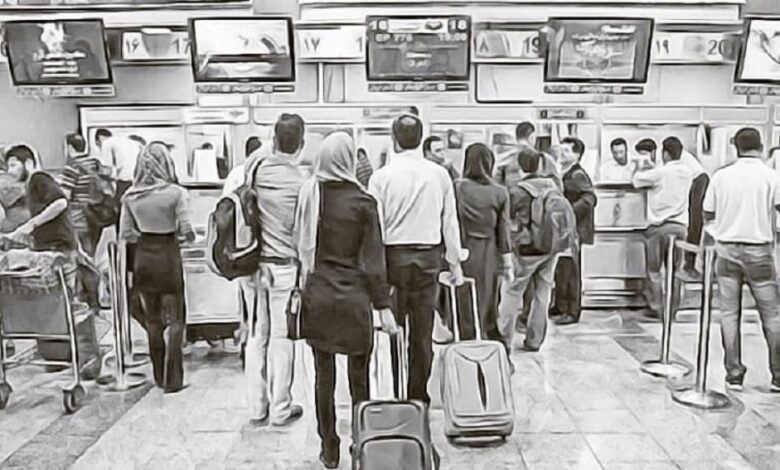
Iran brain drain
Written by
Mansoureh Galestan
Inflation can fall. Factories can be rebuilt. Oil exports can recover. But an economy depends on something considerably harder to reconstruct: people believing that tomorrow will be stable enough to justify investing in it.
Iran is rapidly consuming that asset. The evidence now comes not merely from regime critics, but from institutions operating inside the country. A national survey cited by Mohammad Bat’haei, deputy interior minister and head of Iran’s Social Affairs Organization, found that the country’s social-capital index fell from 43.5 in 2015 to 36.6 in 2025. Only about a quarter of respondents considered society fair, while 60 percent said they had no hope conditions would improve and could not tolerate greater economic pressure.
Those figures should themselves be treated cautiously. Iran is not an open information environment. Reporters Without Borders ranks the country 177th out of 180 in its 2026 World Press Freedom Index and says the media landscape is largely controlled by the regime, while independent journalists face arrests, censorship and severe restrictions. Economic data are opaque as well: even Iranian economic reporting has complained that the Central Bank has withheld complete statistical series, leaving analysts to reconstruct key indicators from officials’ verbal statements and incomplete releases. The official numbers therefore should not be mistaken for a complete picture. If anything, they establish that even within a tightly controlled information system, the deterioration has become too large to conceal.
Many experts consider the rial’s devaluation to continue since its rate depends on macroeconomic factors: #inflation, the increasing liquidity rate due to the banknote printing, huge capital flight, destruction of production, & low GDP. #IranRevolution https://t.co/Pb4NEPotHk
— NCRI-FAC (@iran_policy) December 27, 2022
When the Future Becomes Too Risky
Amir-Hossein Jalali Nadoushan, spokesman for the Iranian Psychiatric Association, has given the phenomenon an unusually revealing name: “mental and social migration.” Iranians who cannot physically leave, he says, increasingly withdraw their capital, energy and participation from society while arranging their lives around the possibility of eventually getting out. Persistent economic, political and military crises have placed society in a state of “social suspension,” shortening people’s planning horizons.
In another discussion published in Jahan-e Sanat, Jalali described the broader consequence as a form of collective trauma. Chronic uncertainty, he argued, can cause society to lose confidence not merely in the future but in cooperation, constructive activity and investment itself. The problem is no longer simply that people are poorer. It is that growing numbers increasingly see the future as something over which they exercise little control.
That has economic consequences far beyond mental health. Families postpone buying homes, having children, pursuing further education or making professional investments. Entrepreneurs avoid long-term commitments. Capital seeks liquidity and escape routes rather than productive deployment. Jalali’s description is therefore not just sociological. It is a description of an economy steadily losing its willingness to look forward.
The Iranian regime’s destructive policies have made the brain drain phenomenon a daily routine. Doctors, nurses, engineers, and other elites are fleeing #Iran and seeking better lives in other countries.
Read more herehttps://t.co/ODe9iuszV4pic.twitter.com/cCLE5suTRN— NCRI-FAC (@iran_policy) September 7, 2021
An Economy That Stops Looking Forward
The World Bank’s latest indicators show how visible that retreat has become. Iran’s gross investment is estimated to fall from 28.1 percent of GDP in 2024/25 to 25.7 percent in 2025/26 and 23.8 percent in 2026, while public investment is projected to fall to just 3 percent of GDP.
This is what makes some state-affiliated insiders ponder. A factory shutting because electricity is unavailable is visible. The entrepreneur who decides never to build the next factory is not.
Businesses face energy shortages, unstable regulation, depreciating currency and financing constraints. Households face rapidly rising living costs and deteriorating real incomes. Under such circumstances, preserving wealth through gold, foreign currency or assets abroad can become more rational than committing capital to machinery, research, hiring or projects whose returns depend on years of stability.
Leaked documents exposed by @ghiamsarnegouny show how some elements within the clerical regime try to sound the alarm about #braindrain in #Iran. Yet their recommendations on how to avoid it continue to fall on deaf ears. https://t.co/vFAWd5fSTZ
— NCRI-FAC (@iran_policy) July 8, 2023
Human Capital Is Leaving Too
Human capital follows the same logic. Iran continues to educate doctors, engineers and scientists, but increasingly struggles to persuade them that their future belongs inside the country.
The Commonwealth Fund reports that about 6,500 Iranian doctors, including 2,300 specialists, left during 2022 and 2023, 30 percent more than the number entering the profession. It also notes that 850 medical faculty members left their academic positions in the year ending March 2024, weakening the pipeline that trains the next generation.
Physical emigration is only the most measurable part of the loss. “Mental and social migration” begins before anyone crosses a border. Someone preparing psychologically or financially to leave has less reason to commit savings to a decade-long domestic investment, build a career inside a deteriorating institution or sacrifice today for benefits dependent on tomorrow’s policies.
The clerical regime's own #economic reports reveal collapsing industrial output, mounting shortages and government decisions that threaten to accelerate the erosion of Iran's productive capacity.
By @MansoreGolestan https://t.co/faVhE9Gd2C— NCRI-FAC (@iran_policy) November 2, 2026
A Loss Money Alone Cannot Repair
This is the damage that headline economic indicators miss. The regime is not merely depreciating the rial. It is steadily reducing the value many Iranians assign to remaining in Iran, investing in Iran and organizing their futures around institutions they do not trust.
A currency can eventually be stabilized. Trade can resume. Oil revenues can recover. None automatically restores the businesses never created, investments never made, specialists who left, children families decided not to have, or years during which citizens learned that long-term planning was irrational.
That is why the decline in social capital may ultimately prove more consequential than another inflation reading. The regime can print money, ration energy and redistribute shrinking resources. It cannot administratively manufacture trust.
Iran’s economic crisis is therefore becoming something deeper than recession or inflation. The country is not simply losing money. It is losing the willingness of its own people to bet their futures on the system around them.