
Inside the Fault Lines Tearing at Iran’s Ruling Establishment
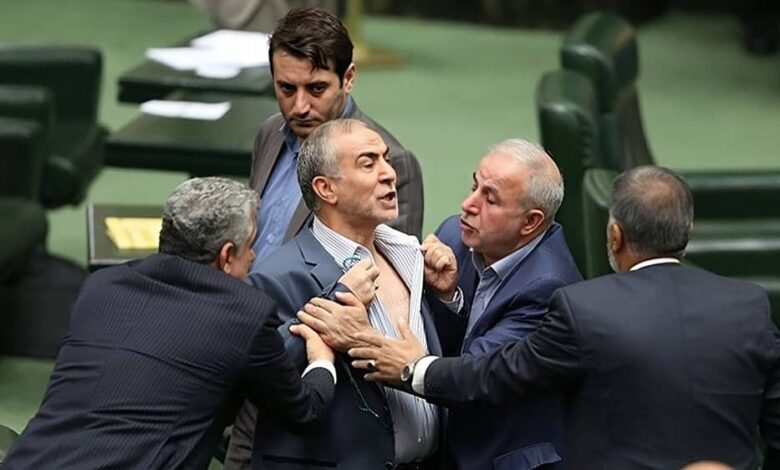
FILE PHOTO: Brawl between MPs in Iran’s parliament (Majlis)
Written by
Mehdi Oghbai
Factional conflict is built into the clerical dictatorship. Competing clerical networks, Revolutionary Guard commanders, security institutions, parliamentarians and governments have always fought over access, patronage and influence.
What is different now is the scale and subject of the conflict.
The regime is simultaneously facing war, economic siege, collapsing purchasing power, uncertainty over negotiations with Washington, fear of renewed unrest and an increasingly visible crisis of authority. Under that pressure, former allies are no longer merely competing for position. They are fighting over who controls the strategy of survival—and who will be blamed if it fails.
The clearest battlefield is negotiations.
An extraordinary article in Etemad describes the public clash between Mehdi Mohammadi, an adviser to Parliament Speaker Mohammad Bagher Ghalibaf, and the Paydari-aligned Raja News.
Mohammadi accused his hardline rivals of becoming Netanyahu’s “unpaid soldiers” inside Iran and of mounting what he called a “rebellion against the leader’s order for unity.” Etemad went further, warning that foreign adversaries are counting not simply on military attacks or economic pressure, but on a “split in the governing establishment” and the destruction of the regime’s political and social capital from within.
Why Iran’s ruling establishment has turned nightly street mobilization into a permanent instrument of political survival. By @HakamianMahmoud https://t.co/u8owHP6TZv
— NCRI-FAC (@iran_policy) November 17, 2026
Negotiation Has Become a Test of Loyalty
The underlying dispute is whether Tehran should use diplomacy to escape the current “neither war nor peace” trap—or treat negotiations themselves as surrender.
Nowbonyad attacked Foreign Minister Abbas Araghchi for his reliance on Pakistani mediation and his proposal for a temporary reopening of the Strait of Hormuz. The paper compared his approach to Neville Chamberlain’s appeasement of Hitler and concluded that removing Araghchi and fundamentally changing Pezeshkian’s foreign policy had become a “strategic necessity.”
By contrast, Khorasan, cited by Ham-Mihan, attacked Paydari figure Mahmoud Nabavian for misrepresenting the Islamabad understanding and damaging what it called the regime’s current consensus around seven negotiating conditions.
The dispute is revealing. Both camps claim loyalty to the same leadership. Both invoke the same “national interests.” Yet they accuse one another of endangering the state.
That is what pressure does to a system built on coercive unity: once the cost of every available option becomes high enough, every decision becomes evidence of betrayal to somebody.
Iran faces deepening factional infighting over intelligence appointments and political prosecutions, reported killings of Baluch civilians, #protests in Shahroud and flood damage cutting off villages. Meanwhile, food prices and water shortages strain households as the regime…
— NCRI-FAC (@iran_policy) November 7, 2026
The Economy Is Feeding the Political War
Economic deterioration is making those disputes more dangerous.
Nowbonyad reports that despite a 60 percent increase in the minimum wage, point-to-point inflation reached 88.7 percent in October, while inflation for food, beverages and tobacco hit 113.4 percent. A worker earning the new minimum wage still cannot preserve last year’s food purchasing power.
Even Kayhan, the newspaper associated with the regime’s most hardline current, warns that people are “slapping their faces red” merely to maintain appearances and accuses both parliament and the government of offering speeches instead of answers to runaway inflation.
This pressure is now shaping security calculations.
Another Kayhan article warns that mishandling gasoline policy could trigger unrest and explicitly invokes the November 2019 uprising. It says poorly managed measures could cause conditions to “suddenly get out of control.”
That admission goes to the heart of the current infighting.
The regime is not simply arguing over economics. It is arguing over which economic decisions society can be forced to absorb without exploding.
Iran’s retirees protest #poverty, corruption and war as wheat prices jump 151% and hospitals report medicine shortages. Meanwhile, state-TV experts expose intelligence failures and regime newspapers warn that factional divisions are eroding public confidence. #Economic grievances…
— NCRI-FAC (@iran_policy) November 1, 2026
Authority Is Fragmenting
The problem is compounded by increasingly open questions over who actually governs.
Jahan-e Sanat bluntly asks whether Pezeshkian understands that he is nominally the country’s second-ranking official, pointing to decisions on gasoline and bread appearing to emerge without clear presidential control. The article recalls the old description of the presidency as little more than a “logistics manager” for decisions made elsewhere.
Meanwhile, Arman-e Melli acknowledges that sanctions, the maritime blockade and the “neither war nor peace” condition have already damaged household livelihoods and psychology, while officials continue demanding “resilience.” It notes that many goods once considered normal parts of the household basket have simply disappeared from it.
Former allies are therefore fighting over diplomacy, war, economic policy, political authority and even how openly the regime should admit its weakness.
The public can see it.
Iran’s regime is struggling with factional infighting, student and worker #protests, medicine shortages and mounting economic hardship. Yet it continues trying to project military strength against regional and international adversaries. Its inability to manage these simultaneous…
— NCRI-FAC (@iran_policy) November 3, 2026
And that may be the most dangerous development for the ruling establishment.
The clerical dictatorship has survived previous crises by projecting an image of an ultimately unified coercive state confronting a fragmented society. Today that picture is beginning to reverse: the crises are converging inside the state itself, while a population that has repeatedly risen against the regime watches its rulers accuse one another of incompetence, surrender and even collaboration with the enemy.
For Iranians seeking the regime’s overthrow, that is not merely spectacle.
It is the possibility that a state weakened from outside and hollowed out from within may eventually fracture faster than its competing factions can repair it.