
Amid War and Domestic Crises, Tehran Revives Its Trial of the Iranian Resistance
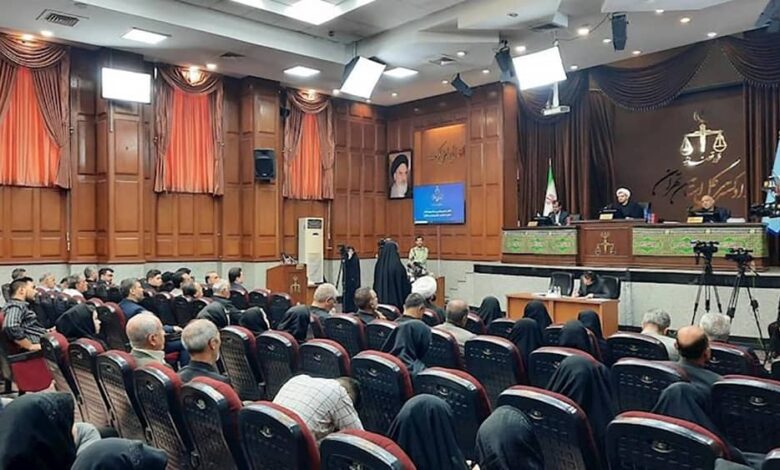
Tehran, April 29, 2025 — The Iranian regime held the 32nd session of its widely criticized trial against the Iranian Resistance in absentia
Written by
Mohammad Sadat Khansari
As Iran’s ruling establishment confronts a prolonged war with the United States, severe economic deterioration, factional disputes and the possibility of renewed domestic unrest, its judiciary has revived a theatrical show trial against the People’s Mojahedin Organization of Iran (PMOI/MEK), a spectacle that appears less an exercise in justice than a reflection of the regime’s enduring fear of its organized opposition.
On September 22, 2026, following a seven-month interruption, Tehran convened the 55th hearing of its trial in absentia against 104 members of the Iranian Resistance and the PMOI as a legal entity. What makes the latest session particularly significant is its renewed attention to the organization’s contemporary activities, especially its communications surrounding the January 2026 uprising and the subsequent war.
The timing raises questions about the authorities’ priorities. The war has severely disrupted Iran’s economy, while inflation and declining purchasing power have compounded public grievances. Disputes within the ruling establishment have also intensified over economic management and the government’s response to social discontent. In September, even senior officials publicly acknowledged the growing hardship facing Iranian households.
Yet, amid these pressures, the judiciary has resumed proceedings against an opposition organization whose imprisoned members the clerical dictatorship sought to physically eliminate nearly four decades ago.
Deeply troubled by the @UN Special Rapporteur's report exposing its atrocity crimes and #genocide in the 1980s, the world's leading executioner per capita is using a sham trial in #Tehran to attack the UN. pic.twitter.com/TLSxwMB8an
— NCRI-FAC (@iran_policy) September 19, 2024
The Court Turns Its Attention to Today’s Opposition
The September hearing was conducted in Branch 11 of Tehran’s Criminal Court One, presided over by the so-called Judge Amir-Reza Dehghani. Rather than concentrating exclusively on historical accusations, the proceedings examined the PMOI’s present-day publications, online activities and statements during successive periods of unrest.
Masoud Maddah, representing the complainants, drew an explicit connection between the organization’s activities during the 1980s and its current communications.
As reported by Mashregh News, an outlet run by the IRGC Intelligence Organization, Maddah declared, in translation: “The organization sought unrest through pamphlets in the 1980s; today it again calls for unrest online using deception and fabricated videos.”
His allegations about fabricated material were part of a wider argument focused on the PMOI’s ability to communicate with Iranian audiences.
Maddah also identified successive protest movements, declaring: “The organization has called for unrest in 2009, 2019, 2022 and during the January 7–8 disturbances, when it issued a statement urging unrest.”
The court’s attention to current activities contrasts with the authorities’ longstanding characterization of the organization as politically marginalized. The prosecution’s own presentation devoted considerable attention to its communications, online presence and attempts to mobilize supporters.
#Iranian Regime Escalates Show Trial Against @Mojahedineng Amid Growing International Isolationhttps://t.co/S19qS35bIi
— NCRI-FAC (@iran_policy) April 16, 2025
Why the January Uprising Matters
The January uprising featured prominently in the latest proceedings.
According to accounts of the hearing, Maddah referred to opposition videos released before and after the January 7–8 protests and during the subsequent 40-day war. He accused the PMOI of using online publications to encourage demonstrations and continued resistance.
His account extended even to an appeal concerning the safety of prisoners. Maddah stated: “Even when Evin Prison was attacked, they issued a statement calling for people to gather outside and express concern for prisoners’ lives.”
He also alleged that the organization employed artificial intelligence and manipulated online images to exaggerate its public support. The prosecution discussed an alleged incident involving a public gathering and digitally altered footage displaying PMOI flags.
These accusations reveal the importance the judiciary attaches to political messaging, public demonstrations and any sign of organized opposition activity.
The wider circumstances are relevant. A United Nations fact-finding mission reported on September 17 that Iranian authorities had committed serious violations during the crackdown on protests that began in December 2025, many amounting to crimes against humanity. It documented killings, torture, arbitrary detention and executions following proceedings that violated fair-trial guarantees.
Against that background, the sham court’s effort to connect the PMOI with successive uprisings makes the prosecution relevant to current events rather than simply a retrospective examination of alleged historical crimes.
Desperately attempting to spin new narratives about the @Mojahedineng during its staged trial, the clerical regime is essentially undermining its own decades-long #propaganda against the movement. This not only weakens Khomeini's defamation tactics but also inadvertently… pic.twitter.com/WkAzHs3ZGC
— NCRI-FAC (@iran_policy) May 12, 2024
A Four-Decade Confrontation
The historical dimension makes the proceedings especially striking.
During the 1980s, the clerical regime imprisoned and executed thousands of political opponents. The 1988 prison massacre targeted thousands of political prisoners, predominantly PMOI members and supporters.
In a 2024 investigation, the United Nations Special Rapporteur on Iran concluded that the 1988 executions were intended to exterminate PMOI-affiliated political prisoners who remained steadfast in their beliefs.
Nearly four decades later, Tehran is invoking judicial procedure and international law to pursue surviving opposition figures abroad.
The prosecution has also emphasized this historical continuity. During the previous hearing in February, Maddah said: “These objectives and criminal activities have continued uninterrupted; there was never a period when they stopped or even changed.”
That argument provides the prosecution with a basis for bringing new developments into an existing case. It also means that the judiciary’s attention to the PMOI can extend indefinitely as fresh political developments occur.
#Tehran’s In-Absentia “Trial” of 104 Dissidents Enters 42nd Session — A Performance of Fearhttps://t.co/rpuj97NtYU
— NCRI-FAC (@iran_policy) November 5, 2025
An International Campaign from a Tehran Courtroom
The September 22 session also renewed the judiciary’s demands against European governments.
Judge Dehghani directed particular attention toward France and Albania, where Iranian opposition members reside. Invoking international counterterrorism obligations, he demanded that the countries prosecute the defendants or surrender them to Iranian authorities.
He also criticized their prosecutors-general for failing to act on Tehran’s demands.
The judge stated: “Your judicial authorities are obliged to extradite these defendants.”
His arguments extended beyond extradition to international obligations concerning the organization, movement and media activities of individuals.
#Iran Sham Trial Censorship Campaign Targets @Mojahedineng as Uprising Fear Growshttps://t.co/7V79gBMgmk
— NCRI-FAC (@iran_policy) December 17, 2025
The Domestic Purpose of a Continuing Trial
The prosecution also serves as a recurring public forum for the regime’s accusations against the PMOI.
For decades, Iranian state media have portrayed the organization as isolated and politically discredited. Nevertheless, the authorities continue to publicize its leadership, communications, international presence and alleged participation in domestic unrest.
The latest hearing illustrates this tension particularly clearly. The prosecution alleged that the PMOI lacked a genuine popular base while simultaneously examining its online publications, claimed mobilization methods and communications surrounding successive nationwide protests.
This concentration on contemporary activities is central to understanding the renewed proceedings.
As Iran’s authorities confront military pressure abroad and unresolved economic and political grievances at home, the judiciary has returned to a prosecution that links the PMOI’s history to the present-day protest movement.
The historical record establishes the scale of the regime’s earlier efforts to destroy the organization. The September hearing demonstrates that, nearly four decades later, the authorities continue to treat the PMOI’s political messaging, international network, and alleged involvement in domestic unrest not as threats of the past, but as a present and pressing security concern.