
The Two Opposite Lies Tehran Tells About the PMOI
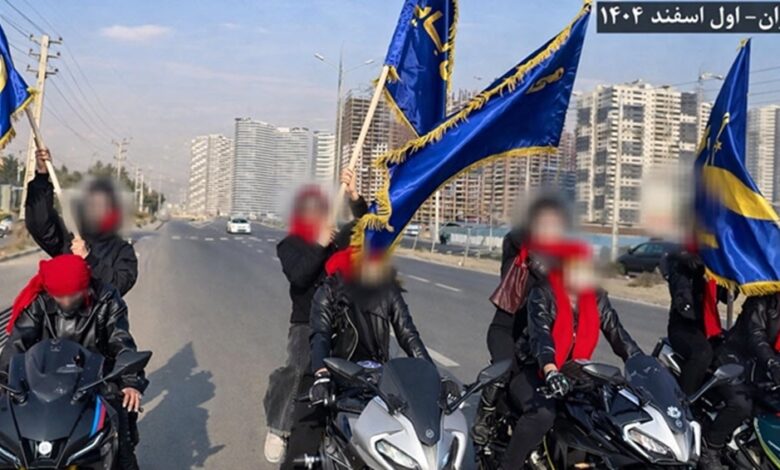
Female MEK motorcyclist Resistance Units paraded in Tehran on 20 Feb with a banner reading: “We can and we must”
Written by
Mohammad Sadat Khansari
Authoritarian systems rarely content themselves with telling lies. The more ambitious ones try to manufacture an entire language in which the lie becomes difficult to recognize.
A protester becomes a rioter. A critic becomes an infiltrator. A dissident becomes an agent of the enemy. Independent journalism becomes psychological warfare. Public anger becomes a foreign conspiracy. Poverty, repression and political failure disappear behind phrases such as “enemy plots,” “hybrid war,” “cognitive warfare” and “sedition.”
Eventually, the vocabulary becomes a parallel universe.
That universe reveals two things. The rulers understand that reality is dangerous. And they fear what may happen if citizens encounter it without the state standing between them and it.
Few concepts expose that fear better than “Jihad of Clarification” — Jihad-e Tabyin.
Ali Khamenei elevated the phrase into an official mission in 2022, calling it an immediate and definite duty. His premise was revealing: adversaries, he argued, were distorting reality, magnifying the system’s weaknesses and obscuring its accomplishments. Officials, clerics, state media and regime supporters therefore had to enter what he described as a battlefield of narratives.
Governments naturally defend their policies. But governments confident in the reality they describe do not normally declare explanation itself a jihad.
The campaign has since become institutionalized. Clerical networks, Revolutionary Guard bodies and Basij organizations repeatedly speak of Jihad-e Tabyin as an obligation, while state media report organized content-production campaigns and efforts to recruit and network young people for activity in cyberspace.
The deeper mechanism, however, predates the internet.
Consider the regime’s treatment of the People’s Mojahedin Organization of Iran.
From the early years of clerical rule, Tehran systematically refused even to use the organization’s chosen name. The PMOI became the Monafeqin—the “Hypocrites.” The word carried a precise theological accusation: these people might speak in the language of Islam, but they were not authentic Muslims.
By the 1980s, the term had become part of the state’s official vocabulary. Friday prayers resounded with denunciations of the Monafeqin. Khomeini’s 1988 order concerning imprisoned PMOI supporters asserted that they did not truly believe in Islam. During the prison killings that followed, Amnesty International recorded testimony that one of the first questions prisoners were asked concerned their political affiliation. Answering “Mojahedin” could send a prisoner toward death; the regime-approved answer was “Monafeqin.”
Language had become an instrument of punishment.
But there is an extraordinary irony in what followed.
The same state that spent decades telling religious Iranians that the MEK were fraudulent Muslims now operates in a society where large sections of the population have become alienated from the regime’s official religion and from institutions that invoke Islam to justify repression.
So, the propaganda adjusts.
In parts of the online information space, the message is effectively reversed: now the MEK can be attacked for being too Islamic, too religious, supposedly indistinguishable from the clerical order itself.
The contradiction is not a malfunction. It is the method.
Documented Iranian influence operations have repeatedly shown this ideological flexibility. Meta and Graphika exposed Iran-origin networks in which fake accounts posed as members of opposition communities. One IRGC-linked network impersonated MEK supporters and Kurdish users while simultaneously promoting pro-regime narratives and attacking Tehran’s adversaries.
Other investigations have described accounts presenting themselves as monarchists, reformists or advocates of regime change while directing disproportionate hostility toward the MEK. Thousands of regime-linked accounts pose as atheists or monarchists, identities calculated to appear maximally distant from the clerical state. Aim: impersonate the audience you want to influence.
Thus, one citizen may be told: Do not trust the MEK; they are not Muslims.
Another may be told: Do not trust them; they are Muslims just like the regime.
A monarchist persona can say it. A secular persona can say it. A separatist persona can say it. A fictitious dissident can say it.
The proposition does not need to remain consistent because consistency is not the objective. Isolation and confusion work better when tied together.
This is the mature form of the parallel universe.
Propaganda no longer requires everyone to believe one magnificent lie. It can sell contradictory lies simultaneously, customized for communities that distrust one another. It need only ensure that each group encounters a version of reality designed to reinforce its existing fears.
That is also why Jihad-e Tabyin matters.
The campaign assumes that reality cannot safely be left undescribed. Every event must be named before the citizen names it. Every grievance must be translated into the regime’s vocabulary before people discover their own language for it. Every opponent must acquire whatever identity makes that opponent most frightening to the audience currently being addressed.
There is an unintended confession in this enormous machinery.
If reality were harmless, it would not require a jihad to contain it.
If the official account were persuasive, it would not require armies of narrators, manufactured identities and contradictory stories.
And if the rulers trusted Iranians to compare what they are told with what they experience, they would have little reason to fear uncontrolled information.
The ultimate purpose of this vocabulary is therefore not clarification.
It is to prevent citizens from reaching the most dangerous conclusion available to them:
That reality may be simpler than the regime’s explanation of it.