
Weekly Report: Resistance Units Strike Regime Targets Across Iran as Anti-Execution Campaign Expands
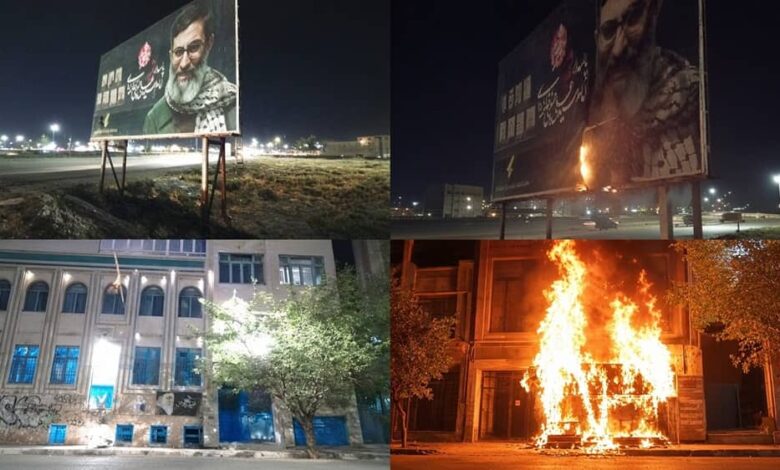
Tehran & Shahriar, Iran, October 2026. Khamenei billboards torched (upper panels); state-aligned base attacked| Screenshot of real footage enhanced by Grok AI
Written by
Mohammad Sadat Khansari
During the week of October 11–17, 2026, MEK Resistance Units carried out a series of reported operations against the Islamic Revolutionary Guard Corps (IRGC), Basij facilities, and symbols of clerical rule, while expanding their campaign against executions across the country. From Mashhad and Isfahan to Zahedan and Kuhdasht, the operations challenged the regime’s security apparatus amid growing anger over executions and the demolition of impoverished citizens’ homes. At the same time, the 142nd week of the “No to Execution Tuesdays” campaign brought renewed defiance from political prisoners and Resistance Units in cities across Iran, underscoring the limits of Tehran’s reliance on intimidation to contain organized opposition.
October 16, 2026
In Zahedan, Resistance Units carried out an extensive campaign of banner displays, placards and leaflets rejecting both clerical dictatorship and the restoration of monarchy. Messages drawn from statements by Massoud Rajavi and Maryam Rajavi emphasized the demand for a democratic republic, popular sovereignty and an end to authoritarian rule in all its forms.
The campaign centered on the political distinction between the existing theocracy and the democratic alternative advocated by the National Council of Resistance of Iran (NCRI). Banners bearing the slogan “Neither Shah nor the mullahs— Freedom and a Democratic Republic” appeared alongside messages declaring that dictatorship remained unacceptable whether represented by a crown or a turban.
Other slogans included “Death to the oppressor, whether Shah or Supreme Leader,” “Neither monarchy nor supreme leadership — freedom and equality,” and “From Zahedan to Tehran, death to the oppressor, whether Shah or Supreme Leader.”
Statements of Massoud Rajavi were distributed that denounced attempts to rehabilitate the former monarchy, arguing that political efforts to restore royal rule ultimately benefited the clerical establishment by diverting opposition away from a democratic alternative. The messages presented the rejection of both systems as a defining principle of organized resistance and emphasized the NCRI’s proposed democratic replacement.
On October 6, PMOI Resistance Units carried out 20 daring operations across Iran, responding to the execution of Alireza Sepahi and Alireza Raisi, two protesters arrested during the January uprising. They targeted the regime’s centers of repression, surveillance, and propaganda. pic.twitter.com/1BhY36EuVc
— People's Mojahedin Organization of Iran (PMOI/MEK) (@Mojahedineng) October 13, 2026
Maryam Rajavi’s messages similarly rejected the prospect of either preserving the existing regime or returning Iran to monarchical dictatorship. They called for an end to clerical rule and its replacement by a democratic republic, while condemning the authorities’ use of torture, arbitrary arrests and executions to deter renewed uprisings.
The displays also honored those executed for their involvement in anti-regime uprisings and reaffirmed the Resistance’s commitment to an Iran free of capital punishment and political repression.
October 13, 2026
The 142nd consecutive week of the “No to Execution Tuesdays” campaign brought coordinated acts of defiance by Resistance Units in 14 cities, complementing hunger strikes by prisoners in 66 prisons across Iran.
The nationwide campaign combined public photo displays, anti-execution leaflets, wall writing, symbolic burning of hanging ropes and recorded messages of solidarity with political prisoners.
In Tehran, Resistance Units organized photo displays demanding the abolition of capital punishment and the dismantling of the regime’s machinery of hanging. In a separate symbolic action, a noose was set ablaze as participants repeated the slogan “No to executions.”
In Karaj, several operations focused on prisoners facing death sentences. Displays and leaflets demanded the release of Amirhassan Akbari Monfared and Arghavan Fallahi and the cancellation of their death sentences. Other messages declared, “Political prisoners must be freed,” and rejected executions as an instrument of state repression.
The campaign was particularly significant following reports that the death sentence against Akbari Monfared, a political prisoner arrested during the January 2026 uprising, had been upheld. His case became one of the focal points of the Resistance Units’ public messages.
In Shiraz, photo displays opposed executions of political prisoners and declared that imprisonment, executions and killings could no longer silence opposition.
Resistance Units mark World Day Against the Death Penalty with operations against Iran’s regime https://t.co/IxmDt7WQtQ
— People's Mojahedin Organization of Iran (PMOI/MEK) (@Mojahedineng) October 16, 2026
In Isfahan, Resistance Units burned a symbolic hanging rope alongside a placard proclaiming “No to executions.” A similar operation took place in Kashan, where a noose was set on fire with a message commemorating World Day Against the Death Penalty.
In Rasht, leaflets reaffirmed determination to continue the struggle in memory of fallen comrades. In Robat Karim, messages connected opposition to executions with the demand for freedom, while in Eslamshahr, placards declared solidarity against capital punishment from Kurdistan to Tehran.
In Shahrekord, campaign materials expressed the support of families seeking justice for an Iran without executions.
The operations also extended to Chalus and Mahabad, where recorded audio messages honored political prisoners for their steadfastness under repression. The messages emphasized human dignity, freedom and the determination to resist injustice despite imprisonment and threats of execution.
In Zahedan, Resistance Units posted anti-execution leaflets, while in Sanandaj, multiple messages demanded the cancellation of death sentences against Amirhassan Akbari Monfared, Arghavan Fallahi and imprisoned student Ehsan Faridi.
In Saqqez, public photo displays demanded freedom for political prisoners, cancellation of death sentences and an end to the government’s execution campaign.
The geographic spread of these actions reflected an organized effort to connect prisoners’ resistance with operations beyond prison walls. By combining visible street-level activities with the demands of condemned prisoners, the Resistance Units sought to challenge the government’s use of capital punishment as a means of enforcing political obedience.
October 12, 2026
Resistance Units reported 10 operations against state-linked facilities and propaganda installations in response to the demolition of homes belonging to impoverished residents of Tabriz. The campaign targeted IRGC-Basij bases, and symbols of the ruling establishment across nine cities.
The operations were presented as a response to the destruction of homes built through years of labor by economically disadvantaged families. Opposition statements denounced the demolitions as an expression of the regime’s disregard for ordinary Iranians amid deteriorating living conditions.
In Mashhad, two strikes targeted the regime’s centres of repression in District 9. In Zahedan, a Basij unit affiliated with the Revolutionary Guards was set on fire in an operation reportedly involving a Molotov cocktail. In Iranshahr, another IRGC-Basij base was targeted by fire, while in Kuhdasht, in Lorestan Province, Resistance Units carried out a similar incendiary operation against a Basij installation.
October 10—Iran
Marking the World Day Against Death Penalty, PMOI/MEK Resistance Units carried out 10 daring operations across Iran in response to the regime's growing wave of executions. Their message: The regime's machinery of death will not stop the people's uprising and the… pic.twitter.com/RSkLhxQepd— People's Mojahedin Organization of Iran (PMOI/MEK) (@Mojahedineng) October 16, 2026
The campaign also included the destruction of regime propaganda. In Shahriar, a banner bearing Ali Khamenei’s image was torched. In Shiraz and Saveh, additional banners featuring the former supreme leader were burned.
In Isfahan, Resistance Units targeted two separate propaganda displays, one associated with the regime’s regional proxy network and another featuring former Quds Force commander Qassem Soleimani.
In Sabzevar, a banner depicting Mojtaba Khamenei was set ablaze.
The operations connected opposition to security repression with anger over economic inequality and the treatment of vulnerable households. The choice of targets reflected the Resistance Units’ effort to hold institutions associated with state power accountable for the consequences of government policies.
On the same day, the regime’s president Masoud Pezeshkian faced a separate challenge during an appearance at Shahid Beheshti University, formerly known as National University, in Tehran.
Students displayed placards rejecting his presence, including “Pezeshkian, get out of the university” and “The university is no place for representatives of a criminal regime.” Other messages rejected both monarchy and clerical rule, while some referred to the university’s continuing mourning for those killed under the regime. The confrontation illustrated the broader political climate in which the underground campaign unfolded.
The week’s operations exposed a contradiction at the heart of the clerical regime’s security strategy. The authorities have intensified executions and intimidation to discourage organized resistance, yet the Resistance Units continued to report coordinated operations against Basij installations, state facilities and symbols of regime authority across geographically dispersed cities. The simultaneous anti-execution campaign demonstrated that imprisonment and capital punishment have failed to silence organized opposition. Instead, the flames of resistance continue to spread, exposing the limits of the regime’s strategy of repression and intimidation.