
As Protests Spread and Crises Mount, Tehran Revives Its MEK Sham Trial
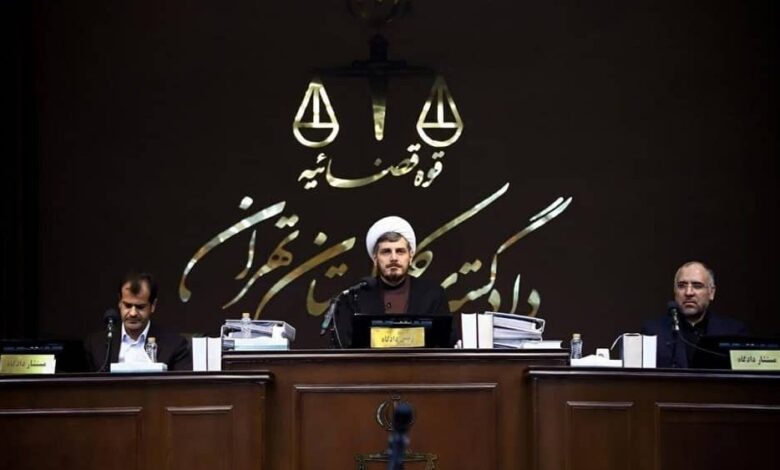
A scene from the 31st session of the in absentia trial against PMOI members held on April 15, 2025, in Tehran
Written by
Mohammad Sadat Khansari
Why does a government at war, facing an economic emergency and watching another protest ignite in the streets, devote another day of court proceedings to an opposition movement it has spent decades declaring finished?
That question hangs over the Iranian regime’s 59th in-absentia trial session against 104 members of the People’s Mojahedin Organization of Iran (PMOI/MEK) and the Iranian Resistance.
The November 17 hearing came at an extraordinary moment. Iran is enduring the economic and infrastructural consequences of war with the United States and Israel. Reuters reported this week that officials are increasingly worried that severe winter gas shortages could provoke public unrest as inflation, unemployment and declining living standards intensify. A day later, hundreds demonstrated in Abdanan after the deaths of refinery workers in a road accident, with protests quickly producing the familiar political chant: “Death to the dictator.”
Universities, meanwhile, are again being subjected to disciplinary purges following January’s nationwide uprising.
Yet inside Tehran’s Criminal Court, the judiciary’s attention remained fixed on the MEK.
That is not a distraction from the regime’s domestic predicament. It is part of its response to it.
Deeply troubled by the @UN Special Rapporteur's report exposing its atrocity crimes and #genocide in the 1980s, the world's leading executioner per capita is using a sham trial in #Tehran to attack the UN. pic.twitter.com/TLSxwMB8an
— NCRI-FAC (@iran_policy) September 19, 2024
A Courtroom Looking Beyond Iran
The hearing opened with the so-called Judge Amir-Reza Dehghani demanding action not merely from Iranian authorities but from France, Britain, Germany, Belgium and Albania.
He accused European governments of facilitating the activities of Iranian opposition members by hosting them and even providing what he called “cyber infrastructure” for actions against the regime. According to the state-media account, he declared: “States including Albania, France and Britain, which support [the defendants] by accommodating them, hosting them on their territory, or providing cyber infrastructure for attacks against the Islamic Republic of Iran, bear responsibility for these actions.”
The language is revealing.
Tehran routinely portrays the MEK as an isolated exile organization with no relevance inside Iran. But here its judiciary describes the organization’s ability to communicate and operate abroad as an infringement upon the regime’s national sovereignty.
Dehghani went further, warning European states that permitting opposition activity could have consequences for them: “Countries should know that hosting defendants accused of terrorist acts and providing the conditions for their activities can bring security and social consequences for themselves.”
This is less an adjudication of historical crimes than a demand that democratic governments restrict a present-day Iranian opposition movement.
#Iran Sham Trial Censorship Campaign Targets @Mojahedineng as Uprising Fear Growshttps://t.co/7V79gBMgmk
— NCRI-FAC (@iran_policy) December 17, 2025
Tehran Resurrects a French Case—but Omits Its Ending
One of the hearing’s more striking moments came when the judge invoked the massive French police operation against the NCRI headquarters in Auvers-sur-Oise in June 2003.
Dehghani complained that the French proceedings had passed through the prosecutor’s office and then been left “dormant,” suggesting unresolved wrongdoing and demanding renewed attention to financial activity associated with Iranian opposition members.
That presentation omits what followed.
The 2003 French raid involved more than a thousand police officers and generated dramatic accusations of terrorism. But subsequent investigation did not substantiate the case implied by the original spectacle. Contemporary reporting in Le Monde noted that investigators had found no weapons or evidence that attacks were being prepared, leading to the entire investigation eventually being dismissed.
Fourteen years of scrutiny did not produce the terrorism case that Tehran now seeks to resurrect.
Tehran has already lost the central legal battles behind its effort to brand the MEK as a terrorist organization. Britain removed the MEK from its proscribed list in 2008 after adverse court rulings, the European Union delisted it in 2009 following legal challenges, and the United States revoked its terrorist designation in 2012.
Yet Tehran continues to recycle the same discredited label even after it lost the legal battles over the MEK in Britain, the European Union, and the United States. Those designations were repeatedly entangled with diplomacy and political bargaining with Tehran; once that legal architecture collapsed, the regime shifted to preserving the same stigma through pressure, selective retelling, and smear campaigns.
#Iranian Regime’s Sham Trial Turned into a Censorship Campaignhttps://t.co/rLMySQjOFf
— NCRI-FAC (@iran_policy) December 3, 2025
Even the “Red Notice” Argument Is Not What Tehran Says
The judge also invoked alleged INTERPOL Red Notices and claimed European governments therefore had obligations to act against the defendants.
But a Red Notice is not an international arrest warrant, nor does it compel a state automatically to extradite anyone.
INTERPOL itself specifically prohibits intervention in matters of a predominantly political, military, religious or racial character. Requests must be assessed against those restrictions.
Yet the Tehran court converts its own accusations into a circular argument: because Iran labels its opponents terrorists and seeks international notices against them, foreign governments are then portrayed as violating international law when they refuse to treat Tehran’s accusation as a verdict.
The clerical regime says the @Mojahedineng has no support inside Iran. Its own judges, prosecutors, clerics, and state media tell a very different story.
By @khansari_m https://t.co/lgplCwc2kR— NCRI-FAC (@iran_policy) October 7, 2026
Why Now?
This brings the proceeding back to the question the court cannot answer.
Why, after 59 sessions, is this still a priority?
Why, when the regime is fighting a war abroad and managing deepening economic instability at home, is its judiciary demanding European restrictions on MEK communications, financing, travel and political activity?
Why repeatedly summon state media to broadcast a case against an organization the regime insists has no meaningful constituency?
The domestic circumstances make those questions harder to dismiss. Tehran’s obsession with criminalizing organized opposition looks less like historical housekeeping than political preparation.
The 59th hearing does not merely revisit what the MEK did decades ago. It demands that Europe restrict what the organization can do now. The regime has spent decades telling Iranians that the Resistance was destroyed, isolated, irrelevant, or incapable of affecting events inside the country. Its courtroom is telling a different story.
At a moment when Tehran fears what another spark of social anger might produce, it is once again mobilizing judges, prosecutors, state media and international pressure against the same organized opponent.
The question is no longer why Tehran remembers the MEK. It is why, in one of the regime’s most vulnerable periods, it believes everyone else must be made to act against it too.