
NCRI Supporters Mobilize Across Western Capitals in Coordinated Anti-Execution Campaign
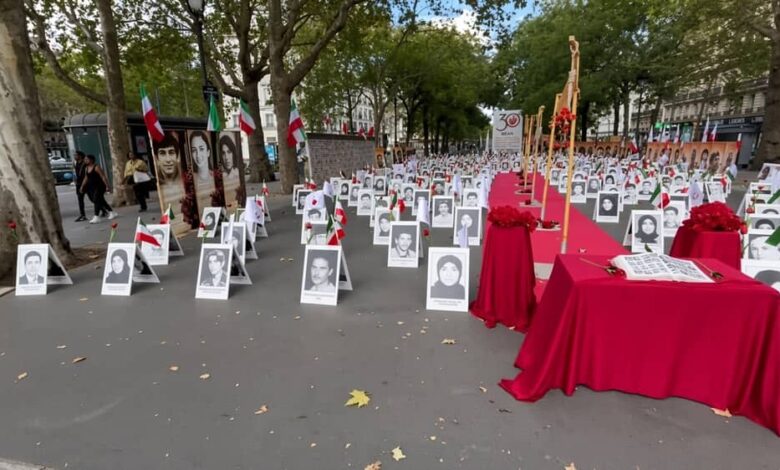
NCRI supporters in Paris, France, held a photo exhibition for the fallen heroes of Iran’s fight for freedom on August 22, 2026
Written by
Safora Sadidi Mohammadi
During the week of August 23–29, 2026, supporters of the Iranian Resistance launched a coordinated global campaign across major North American, European, and Australian cities to protest Tehran’s escalating wave of domestic executions and human rights violations. The activists staged rallies, sit-ins, and photo exhibitions. They linked historical atrocities, such as the 1988 massacre of political prisoners, to the ongoing executions of detainees arrested during the January 2026 uprising. Spanning over a dozen international metropolitan centers, this diplomatic pressure campaign demanded that Western governments close Iranian embassies, end policies of appeasement, and support the establishment of a democratic republic based on Maryam Rajavi’s Ten-Point Plan.
August 29, 2026
In Paris, France, supporters of the Iranian Resistance conducted an anti-execution photo exhibition at Palais-Royal Square, braving rainy conditions to display portraits of victims. The exhibition highlighted martyrs from the 1988 massacre alongside political prisoners and protesters executed through August 2026. Organizers emphasized that the memory of the victims cannot be erased and promoted the campaign under the hashtag #StopExecutionsInIran, continuing a series of similar actions held across central Paris in recent weeks.
3-On August 29, 2026, supporters of the PMOI held an anti-execution photo exhibition at Palais-Royal Square in #Paris, displaying photographs of people executed in Iran and calling for an end to the death penalty.#StopExecutionsInIran pic.twitter.com/Xy54D1VqUI
— Iran Freedom (@4FreedominIran) August 30, 2026
August 28, 2026
In Berlin, Germany, demonstrators continued a sit-in protest outside the Iranian regime’s embassy, an action that has been ongoing since February 28. Protesters demanded the closure of the embassy, denouncing it as a hub for espionage and terrorism, and called for an end to the executions of PMOI political prisoners and January 2026 uprising detainees. The demonstrators reaffirmed their rejection of both war and appeasement, emphasizing that the only viable solution is a democratic republic based on Maryam Rajavi’s Ten-Point Plan. Meanwhile, in Melbourne, Australia, supporters organized a book stand and photo exhibition backing the nationwide “No to Execution” campaign, urging the Australian public to recognize the Iranian people’s opposition to both monarchical and theocratic dictatorships.
4-Romania – August 29, 2026: Supporters of the PMOI, held a photo exhibition in #Bucharest to commemorate Iran’s 1988 massacre victims and condemn ongoing executions.#1988Massacre #StopExecutionsInIran pic.twitter.com/C6mwSLhdSY
— Iran Freedom (@4FreedominIran) August 29, 2026
August 27, 2026
Members of the Academics in Exile Association in the UK, alongside PMOI and NCRI supporters, convened in Manchester to host a book stand and photo exhibition. Through personal testimonies and visual displays, the event detailed the regime’s escalating use of executions against political prisoners and January 2026 protesters. Visitors expressed solidarity, signing petitions that urged the United Nations and the international community to take concrete action to halt the executions and support Iran’s transition to a secular democratic republic.
Video
Berlin: PMOI Supporters Continue Sit-In Against Executions, Call for a Democratic Republic in Iran – August 28, 2026#StopExecutionsInIran #No2ShahNo2Mullahs #NCRIAlternative pic.twitter.com/MLiwaLmDfK— Iran Freedom (@4FreedominIran) August 29, 2026
August 25–26, 2026
Solidarity actions expanded across several European cities mid-week. In Paris, an ongoing book stand and photo exhibition highlighted the Iranian people’s demand for fundamental rights and a democratic republic, rejecting all forms of authoritarian rule. In Hamburg, Germany, supporters held a rally condemning the execution of PMOI political prisoners and January 2026 protesters, urging the German government to adopt a firm policy against Tehran’s human rights violations. In Gothenburg, Sweden, a rally was held in solidarity with the 135th consecutive week of the “No to Execution Tuesdays” campaign, echoing slogans against the regime and backing Maryam Rajavi’s call to expand the abolitionist movement globally. In Berlin, the ongoing sit-in protest specifically paid tribute to the 30,000 victims of the 1988 massacre.
#Iran #News in Brief – August 28, 2026 https://t.co/I3crQ40ri1
— Iran Freedom (@4FreedominIran) August 28, 2026
August 22, 2026
A massive wave of coordinated actions took place across multiple continents to commemorate the victims of the 1988 massacre and recent crackdowns. In Brussels, Belgium, and Amsterdam, Netherlands, supporters held rallies and exhibitions at major public squares—such as Dam Square in Amsterdam—laying flowers for the martyrs of the 1988 killings, executed PMOI members, and January 2026 uprising victims. In Vancouver, Canada, and Oslo, Norway, demonstrators urged their respective governments to adopt decisive policies, with activists in Oslo specifically demanding the closure of the local Iranian embassy.
3-UK – August 27, 2026: #Manchester Exhibition Highlights Iran’s Escalating Executions and Calls for Democratic Change#StopExecutionsInIran #FreeIran pic.twitter.com/GekFJfPKbZ
— Iran Freedom (@4FreedominIran) August 28, 2026
In Paris, the fourth consecutive week of public action culminated in a rally at Place de la Bastille, where demonstrators chanted against the regime’s execution machinery. In Stockholm, Sweden, protesters gathered outside the Swedish Parliament to condemn the executions of Ghaem Hosseini and Shahram Sadeghi—protesters from the January 2026 uprising—and demanded the closure of the Iranian embassy. Activists in Gothenburg commemorated the August 19, 1953, coup against Dr. Mohammad Mossadegh, while honoring deceased PMOI Central Council members Nasrin Shahrabi and Mozhgan Mahdavi, alongside executed protesters Hosseini and Sadeghi. Similar exhibitions demanding accountability and international tribunals for regime officials took place in Bucharest, Romania, and Heidelberg, Germany, with a parallel event held in Lugano, Switzerland, where Swiss citizens signed petitions supporting a secular republic.
#Gothenburg Rally Backing the 135th Week of “No to Execution Tuesdays” Across 61 Iranian Prisons #StopExecutionsInIran #FreePoliticalPrisoners #NoDeathPenalty https://t.co/vJcqV2yUeN
— Iran Freedom (@4FreedominIran) August 27, 2026
The synchronized diaspora demonstrations spanning August 23–29 expose how the Iranian regime’s domestic strategy of mass executions has failed to suppress opposition, instead fueling a highly organized international movement. By systematically connecting historical atrocities like the 1988 massacre to the ongoing execution of January 2026 uprising detainees, these protests actively erode Tehran’s diplomatic legitimacy. The widespread public rejection of both monarchical restoration and theocratic rule signals a politically mature opposition unified around the Ten-Point Plan. Ultimately, this global mobilization forces Western governments to confront a stark reality: ongoing diplomatic appeasement is unsustainable, and supporting the Iranian people’s demand for a secular, democratic republic is critical.