

Dollar Hits 208,000 Tomans as Fuel Strains Deepen and Tehran Fears Another Price Shock
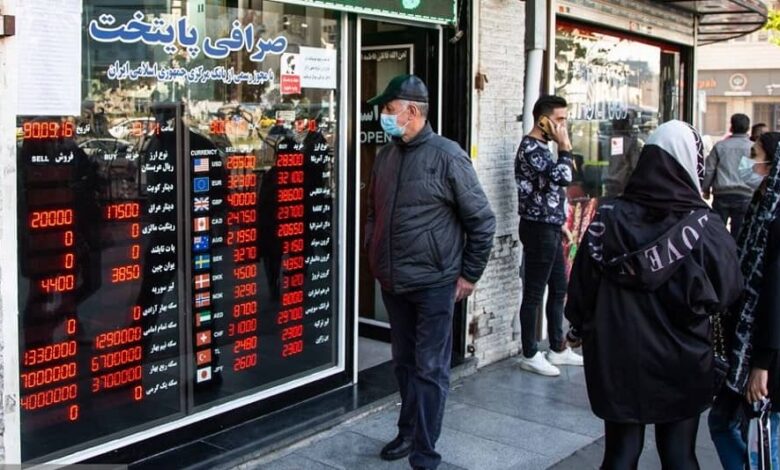
An elderly Iranian man studies dollar and euro rates outside a Tehran currency exchange
Written by
Mansoureh Galestan
Iran’s currency crisis set another record on August 30, 2026, with the dollar reaching about 208,000 tomans in online trading after closing the previous day near 206,400. The rise is especially striking because the Central Bank had already begun a large-scale attempt to increase physical-dollar supply after the currency crossed the 200,000-toman threshold.
On August 29, the Central Bank disclosed that only $20 million of as much as $500 million in banknotes made available through banks had actually been purchased between August 25 and August 27. The bank portrayed that as evidence that cash demand was weaker than assumed and said it remained ready to meet orders up to the full $500 million. Yet the free-market dollar moved to another record immediately afterward, widening the gap between the authorities’ explanation of the market and the price Iranians actually confront.
The danger is what comes next. The weaker rial raises the local-currency cost of imports and production inputs before previous exchange-rate shocks have fully worked their way through prices. The regime’s president Masoud Pezeshkian acknowledged the strain in his latest state-television interview, saying the government had failed to raise food-support payments as promised: “We are ashamed before the people.”
The Anatomy of Iran’s Inevitable Social Explosion https://t.co/KjBqHF6Lmu #Iran
— Masumeh Bolurchi (@MasumehBolurchi) August 4, 2026
Petrol Becomes a Systemic Risk
The fuel crisis is simultaneously moving from the filling station to the underlying distribution system. The Oil Ministry’s Shana news agency reported on August 29 that average petrol consumption jumped from 138 million liters a day in August to around 145 million liters during the first five days of the new month. More importantly, the National Iranian Oil Refining and Distribution Company acknowledged that part of Tehran’s fuel-storage and logistics infrastructure had been damaged, slowing deliveries and contributing to queues.
Parliament’s Energy Commission has provided an even more troubling picture. Its spokesman, Reza Sepahvand, put production at roughly 132 million liters a day, while consumption had already risen above 137 million and could exceed 140 million. He also claimed that the authorities were drawing on gasoline reserves to bridge the imbalance, while insisting there was “no problem” supplying the country.
What alarms the establishment is not merely the shortage but what any attempt to correct it could trigger. On August 30, Gholam-Ali Haddad-Adel warned publicly: “People should not wake up on Friday morning and see that gasoline has become more expensive.” He said any change required a “national unity and cohesion” component and must account for the social reaction. The language is revealing: fuel pricing is being treated not simply as an economic decision but as a potential political-security shock.
Empirical Data and Street Riots Expose Iran Regime’s Misplaced Priorities as the True Engine of #Economic Devastationhttps://t.co/297ujYv7EX
— NCRI-FAC (@iran_policy) August 27, 2026
The State Is Running Out of Easy Choices
The state is therefore trapped between contradictory imperatives. It needs to curb demand because production and distribution cannot comfortably sustain present consumption, but ration cuts or price increases risk public anger. It needs to stabilize the rial, but the currency continues weakening despite intervention. And it ought to protect household purchasing power precisely when higher exchange rates and energy costs threaten another inflationary wave.
The deterioration is also reaching employment. State-aligned Tasnim has acknowledged that workforce reductions have become a serious problem in production units, with MP Mohammad Rashidi warning that the issue is acute nationally and particularly in Kermanshah. Meanwhile, Mehr reported on August 30 that Kermanshah’s 11.9 percent unemployment rate had again placed it at the top of the country’s unemployment rankings.
Taken together, the latest developments show why Tehran’s room for maneuver is contracting. The regime cannot stabilize the currency simply by offering dollars, cannot sustain petrol consumption indefinitely through strained logistics and reserves, and cannot easily impose higher costs on a society whose purchasing power is already eroding. The striking feature of the current crisis is not any single statistic, but the convergence of currency, fuel, employment and household pressures—leaving the regime facing unavoidable economic decisions that its own officials fear could ignite an already explosive society nationwide.