
As Toman Hits 204,000 and Fuel Runs Dry, Iran’s Clerical Regime Faces Mounting Storm
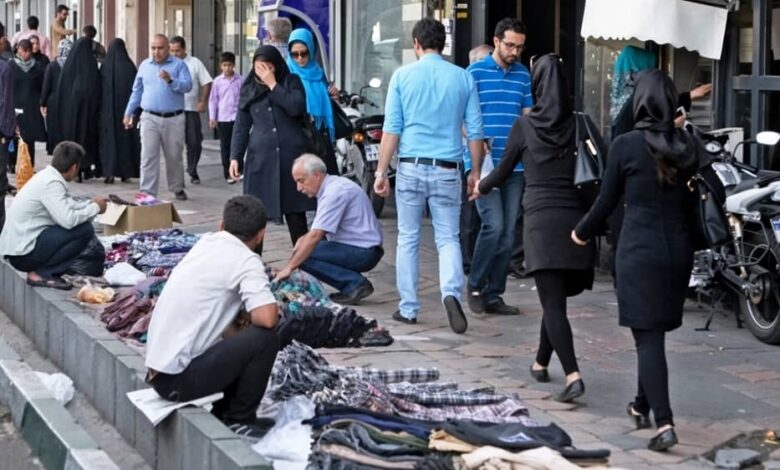
Street vendors display clothes on the sidewalk as shoppers stroll past storefronts in a busy Iranian city market
Written by
Amir Taghati
With the US dollar surging past an unprecedented 204,000 tomans on August 24, 2026, and fuel pumps shutting down across Tehran, Iran’s clerical establishment faces an existential convergence of economic freefall and public fury. State newspaper Khorasan reported on August 24, 2026, that new international sanctions targeting Iranian trust accounts in the UAE could push exchange rates toward 250,000 tomans by year-end. The currency collapse has triggered hyperinflation in basic goods, with state news agency ISNA revealing in late August 2026 that chicken fillet prices reached 1.2 million tomans per kilogram, while the gradual elimination of preferred foreign exchange subsidies sent pharmaceutical prices climbing up to 200 percent.
This monetary crisis is compounded by a dramatic collapse in public infrastructure. Across eastern and southern Tehran, state oil distribution caps forced gas stations to turn off nozzles by early afternoon, trapping motorists in massive gridlocks. Similar fuel panics have organized across regional highways, with heavy trucks queued for miles along the Haraz road and CNG stations paralyzed in Zahedan. Simultaneously, unannounced power cuts have hit Tehran and Shahriar commercial districts, provoking intense anger among shopkeepers suffering heavy financial losses.
Public indignation is rapidly expanding beyond localized economic grievances into open challenge against state governance. On August 24, 2026, telecommunication retirees staged coordinated protests in Tehran, Isfahan, Ahvaz, and Bijar against systemic plunder and poverty. In Isfahan, steelworkers marched through the streets chanting, “Enough warmongering, our tables are empty!” State daily Jahan-e Sanat offered a stark warning on August 23, 2026, writing: “The society is currently in a more critical condition… The current situation needs only a spark.”
Iran’s #economy is not merely poor — it is poverty administered with systemic insult. Blackouts, soaring food prices, empty reservoirs, and a regime that answers only with bullets. The old arithmetic of #terror is failing.
Hunger does not get tired. pic.twitter.com/OYs7vVX79a
— NCRI-FAC (@iran_policy) August 23, 2026
Executive Paralysis and Factional Warfare
Trapped by memories of the violent November 2019 fuel uprisings, the administration of Masoud Pezeshkian remains frozen and unable to implement planned energy price adjustments. State daily Arman noted on August 23, 2026, that historical trauma from past gasoline shocks has left executive officials hesitant to take action. Addressing the public crisis on state broadcaster Khabar TV on August 23, 2026, Pezeshkian opted for the role of the contrite populist: “Why should our people come to the streets and protest? Protest is their right. It is because I was asleep; I must wake up and not allow injustice to reach a point where it stirs up a storm.”
As public pressure mounts, the regime’s political establishment has turned inward, engaging in open factional warfare over economic failures. Speaking to the state-aligned Telegram channel Khaneh Eqtesad on August 23, 2026, Mohammad Reza Sabzalipour, president of the World Trade Center Tehran, rejected government efforts to blame foreign conflict for domestic inflation, stating: “The government itself is the pioneer and flag-bearer of price hikes.” On the same day, parliamentary representative Sara Fallahi warned Pezeshkian on parliament’s Khaneh Mellat outlet against falling for the gasoline price hike “banana peel” offered by government advisors.
Hardline state organs are attempting to enforce discipline by silencing public admissions of administrative vulnerability. On August 23, 2026, state-aligned newspaper Farhikhtegan published a commentary titled “Signals of Weakness Forbidden,” criticizing Central Bank officials and cabinet ministers for publicly disclosing frozen foreign currency reserves and oil revenue drops. The daily argued that communicating internal helplessness projects weakness to international foes while feeding domestic panic and market hoarding.
The Iranian regime doesn’t survive by being loved—it survives by extinguishing every real alternative. Reformism was a mirage. The monarchy is a manufactured distraction. What it truly fears is organized hope.
“The Architecture of #Hope and Paranoia in Iran” by Farid…
— NCRI-FAC (@iran_policy) August 19, 2026
Regional Brinkmanship and Systemic Exhaustion
To project strength while under pressure at home, state authorities are escalating external threats and military posturing. On August 22, 2026, Mohsen Rezaei, Secretary of the Supreme National Security Council, warned that Tehran would target US commercial assets in the region and block crude exports through the Persian Gulf if economic pressure continues. Rezaei also signaled a shift in military doctrine, suggesting that developing nuclear weapons would prove cheaper and more effective than conventional defense systems.
This aggressive posture is being reinforced throughout the clerical security apparatus. On August 22, 2026, Rasoul Falahati, the Friday prayer leader of Rasht, stated on state broadcaster Baran TV that Supreme Leader Ali Khamenei instructed military forces to “act aggressively.” Simultaneously, news outlet Entekhab reported on August 23, 2026, that Parliament’s National Security Commission approved legislation authorizing the regime to levy transit, environmental, and navigation fees in rials or foreign currency on commercial vessels passing through the Strait of Hormuz.
Despite this external bravado, the clerical establishment’s domestic foundation reflects physical and operational exhaustion. Official figures published by state news agency ISNA on August 25, 2026, revealed that 45 percent of Iran’s major reservoir dams remain completely empty, highlighting severe environmental and infrastructural breakdown. As basic utility networks fracture and popular rage accelerates, the regime’s reliance on external threats and internal repression offers no sustainable escape, setting the stage for a dramatic domestic confrontation.