
Former FBI Director Louis Freeh Calls for Global Accountability for Iranian Regime Crimes
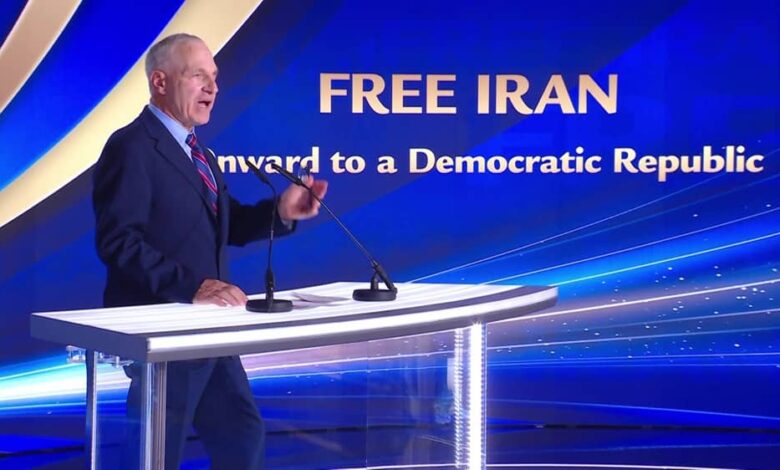
Former Director of the Federal Bureau of Investigation Louis Freeh addresses the second day of the Free Iran 2026 World Summit on June 21, 2026
Written by
Amir Taghati
At the Free Iran 2026 World Summit in Paris on June 21, 2026, former FBI Director Louis Freeh delivered a powerful address emphasizing the urgent necessity of “personal accountability” for the Iranian regime’s history of state-sponsored terrorism and human rights abuses.
Drawing upon his extensive experience as a former prosecutor and FBI director, Freeh underscored that the members of the Iranian Resistance present at the summit are not merely attendees, but “key witnesses” whose testimony constitutes vital evidence of war crimes. He challenged the international community to move beyond diplomatic platitudes and prioritize legal accountability. He reminded the audience of his own professional history, noting that the baseless terrorism designation of the MEK was eventually overturned due to a complete lack of evidence, and pointed to his previous work indicting perpetrators of the Khobar Towers bombing as a model for how future prosecutions must be handled.
Freeh championed Madam Rajavi’s Ten-Point Plan, particularly its commitment to seeking justice for massacred political prisoners. He concluded that holding regime officials personally responsible for their crimes must remain a central pillar of international discourse.
The full script of Director Louis Freeh‘s speech follow:
Ex-FBI Dir Louis Freeh: Why individual criminal liability is essential for the future of a free Iran
Thank you very much.
Thank you, ladies and gentlemen. It’s a pleasure to be here with you and all of my colleagues.
Madam Rajavi, always an honor and privilege to see you.
[It is] very disturbing to see a video like that as someone who spent many, many years in law enforcement.
But in our law enforcement systems, including the one here, we have what’s called personal accountability, which means that complaints, evidence, and allegations against law enforcement officers and government officials are taken very seriously at some point.
What I want to talk about today—and I’m so happy to see our Ashraf friends and colleagues here… Let me tell you why I’m particularly happy to see you.
As a former prosecutor, I see you as the key witnesses and evidence that will hold the people in Iran who have been running this terrorist regime personally accountable.
And that is what I want to talk about briefly. We’ve not talked about this yet at this session: personal accountability.
The 14-point MOU, the G7 statement—you might have seen it in Évian—they talk about freedom in the Strait of Hormuz, but they don’t talk about freedom for the Iranian people.
It’s ironic in a sense because in 1938, at that same place, Évian, the allies convened, pre-World War II, at the request of President Roosevelt of the United States.
And the issue was: who will protect the Jewish refugees that were trying to flee from Nazi Germany.
They had a meeting for two or three days. Great speeches; everybody had something to say.
At the end of the conference, not one single country, except the Dominican Republic, agreed to take any of the Jewish refugees.
Not only was that fatal for thousands and thousands of people and families, but it sent a message to the Nazi regime that the allies didn’t care, or at least were not even focused on the problem of personal accountability and protection of victims.
The 14-point plan, for whatever it’s worth, doesn’t mention, doesn’t even reference, political and public executions. It doesn’t talk about the safety and protection of the Iranian people.
If you tell somebody that help is on the way, you have to show, at least in a memorandum of understanding, that you believe that some help and protection is needed.
Now, conversely, Mrs. Rajavi, in your Ten-Point Plan, in point three, first you affirm the Universal Declaration of Human Rights, and then you say, “seeking justice for massacred political prisoners” is one of your essential core points.
Louis Freeh, former director of the FBI:
Maryam Rajavi’s 10-Point plan stands for justice, human rights, and accountability for those executed by this regime. #ParisFreeIranRally#100kFreeIranRally pic.twitter.com/DrXVO9gcRW
— OIAC: Organization of Iranian American Communities (@OrgIAC) June 21, 2026
Not revenge, but seeking justice and holding people personally accountable for war crimes, murders, and state-sponsored terrorism.
I first got involved and first heard of the MEK, by the way, when I was in my former government job, and we read one day that the White House had designated this organization as a terrorist organization.
We thought it was very interesting because no one had asked the FBI, which is the primary domestic counterterrorism organization, to give any opinion or review on the organization.
And the reason was there was absolutely no factual basis for that designation, as was found out when it finally was about to go to court and the Secretary of State, the White House Counsel, and the Attorney General decided they would delist the organization—not out of generosity of spirit, but because they had no evidence.
What we can do looking forward, beyond the 14-point plan, beyond all the hopes and expectations, is look to the future and start organizing ourselves so we can hold war criminals personally accountable for crimes.
We need to talk about that more. We need to have that in our talking points.
You know, when they blew up the Khobar Towers, which of course was the IRGC working with the Saudi Hezbollah, we ended that phase by indicting 14 individuals who were responsible for the murder of 17 Americans and hundreds of other people, including many Saudis.
That indictment still sits on the docket in the Eastern District of Virginia.
Someday, somewhere, those 14 people, to the extent that they’re still alive, will be held personally accountable for those murders and those acts of terrorism.
But, ladies and gentlemen, that case just doesn’t even compare to what we hear and what we see.
We saw that video this afternoon, an incredibly moving and powerful video of these victims, who are also witnesses, by the way. That’s testimonial evidence that can be used in a court of law under totally proper due process.
There are millions of crimes, brutal crimes, serious crimes, that have been committed by active members of the current regime in Tehran.
And I think, as Mrs. Rajavi, you have in your Ten-Point Plan, I think our governments, and more importantly, the free Iranian people—which will be realized someday—need to have accountability and hold people personally responsible for these crimes.
And that ought to be one of our major talking points. That’s something we shouldn’t forget.
Thank you very much.
Former FBI Director Louis Freeh Calls for Global Accountability for Iranian Regime Crimes
Written by
Amir Taghati
27th June 2026
Facebook Twitter LinkedIn Pinterest Reddit Email Print
Former Director of the Federal Bureau of Investigation Louis Freeh addresses the second day of the Free Iran 2026 World Summit on June 21, 2026
Former Director of the Federal Bureau of Investigation Louis Freeh addresses the second day of the Free Iran 2026 World Summit on June 21, 2026
At the Free Iran 2026 World Summit in Paris on June 21, 2026, former FBI Director Louis Freeh delivered a powerful address emphasizing the urgent necessity of “personal accountability” for the Iranian regime’s history of state-sponsored terrorism and human rights abuses.
Drawing upon his extensive experience as a former prosecutor and FBI director, Freeh underscored that the members of the Iranian Resistance present at the summit are not merely attendees, but “key witnesses” whose testimony constitutes vital evidence of war crimes. He challenged the international community to move beyond diplomatic platitudes and prioritize legal accountability. He reminded the audience of his own professional history, noting that the baseless terrorism designation of the MEK was eventually overturned due to a complete lack of evidence, and pointed to his previous work indicting perpetrators of the Khobar Towers bombing as a model for how future prosecutions must be handled.
Freeh championed Madam Rajavi’s Ten-Point Plan, particularly its commitment to seeking justice for massacred political prisoners. He concluded that holding regime officials personally responsible for their crimes must remain a central pillar of international discourse.
The full script of Director Louis Freeh‘s speech follow:
Ex-FBI Dir Louis Freeh: Why individual criminal liability is essential for the future of a free Iran
Thank you very much.
Thank you, ladies and gentlemen. It’s a pleasure to be here with you and all of my colleagues.
Madam Rajavi, always an honor and privilege to see you.
[It is] very disturbing to see a video like that as someone who spent many, many years in law enforcement.
But in our law enforcement systems, including the one here, we have what’s called personal accountability, which means that complaints, evidence, and allegations against law enforcement officers and government officials are taken very seriously at some point.
What I want to talk about today—and I’m so happy to see our Ashraf friends and colleagues here… Let me tell you why I’m particularly happy to see you.
As a former prosecutor, I see you as the key witnesses and evidence that will hold the people in Iran who have been running this terrorist regime personally accountable.
And that is what I want to talk about briefly. We’ve not talked about this yet at this session: personal accountability.
The 14-point MOU, the G7 statement—you might have seen it in Évian—they talk about freedom in the Strait of Hormuz, but they don’t talk about freedom for the Iranian people.
It’s ironic in a sense because in 1938, at that same place, Évian, the allies convened, pre-World War II, at the request of President Roosevelt of the United States.
And the issue was: who will protect the Jewish refugees that were trying to flee from Nazi Germany.
They had a meeting for two or three days. Great speeches; everybody had something to say.
At the end of the conference, not one single country, except the Dominican Republic, agreed to take any of the Jewish refugees.
Not only was that fatal for thousands and thousands of people and families, but it sent a message to the Nazi regime that the allies didn’t care, or at least were not even focused on the problem of personal accountability and protection of victims.
The 14-point plan, for whatever it’s worth, doesn’t mention, doesn’t even reference, political and public executions. It doesn’t talk about the safety and protection of the Iranian people.
If you tell somebody that help is on the way, you have to show, at least in a memorandum of understanding, that you believe that some help and protection is needed.
Now, conversely, Mrs. Rajavi, in your Ten-Point Plan, in point three, first you affirm the Universal Declaration of Human Rights, and then you say, “seeking justice for massacred political prisoners” is one of your essential core points.
Not revenge, but seeking justice and holding people personally accountable for war crimes, murders, and state-sponsored terrorism.
I first got involved and first heard of the MEK, by the way, when I was in my former government job, and we read one day that the White House had designated this organization as a terrorist organization.
We thought it was very interesting because no one had asked the FBI, which is the primary domestic counterterrorism organization, to give any opinion or review on the organization.
And the reason was there was absolutely no factual basis for that designation, as was found out when it finally was about to go to court and the Secretary of State, the White House Counsel, and the Attorney General decided they would delist the organization—not out of generosity of spirit, but because they had no evidence.
What we can do looking forward, beyond the 14-point plan, beyond all the hopes and expectations, is look to the future and start organizing ourselves so we can hold war criminals personally accountable for crimes.
We need to talk about that more. We need to have that in our talking points.
You know, when they blew up the Khobar Towers, which of course was the IRGC working with the Saudi Hezbollah, we ended that phase by indicting 14 individuals who were responsible for the murder of 17 Americans and hundreds of other people, including many Saudis.
That indictment still sits on the docket in the Eastern District of Virginia.
Someday, somewhere, those 14 people, to the extent that they’re still alive, will be held personally accountable for those murders and those acts of terrorism.
But, ladies and gentlemen, that case just doesn’t even compare to what we hear and what we see.
We saw that video this afternoon, an incredibly moving and powerful video of these victims, who are also witnesses, by the way. That’s testimonial evidence that can be used in a court of law under totally proper due process.
There are millions of crimes, brutal crimes, serious crimes, that have been committed by active members of the current regime in Tehran.
And I think, as Mrs. Rajavi, you have in your Ten-Point Plan, I think our governments, and more importantly, the free Iranian people—which will be realized someday—need to have accountability and hold people personally responsible for these crimes.
And that ought to be one of our major talking points. That’s something we shouldn’t forget.
Thank you very much.