
The Fractured Facade: Elite Infighting, Student Dissent, and Structural Decay in Iran
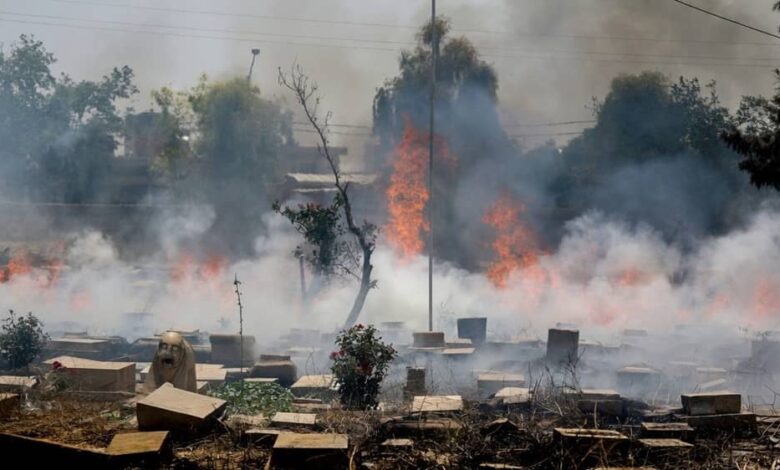
On June 6, 2026, a massive fire devastated the 1,200-year-old historic Dar al-Salam cemetery in Shiraz, destroying over 2,000 square meters of the ancient cultural heritage site
Written by
Farid Mahoutchi
The Iranian regime is grappling with a multi-layered crisis that threatens its internal stability from the supreme leadership down to municipal infrastructure. A series of internal leaks has exposed severe vulnerabilities at the absolute peak of the state’s power grid, revealing a leadership deeply fractured by ideological deadlock and existential panic. As hardline military commanders and revisionist politicians engage in a vicious public civil war over foreign policy, the regime finds its decision-making apparatus completely paralyzed. This institutional decay at the top is unfolding precisely as the state loses control of the narrative, facing an entirely radicalized youth movement on the streets and a systemic, climate-driven collapse of its core infrastructure.
Hardline Factions Reject Western Diplomacy
This internal vulnerability has triggered an aggressive ideological civil war within the regime regarding potential diplomatic engagement with the United States. Hardline elites have launched severe public broadsides against officials who favor a negotiated settlement to ease economic sanctions. Javad Larijani openly condemned high-level state visits to Islamabad—including a prominent trip by Parliament Speaker Mohammad Baqer Qalibaf—characterizing the outreach as a “huge cost” that yielded zero tangible concessions. Larijani rigidly warned against systemic “miscalculations,” flatly asserting that direct negotiations with Washington are entirely unnecessary.
Simultaneously, senior military figures are actively subverting the diplomatic track by beating the drums of war. IRGC Brigadier General Javad Ghafari, the former commander of the Quds Force in Syria, released a fiery audio address fiercely attacking the administration’s diplomatic maneuvers. Ghafari explicitly commanded his forces to bypass large-scale military structures and form independent, highly mobile “two-man battalions” to prepare for an imminent, direct clash with American forces. Condemning any potential diplomatic breakthrough as a “polluted agreement,” Ghafari stated: “Look how Trump is playing with us… Unfortunately, our officials do not possess shame and do not learn lessons.”
"A comprehensive analysis of state media, parliamentary transcripts, and #economic indicators from late May and early June 2026 reveals an establishment trapped in a multi-layered crisis where geopolitical paralysis, macroeconomic collapse, and intense factional infighting are…
— NCRI-FAC (@iran_policy) June 4, 2026
Factional Warfare Paralyzes State Institutions
This aggressive polarization has paralyzed the regime’s legislative and media institutions, turning them into open political battlegrounds. Within the parliament, ultra-hardline MP Amir-Hossein Sabeti accused the United States of intentionally stalling for time in order to unleash a devastating military campaign after the World Cup. Sabeti warned that the current diplomatic track is an exercise in “foolish thinking” that risks transforming Iran’s domestic security environment into a “second Gaza”. This rhetoric drew a sharp counter-attack from former lawmaker Heshmatollah Falahatpisheh, who held the extremist factions directly responsible for the country’s strategic isolation. Falahatpisheh noted that these ultra-radicals intentionally sabotaged critical diplomatic openings to revive the nuclear deal in 2021 and 2022, adding that they “are willing to let the country suffer the fate of Gaza rather than allow an agreement to take shape.”
This factional warfare has violently breached the state’s official broadcaster, IRIB, culminating in what state media outlet Rouydad24 labeled the “War in Jamejam”. In an unprecedented move, authorities abruptly pulled the live, ultra-hardline program Soraya off the air mid-broadcast after the show launched a fierce tirade against the regime’s official foreign policy. The internal chaos deepened further following controversial on-air remarks by an official named Gholamreza Ghasemian. Ghasemian explicitly declared all negotiations with the West to be religiously forbidden (haram) and ominously insinuated that the political crisis has degenerated to such a degree that the country’s leadership has lost total control over the situation.
"Rather than addressing its crises, the Iranian regime appears to believe it can manage them by winning the battle of narratives, outmaneuvering both domestic and foreign adversaries through #propaganda and deception," writes @MasumehBolurchi.https://t.co/JWTBIR3ZqO
— NCRI-FAC (@iran_policy) May 31, 2026
Student Protests Adopting Revolutionary Language
While the ruling elite fractures from within, a formidable threat is rising from the youth. Mass student protests have erupted across major metropolitan hubs—including Tehran, Shiraz, Tabriz, Mashhad, and Karaj—initially sparked by opposition to a new educational law enforcing a mandatory GPA impact on university entrance exams. However, state media analysts expressed deep panic over how rapidly this educational grievance mutated into an overtly political movement. In an analysis titled “The Victory of the Street over the School,” the state-run Khabar Online outlet noted that the protesting high school students instantly bypassed academic channels to adopt the radical language and tactics of past anti-regime uprisings. During these street rallies, Iranian students explicitly chanted:
“Students will die, but will not accept humiliation!” “Heed the call, student, shout out your rights!”
State media explicitly conceded that these slogans were directly borrowed from the wider atmosphere of Iranian street revolts spanning from June 2009 to the winter of 2026. Terrified by the systemic rejection of state authority by a new generation, the regime has responded with outright dismissals. Parliamentary Education Commission representative Abdulvahid Fayazi flatly commanded the youth to abandon their dissent, warning them that “protests are useless” and that “there is no other option” but to accept the state’s decrees.
"Aan analysis of the regime’s domestic policies, escalating social engineering, and recent data from state-controlled media reveals a far more calculated reality: #poverty in Iran is not an accidental failure of governance. It is a deliberate, highly managed strategy of state…
— NCRI-FAC (@iran_policy) May 27, 2026
Environmental Collapse and Infrastructure Failure
Compounding this explosive social and political instability is the systemic collapse of Iran’s basic municipal and environmental infrastructure. On June 6, 2026, a massive fire devastated the 1,200-year-old historic Dar al-Salam cemetery in Shiraz, destroying over 2,000 square meters of the ancient cultural heritage site. State sources admitted that the catastrophic blaze was entirely preventable, caused by a total failure of municipal authorities to clear dried-out weeds amid soaring seasonal temperatures. This local negligence is indicative of a broader climate crisis; the head of Iran’s Meteorological Organization, Sahar Tajbakhsh, issued an emergency warning that the country is entering a summer of unprecedented heatwaves, facing immediate water exhaustion across major economic zones.
This water crisis is deeply structural and exacerbated by years of state mismanagement. The capital has officially entered its sixth consecutive year of severe drought, with major reservoirs dropping to absolute “dead volume”. While Tehran requires 280 mm of annual rainfall to sustain its population, average rainfall has plummeted to a historic low of 160 mm, prompting water industry officials to demand immediate, drastic cuts in consumption to prevent a total shutdown. The consequences are already destabilizing daily life; in provinces like Hamedan, regional authorities have begun enforcing sweeping, unannounced water blackouts from late night until morning. By refusing to publish official timetables or notify the public in advance, the regime has left citizens unable to secure basic daily needs, pushing public fury to a volatile tipping point as the state fractures at every level.