
Tehran Fortifies Military Command to Stifle Internal Uprising Amid Fears of Economic Collapse
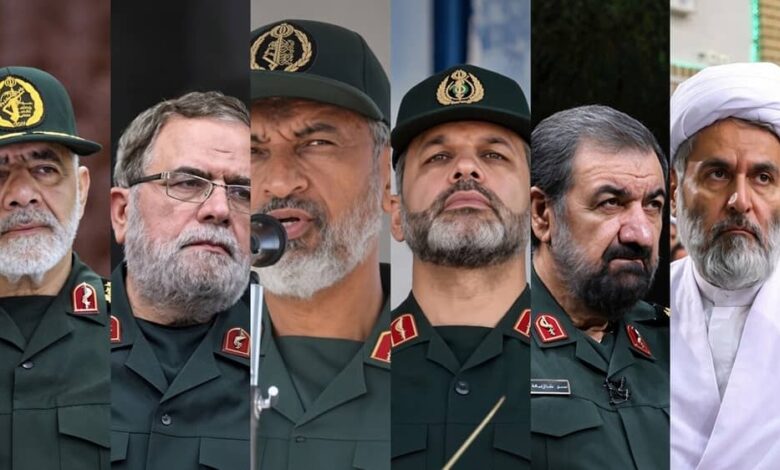
Iranian regime’s newly appointed military leaders Ali Abdollahi, Mostafa Izadi, Ali Azmayi, Ahmad Vahidi, Mohsen Rezaei, Hossein Taeb
Written by
Shahriar Kia
On August 9 and 10, 2026, the Iranian regime executed a sweeping overhaul of its military and security apparatus under the direction of Mojtaba Khamenei. The restructuring, which elevated hardline commanders to the pinnacle of the state’s security architecture, reflects a ruling establishment bracing for prolonged foreign confrontation to distract from a looming internal uprising fueled by a severe economic meltdown.
At the center of this realignment is the August 9 appointment of Mohsen Rezaei as the Supreme Leader’s representative to the Supreme National Security Council (SNSC). Following the decree, the regime’s president Masoud Pezeshkian formally named Rezaei as the SNSC Secretary, cementing his authority over the nation’s most critical strategic body.
Prioritizing Military Doctrine Over Diplomacy
State media openly acknowledged this maneuver as a pivot away from de-escalation. The state-run Imna news agency reported that Rezaei’s appointment “shows the preference and supremacy of the military doctrine over a purely diplomatic approach in the macro-conclusions of the Supreme National Security Council.”
Iran’s War of Survival: Why Economic Pressure May Matter More Than Bombardment https://t.co/jyvkf7aUDw
— NCRI-FAC (@iran_policy) August 12, 2026
Elaborating on this strategic calculation, Imna noted: “Contrary to some analyses presuming a trend toward de-escalation and returning to the negotiating table, the content analysis of field developments shows Iran is preparing for harder scenarios.” The outlet cited the possibility of new conflicts preceding the U.S. and Israeli elections, describing Rezaei’s selection as a step toward maximizing “coordination among various state pillars to manage these crisis conditions.”
The broader reshuffle on August 10 involved the appointment of six senior military figures, illustrating the political dominance of the Islamic Revolutionary Guard Corps (IRGC). Maj. Gen. Ahmad Vahidi—a former Quds Force commander implicated in the AMIA bombing in Argentina—was named Commander-in-Chief of the IRGC. Cleric Hossein Taeb, previously tied to the systemic fabrication of security cases and extrajudicial chain murders, was tapped to head the IRGC Basij to fortify the intelligence network against domestic unrest.
Elite Realignment for Internal Repression
Other appointments underscore a dual focus on crushing internal dissent and projecting aggressive naval posturing. Maj. Gen. Abdollahi, implicated in the 1988 massacre of PMOI political prisoners in Rasht, was appointed Chief of Staff of the Armed Forces, joined by his deputy, Brig. Gen. Heidari. Admiral Ozmaei was promoted to IRGC Navy Commander to realize a “standard navy,” while Maj. Gen. Izadi became the IRGC Deputy Commander-in-Chief.
Report on Nationwide #IranProtests
March 20, 2025 – March 20, 2026https://t.co/OdiPa3vxU4— NCRI-FAC (@iran_policy) August 12, 2026
These appointments triggered swift endorsements from regime insiders. Judiciary Chief Gholamhossein Mohseni Ejei told Rezaei he is now at the “forefront of protecting national interests and countering cross-border threats in the era of the enemy’s hybrid war.” Parliament Speaker Mohammad Bagher Ghalibaf declared that Iran “brings every enemy to its knees,” while Vice President Mohammad Reza Aref said the shift creates “synergy in the country’s capacities and safeguards national stability.”
The reshuffle also exposed institutional fractures, notably through the ouster of former SNSC Secretary Mohammad Bagher Zolghadr. On August 11, Nowbonyad, a newspaper affiliated with the ultra-conservative Paydari faction, described his removal as a “Principled Change.” The paper noted that the shift indicates “deep dissatisfaction with the trend of the past months in this institution,” specifically regarding diplomatic agreements and disputes over control of the Strait of Hormuz.
Economic Meltdown and the Threat of Revolt
As the regime fortifies its security state, state officials are struggling to placate a fractured, economically exhausted society. In an August 10 broadcast on State TV, Pezeshkian detailed a seven-to-eight-hour meeting with Mojtaba Khamenei. Pezeshkian claimed their main concern was the economy, adding, “We are ashamed if we have shortcomings in these hardships,” while pleading for domestic “unity and cohesion.”
"You can terrorize an opinion. You cannot terrorize an appetite. You can shoot a demonstrator, and the regime has shot thousands. You cannot shoot #hunger, and hunger does not get tired, does not go home at night, and does not negotiate," writes @MansoreGolestan.…
— NCRI-FAC (@iran_policy) August 13, 2026
Yet, appeals for unity ring hollow against a backdrop of crushing economic pressure. The ruling establishment’s decision to prioritize military posturing over diplomatic relief reflects a deliberate survival strategy: bracing for foreign war to manage and suppress an anticipated internal uprising. Tehran is laying the groundwork for a new wave of unprecedented high prices, particularly looming fuel price hikes that have historically acted as a primary catalyst for nationwide unrest.
Ultimately, this shakeup reveals a stark institutional calculation. By maintaining a posture of permanent external crisis, the regime seeks to justify its heavy-handed domestic controls and violently suppress an explosive society before the economic collapse triggers an inevitable revolt.