
Nationwide Student Protests Shatter Tehran’s Illusion of Control
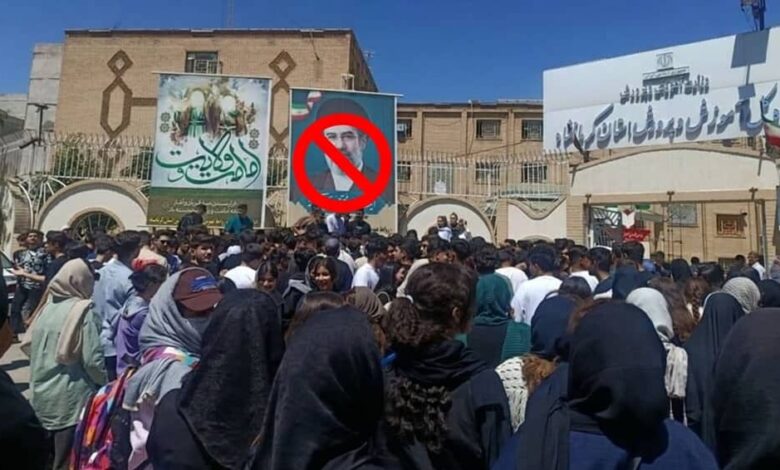
Students in Kermanshah, western Iran, gather outside the Kermanshah Provincial Directorate of Education to protest the regime’s exam rules — June 6, 2026
Written by
Mansoureh Galestan
A massive wave of coordinated student protests swept through dozens of Iranian cities today, turning a localized grievance over educational policies into a sweeping demonstration of public defiance. High school students took to the streets in Tehran, Mashhad, Shiraz, Isfahan, Qom, Tabriz, and numerous other provincial capitals to voice their fierce opposition to a controversial law that makes high school grade point averages a mandatory sixty percent of the score for the highly competitive national university entrance exam. Families and students argue that these constantly shifting regulations increase psychological pressure and completely destroy any semblance of educational equality, leaving the younger generation with a deeply fractured future.
The clerical regime met these peaceful rallies with immediate intimidation and a heavy security presence. In Mashhad, protesting students who had staged a sit-in outside the local department of education were led inside the compound by officials, who then locked the exit doors behind them to prevent escape. Special forces units quickly flooded the area, demanding national identification cards from the trapped teenagers and actively blocking any attempts to film the incident, while several participants were arrested. A similarly tense situation unfolded in the religious city of Qom, where security forces separated male and female students before issuing blatant threats, telling the youth that they would be stuffed into gunny sacks if they did not disperse immediately.
June 6—Tehran, Iran
Students hold protest rally, chanting, "Students will die but won't accept humiliation."#IranProtests pic.twitter.com/Dh5TxVsXKT— People's Mojahedin Organization of Iran (PMOI/MEK) (@Mojahedineng) June 6, 2026
Despite the severe crackdown, the spirit of resistance remained remarkably high. In the capital city of Tehran, determined students staged a high-stakes sit-in directly outside the Supreme Council of the Cultural Revolution, the body responsible for the controversial decree, vowing not to leave until their demands were met. Echoing across the country from Tehran to Kermanshah and Shiraz, young protestors chanted slogans declaring that they would not back down until their rights were secured. They explicitly targeted the state’s structural failures by chanting that they have seen no justice and have only heard empty promises, while reinforcing their solidarity with the defiant cry to not be afraid because everyone is standing together.
This nationwide eruption of youth fury provides a profound window into the systemic vulnerability of the Iranian regime. For months, Tehran has aggressively tried to project an aura of absolute domestic stability and geopolitical strength through a calculated tripartite strategy centered on what it terms “the street,” “the field,” and “diplomacy.” Within the regime’s playbook, “the street” manifests as nightly, state-staged rallies meticulously engineered to occupy public spaces, preempt genuine popular demonstrations, and project an artificial image of social cohesion to outside observers. Meanwhile, “the field” represents Tehran’s hardline reliance on rocket launches, regional terrorism, proxy warfare, and strategic disruptions like the blockade of the Strait of Hormuz to assert dominance. Completing this strategy is its cynical brand of “diplomacy,” which is designed to keep the international community permanently bogged down in endless, maximalist negotiation tactics that buy the regime time while evading real accountability.
More footage of protests by students in Tehran.#IranProtests pic.twitter.com/d0SFMTx0uH
— People's Mojahedin Organization of Iran (PMOI/MEK) (@Mojahedineng) June 6, 2026
Today’s events thoroughly shattered this elaborate illusion, exposing the fundamental collapse of all three pillars in the face of an inherently explosive society. The reality on the ground proves that the state’s manufactured presence on “the street” is entirely useless against the organic, volatile anger of the populace. When a generation raised under intense state indoctrination openly mocks riot police and defies threats of arbitrary kidnapping, the regime’s domestic facade of control completely evaporates.
The continuous cycle of uprisings since 2017 has repeatedly proven that no matter what the regime does to prevent popular revolt, a new trigger will inevitably emerge to ignite the flames of dissent. This volatile reality persists because the clerical regime foolishly believes it can rely on brutal crackdowns to force submission, completely refusing to solve the underlying economic, social, and systemic problems that fuel public fury in the first place. Ultimately, the aggressive military displays in “the field” and the stalling tactics of its “diplomacy” are rendered entirely meaningless when the state cannot even maintain order within its own classrooms. The true engine of change lies in this defiant domestic momentum. By reclaiming the streets, these young protestors have shown that no number of state-staged spectacles, regional blackmail, or cosmetic fixes can smother a volcanic, deep-rooted demand for fundamental change.