
Tehran’s Economic Gambit: The Regime May Light the Fuse, but the Street Will Decide the Endgame
Written by
Mansoureh Galestan
Three-minute read
The clerical regime in Tehran is approaching a decisive threshold where its traditional tactics of stall-and-subsidize have run out of road. Facing an unprecedented alignment of economic paralysis, crippling infrastructure decay, and mounting public anger, Iran’s leadership is being backed into decisions it can no longer delay. While the regime retains the power to initiate drastic economic shifts, such as slashing fuel quotas or enforcing market pricing, it possesses zero capacity to manage the resulting political fallout. The ruling elite may determine when to press the button, but the ultimate resolution of the coming shock will be dictated not in the halls of parliament, but by the street and an organized domestic opposition.
The hard arithmetic underlying this deadlock was laid bare during an open session of the Iranian Parliament on August 17, 2026. Hamid Pourmohammadi, head of the Plan and Budget Organization, revealed that the general budget suffered a catastrophic deficit of 700 trillion tomans over the preceding five months, alongside a 260 trillion tomans deficit in targeted subsidies. Pourmohammadi explicitly warned lawmakers that an “economic surge and peak budget pressure” will hit between September and October, citing severe disruptions to key tax and export revenues in the steel, petrochemical, and gas sectors.
This fiscal collapse is directly battering a population already pushed past the limits of endurance. Speaking in Parliament on August 17, lawmaker Ali Babaei-Karnami cited official figures showing that national inflation has reached 90%, while more than 3.2 million retirees and state workers subsist on monthly wages between 10 and 15 million tomans. On the same day, state-sanctioned newspapers Tose’eh Irani and Ham-Mihan reported that the monthly cost of basic living for an average family surged to 90 million tomans, reflecting a 211% spike in living expenses between March and July 2026 alone.
“You can terrorize an opinion. You cannot terrorize an appetite. You can shoot a demonstrator, and the regime has shot thousands. You cannot shoot #hunger, and hunger does not get tired, does not go home at night, and does not negotiate,” writes @MansoreGolestan.…
— NCRI-FAC (@iran_policy) August 13, 2026
The Fuel Dilemma
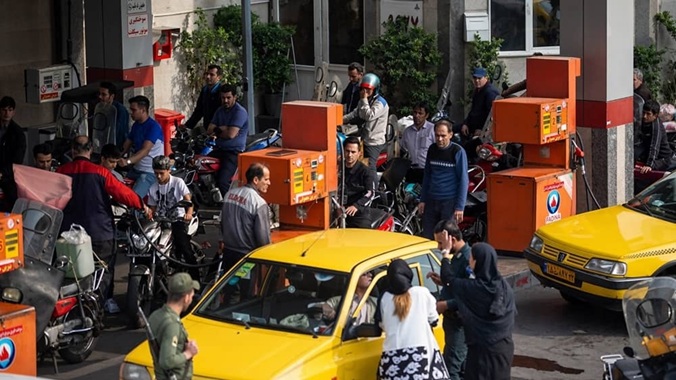
Nowhere is the regime’s forced choice more dangerous than in domestic fuel management. On August 14, 2026, Saqeb Esfahani, head of the Energy Management Organization, reported that daily domestic gasoline consumption reached 135 million liters against a domestic refinery output of just 121 million liters. Facing an unsustainable daily shortfall of 14 to 15 million liters, Esfahani admitted that government options were no longer policy preferences, but an “unavoidable coercion.”
This physical shortage has triggered acute political paralysis within the ruling apparatus. On August 16, Vice President Mohammad-Reza Aref framed fuel price hikes as an “inevitable reality” under conditions of “neither war nor peace.” That same day, however, Parliament Speaker Mohammad Bagher Ghalibaf publicly rejected the regime’s president Masoud Pezeshkian’s proposals, calling price increases “not a calculated measure” and warning that foreign enemies planned to exploit public frustration by combining economic shocks with domestic unrest.
The supreme terror governing these intra-regime debates is the memory of November 2019, when a sudden gasoline price adjustment triggered nationwide anti-regime revolt. On August 18, state-aligned outlet Jamaran News issued a stark warning to officials, writing that “the greatest threat to national security today is not merely external pressure; it is the accumulation of domestic discontent.” Parliamentary Economic Commission Secretary Aboutorabi similarly warned that proposed market-rate fuel adjustments could impose an extra 8 million tomans in monthly expenses on lower-income households, serving as “the infrastructure for a social explosion.”
The Iranian regime doesn’t survive by being loved—it survives by extinguishing every real alternative. Reformism was a mirage. The monarchy is a manufactured distraction. What it truly fears is organized hope.
“The Architecture of #Hope and Paranoia in Iran” by Farid…
— NCRI-FAC (@iran_policy) August 19, 2026
An Uncontrollable Endgame
Beyond the fuel crisis, basic municipal services and financial compliance are breaking down across the country. On August 17, shopkeepers in the Tehran Bazaar staged public protests against daily rolling electricity blackouts during peak afternoon business hours. Meanwhile, state media outlet Chand Saniye reported on August 18, that currency repatriation by non-oil exporters fell from 83% to 52% between 2018 and 2026, with more than $20 billion in export revenues remaining outside official channels in the previous year alone.
This systemic deterioration has exposed the illusion of state control. During the August 17 parliamentary debate, lawmaker Hamid Rasaee criticized delayed welfare distributions, noting that citizens increasingly view administrative failures and broken promises as “fraud.” Addressing lawmakers, Speaker Ghalibaf himself admitted the structural deadlock, declaring: “We no longer have time for trial and error,” while pleading with officials to avoid actions that “anger the public.”
This structural trap leaves Tehran with no smooth exit. Speaking on August 16, Esfahani confirmed that the government will render its final decision within 10 to 15 days on three coercive fuel management models, insisting there will be no “surprises” for a public that has every “right to be anxious”. Yet while the regime may choose when to initiate this risky gambit, the endgame remains entirely out of its hands. This moment presents a golden opportunity for the Iranian people and the Resistance to mobilize, forge a liberation force, and press the clerical dictatorship at its most vulnerable juncture into making increasingly dangerous and lethal decisions.