
How Iran’s Clerical Regime Turned Its Own People into A Revenue Stream
iran state officials corruption
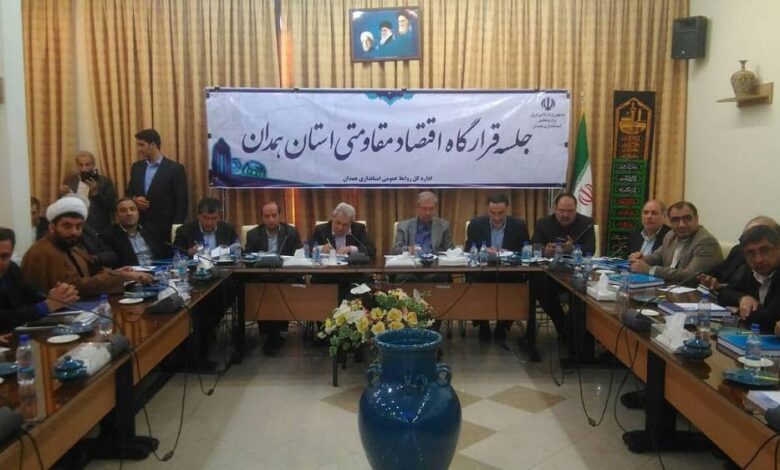
FILE PHOTO: A meeting at the so-called “Resistance Economy Headquarters” in the Hamedan Governor’s Office
Written by
Mansoureh Galestan
There is a single trade at the center of the Iranian regime’s economy, and it has never changed. Find a gap — between two exchange rates, between a promised price and a market price, between what the state tells the public and what the state intends to do — then stand on the profitable side of that gap with a license no ordinary Iranian can obtain. Everything else is costume. The clerical regime has worn the costume of revolutionary justice, of privatization, of resistance to sanctions, of popular capitalism. Underneath, it has run the same racket for forty-seven years, and it has run it against the people in whose name it claims to govern.
1979–1989: theft as theology
The first scheme needed no financial engineering, only a decree. In the months after February 1979, the assets of the deposed elite, of political dissidents like the members of the People’s Mojahedin Organization of Iran (PMOI/MEK), of religious minorities, of merchants who fled and merchants who stayed were swept into new “foundations” — the bonyads — answerable to the clerical leadership and to no auditor, no parliament, no tax authority. The Mostazafan (Foundation for the Oppressed) took factories, hotels, farmland and apartment blocks. The seizure was sold as “the poor inheriting the earth.” In practice a public asset base built over a century was moved off the national balance sheet and onto a private one, permanently, and the poor were handed the receipt rather than the property.
The template was formalized at the end of the decade. Shortly before his death in 1989, Ruhollah Khomeini, the regime’s founder, signed the order that created Setad — Headquarters for Executing the Order of the Imam — nominally a two-year clean-up operation to manage ownerless property for war widows and veterans. It never closed. In a six-month investigation published in 2013, Reuters valued Setad’s real estate and corporate holdings at roughly $95 billion, more than Iran’s annual oil exports at the time, and documented how the empire was assembled through the systematic seizure of thousands of properties from Iranians — Baha’is, Shia citizens, business owners, emigrants — with courts obligingly declaring occupied homes “abandoned.” Original owners were then invited to buy back what had always been theirs. That is the regime’s business model in miniature: manufacture the loss, then sell the remedy.
Delving into Iran’s #Corruption Chronicles – Part 1https://t.co/3uRDWFAqxD
— NCRI-FAC (@iran_policy) December 21, 2023
1990s–2000s: “privatization” as internal transfer
When the post-war reconstruction era demanded market vocabulary, the regime supplied it. State enterprises were put up for sale — and bought, overwhelmingly, by entities the state already controlled: the bonyads, pension funds, banks owned by the armed forces, and the commercial arm of the Islamic Revolutionary Guard Corps (IRGC). The emblematic transaction came in 2009, when the Telecommunication Company of Iran, the country’s telephone monopoly, was sold for around $7.8 billion to a consortium tied to the IRGC after the only serious rival bidder was disqualified days before the auction. Nothing was privatized. National monopolies were merely relabeled and moved beyond the reach of public accounting, while the Guards’ engineering conglomerate, Khatam al-Anbiya, absorbed the pipelines, ports, dams and metro contracts that a normal state awards competitively.
The political insight matters: an institution that owns the ports also decides what passes through them. Once the IRGC became Iran’s largest contractor, economic policy and armed force stopped being separable, and no minister could regulate the shareholder who could arrest him.
2011–2017: the banking harvest
Then came the pure predation on savings. In 2011, a $2.6 billion loan fraud — the largest banking embezzlement in Iranian history to that point — ran through seven state banks on forged letters of credit; the businessman at its center was hanged in 2014, while the officials who signed the paper were largely absorbed back into the system. The lesson circulated widely: participants are expendable, the machine is not.
#Iran News: #Crypto Mining Farm Discovered in Ahvaz Stadium Tunnels Exposes Deepening Corruption in Regime Institutionshttps://t.co/68EfJYuXvD
— NCRI-FAC (@iran_policy) August 11, 2025
The machine’s next target was the household deposit. Through the 2010s, unlicensed “credit institutions” — sponsored by clerical networks, military-linked funds and provincial power brokers — offered depositors 25–30 per cent returns while the state looked away. When Caspian, Arman, Padideh Shandiz and their peers collapsed in 2016 and 2017, millions of small savers discovered that regulators had never regulated. Pensioners camped outside branches in Tehran and Mashhad. The Central Bank, having tolerated the pyramid, then printed money to partially compensate the victims — inflating the currency held by every other Iranian to cover the losses of the few. The theft was thus socialized twice.
2018–2022: the two-tier dollar, the regime’s perfect machine
In April 2018, facing renewed sanctions, the Rouhani government fixed an official import dollar at 42,000 rials while the street rate ran away — to 100,000, then 200,000, then far beyond. Overnight the state created the most lucrative arbitrage in the modern Middle East: obtain cheap dollars by presenting an import license, then sell them at the free rate, or import nothing at all and pocket the spread. This was not a loophole. It was a subsidy allocated by connection, and connection was the only scarce commodity.
Its monument is the Debsh Tea case. Between 2019 and 2022, a single tea importer received about $3.37 billion in preferential currency — in a country whose own Tea Organization put annual import needs near $300 million — and, according to Iran’s inspection body, resold roughly $1.4 billion of it on the open market. The tea itself was allegedly cheap Kenyan leaf sold as premium Indian, plus Iranian tea re-imported to harvest the currency differential. The judiciary confirmed most of the allocations were made under Ebrahim Raisi. Two governments, one racket, three billion dollars — enough to fund the entire national tea supply for a decade — extracted from the reserves of a country where families were dropping meat from their diet. When the preferential rate was finally scrapped in 2022, bread and medicine prices detonated, and the public paid a second time for a subsidy it had never received.
Kazem Seddiqi’s Family Symbolizes Institutionalized Corruption in #Iran’s Regimehttps://t.co/ERNf8NIume
— NCRI-FAC (@iran_policy) June 12, 2025
2019–2020: the pump and dump
The boldest scheme was aimed directly at household savings. In November 2019, then Supreme Leader Ali Khamenei publicly urged Iranians to put their money into “productive investment, including in some instances the bourse.” State television amplified it; officials promised the market would be supported; the government began offloading its own shareholdings into the rally. Some Iranians obeyed. The Tehran Stock Exchange‘s benchmark TEDPIX stood near 500,000 points at the start of the fiscal year, passed a million by May 2020, and crossed two million points on 9 August 2020 — a 300 per cent rise. Some 700 trillion rials poured in during just fifty days of that summer, much of it from first-time investors selling gold, cars and dowries.
Then it broke. By late September the index had fallen 41 per cent, and it kept falling; a year later it hovered near 1.29 million points. Retail investors pulled out what they could — 400 trillion rials, one estimate held — while the state, which had sold into the top, collected hundreds of trillions of rials into the treasury and quietly stopped talking about the bourse. Protesters gathered outside the exchange. No official resigned. The engineering is textbook: the promoter controlled the inventory, the megaphone and the regulator simultaneously, and the retail buyer was the exit liquidity. Sanctions merely supplied the fear that made a rigged market look like shelter.
2018–today: sanctions as a license to skim
The most enduring scheme is the one the regime blames on Washington. When trade must be conducted through front companies, shadow tankers and unmonitored ports, only actors with impunity can trade at all. The IRGC has long operated “invisible jetties” outside customs control, along with airfields where no inspector calls; a former parliamentarian put IRGC-linked smuggling at around $12 billion a year, noting that such volumes “cannot be done through donkeys.” Independent modelling put total Iranian smuggling near $3 billion annually even in the calmer 1990s. Add the discounted crude sold to China through intermediary shells, the commissions on every evaded transaction, and the state-blessed crypto-mining farms drawing subsidized electricity while Iranian households sat in scheduled blackouts, and the picture completes itself: embargo is the Guards’ tariff wall, and enforcement failures are their profit margin.
#Khamenei’s Succession Strategy: Using Palizdar’s “Corruption Revelations” to Legitimize Mojtaba’s Rise in #Iranhttps://t.co/gRTISVcuWD
— NCRI-FAC (@iran_policy) November 11, 2024
The bill
Count the receipts. A currency that traded near 70 rials to the dollar in 1979 changed hands at more than 1.9 million on the open market this July, with the official rate near 1.53 million — the two-tier gap still there, still monetized. A legal monthly minimum wage now converts to roughly $87. Meat, housing and medicine have been repriced out of the reach of the majority in a country holding some of the largest hydrocarbon reserves on earth.
None of that is the arithmetic of failure. Failure is random; this was directional. Every scheme moved wealth in the same direction — from households to foundations, from depositors to unaudited banks, from small investors to the state’s own portfolio, from the national reserve to a tea importer’s currency desk. The clerical regime did not merely fail to make Iranians prosperous. It discovered that their desperation was harvestable, and it built an industry on it.
Such ledgers do not stay closed. The confiscated deeds exist. The Debsh allocation lists exist. The TEDPIX record of who sold at two million points exists. Iranians know exactly whose homes were taken, whose deposits vanished, and which slogan preceded which collapse. A regime that has spent nearly half a century converting a nation’s suffering into private wealth has also, in the process, compiled the evidence against itself. The accounting is coming, and it will be itemized, not on paper but on the streets.