
Economic Crisis in Iran Meets Expanding Security Response as Officials Warn Every ‘Spark’ Could Become a ‘Flame’
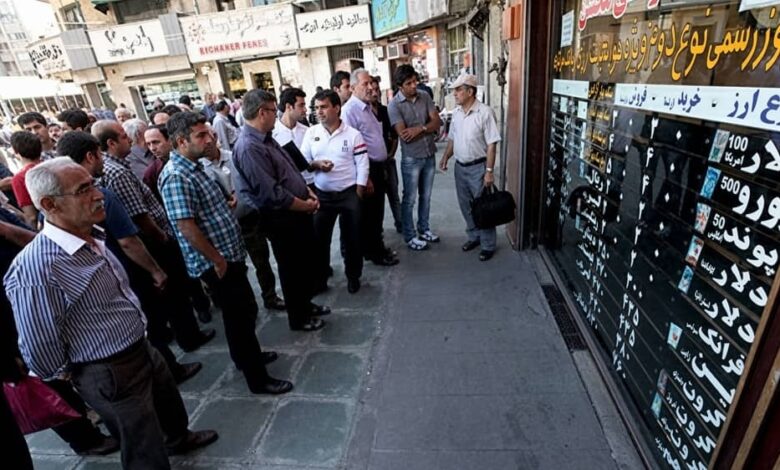
Crowds check dollar and euro rates at a Tehran currency exchange as Iran’s rial comes under pressure
Written by
Farid Mahoutchi
Even the Central Bank’s own figures leave little room for claims of economic normalization. Governor Abdolnaser Hemmati said on September 26 that point-to-point inflation stood at 83.8 percent in September, down only marginally from 84.4 percent in August, while monthly inflation remained 3.9 percent. Tasnim presented the fractional decline as the first in 15 months; Hemmati himself conceded that inflation running around 4 percent a month remained high.
A much darker picture appeared the same day in the domestic business daily Donyaye Eghtesad. Its survey of 18 economists and nine business figures projected year-end point-to-point inflation at roughly 99 percent under an intensified-pressure scenario, 80 percent if present conditions persist and 62 percent even under reduced tensions. Economist Mohammad-Mehdi Behkish said food inflation had already exceeded 100 percent and described present living conditions as unsustainable; another contributor called the 10.1 percent contraction recorded in spring a “bitter turning point” for Iran’s economy.
The pressure is visible outside economic models. More than 4,700 working and retired teachers have signed a petition demanding their legal pay, medical and welfare entitlements and transparency over their pension fund. Separately, a representative of construction workers told ILNA that Iran lacked “livelihood security” and criticized officials who rely on favorable charts while conditions at workers’ dinner tables deteriorate.
"Iran is entering the final days of September under simultaneous pressure from soaring living costs, a weakened #currency, fuel shortages and problems across industrial supply chains," @MansoreGolestan writes.https://t.co/N7NEb86C1o
— NCRI-FAC (@iran_policy) September 19, 2026
State Media Acknowledges the Economic “Spark”
Perhaps the most revealing material published Saturday came from Tasnim itself. In a lengthy examination of the January unrest and the authorities’ continuing nighttime rallies, a regime-aligned social researcher explicitly rejected the claim that the earlier protests were purely foreign-instigated. “The initial spark was economic: livelihood,” he said, adding that the language of the protests subsequently became political. He warned that “a system that only sees the defender is surprised by the protester.”
That admission closely matches the language now coming from the security establishment. In a state-television interview, former police commander Esmail Ahmadi-Moghaddam said the Intelligence Ministry, Basij, IRGC and police must remain vigilant because adversaries seek to turn “every spark” into “a flame” and set some corner of the country alight. He praised the security agencies for having controlled developments “in time” and insisted that media and political figures must not transmit signals of weakness or internal disagreement.
The same interview showed why social anxiety and economic management have become inseparable in official thinking. Ahmadi-Moghaddam acknowledged that oil exports had been effectively halted for roughly 40–50 days, that some strategic goods had been difficult to obtain and that energy supplies remained strained. His prescriptions ranged from stronger intelligence control to restoring purchasing power and asking households to cut energy use—including closing rooms and wearing warmer clothes indoors.
"Iran’s accumulating #economic pressures moved visibly into the streets on September 20, 2026, as retirees demonstrated in several cities while the rial again weakened sharply," writes @shahriarkia.https://t.co/scTS9SL15B
— NCRI-FAC (@iran_policy) September 20, 2026
From Inflation to Hijab, Everything Becomes Security
The IRGC is increasingly describing almost every sphere of national life through the language of warfare. On September 26, Ground Forces commander Mohammad Karami said the country faced an “all-out hybrid war” encompassing economic, social, cultural, political, security, military and cognitive dimensions.
Clerical officials are applying the same security framework to social behavior. Qom Friday prayer leader Mohammad Saeedi declared that women deliberately appearing without compulsory hijab could become instruments for overthrowing the system, describing such conduct as a threat to national security and calling for a severe response against those deemed intentional offenders. In Karaj, Friday prayer leader Mohammad-Mehdi Hosseini Hamedani warned officials against statements or diplomatic actions that could signal weakness, saying such messages could destroy “social resilience” and generate hopelessness.
Universities are also reopening under renewed political pressure. Tasnim published demands on September 26 that unresolved cases arising from last winter’s university unrest be completed and penalties enforced, arguing that those incidents could not be treated as ordinary campus protests. The article explicitly linked disciplinary action to preventing a recurrence as students return for the new academic year.
"Even by the Iranian regime’s own measurements, the #economy is contracting at an extraordinary pace," writes Farid Mahoutchi.https://t.co/vvd8XGsOG9
— NCRI-FAC (@iran_policy) September 22, 2026
Economic Disorder and Political Friction
Fresh disclosures are also raising questions about the machinery financing the state. MP Hadi Ghavami told Tasnim that he had reported roughly $300 million leaving Tourism Bank through “trust” structures, while warning that the Central Bank must not become a “piggy bank” for the government or unbalanced banks. He explicitly traced such financing through monetary expansion to higher inflation and declining household purchasing power.
Meanwhile, Parliament issued Communications Minister Sattar Hashemi another “yellow card,” this time over poor internet and telephone services and unresolved retiree grievances. But the vote is better understood in the context of intra-regime blame-shifting than institutional accountability. Parliament itself has been embroiled in controversies over lawmakers’ pay and allowances, loans and preferential vehicle allocations. With inflation and public anger mounting, lawmakers are increasingly directing responsibility toward Pezeshkian’s cabinet.
The more revealing pattern is how broadly the regime now defines a security threat. In Qom, Friday prayer leader Mohammad Saeedi said deliberate defiance of compulsory hijab could serve as an instrument for overthrowing the system and should be treated as a threat to national security. Women’s dress, campus dissent, economic grievances and critical media are thus increasingly being folded into the same security vocabulary.
That matters because it expands the perceived threat from political dissent to everyday social behavior. The more ordinary grievances and personal choices are treated as challenges to the state itself, the greater the risk that scattered discontent becomes political confrontation—the very process officials describe when they warn that a “spark” can become a “flame.”