
Petre Roman Draws Parallels to Romanian Revolution, Forecasts Imminent Fall of Iran’s Regime
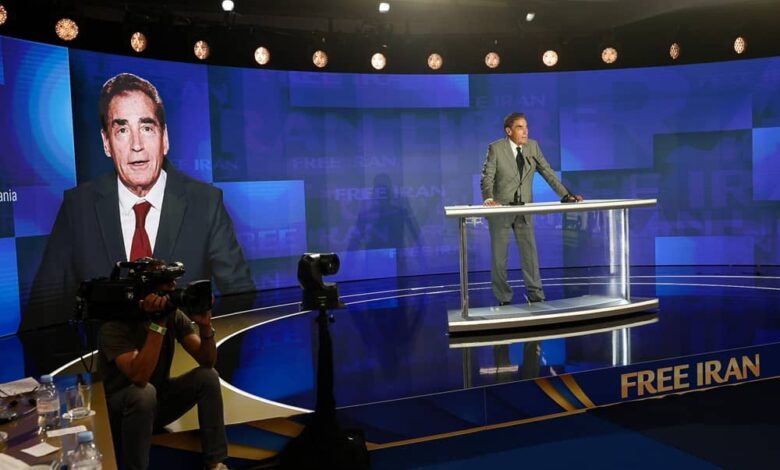
Former Romanian Prime Minister Mr. Petre Roman addresses the 2026 Free Iran World Summit on June 20, 2026
Written by
Mehdi Oghbai
Speaking at the Free Iran 2026 World Summit, former Prime Minister of Romania Petre Roman delivered a compelling address forecasting the imminent collapse of the clerical dictatorship in Iran. He drew powerful parallels between Iran’s current political climate and his personal experience fighting the Ceaușescu dictatorship in Romania, noting that violent suppression often signals a regime’s final days. He recounted surviving a massacre in Bucharest just hours before the sudden fall of Romania’s totalitarian government, suggesting a similar tipping point is approaching in Tehran.
Roman strongly condemned the ruling clerics for executing thousands of citizens and deliberately blocking the Strait of Hormuz to blackmail the global economy. He dismissed Tehran’s claims of strength as a façade, pointing to the nation’s shattered economy and widespread poverty as definitive proof of the regime’s profound vulnerability. Furthermore, he criticized French authorities for attempting to suppress democratic demonstrations in Paris.
To secure a completely democratic transition, Roman praised Maryam Rajavi’s Ten-Point Plan as a rigorous and essential roadmap. He emphatically stressed that this strategic vision provides the Iranian people with the absolute certainty needed to dismantle the current system. Roman concluded with a steadfast, powerful message of solidarity, confidently asserting that the NCRI will soon achieve a permanently free Iran.
The full script of Petre Roman’s speech follows:
Much esteemed dear President Maryam Rajavi, dear friends, brave fighters for a free Iran, members of the Resistance of Iran.
I’m greatly honored to be with you today. This morning, leaders of the NCRI offered their thanks to me for being here with you. This is not the way it is. It’s just the opposite.
I have the very real and great privilege to be part of the fight for a just cause. What can be more wonderful than that? So, I offer my sincere gratitude for this.
Dear friends, Madam Member of Parliament, Madam President, let me express my gratitude and admiration for your firm and courageous words. You reminded us that the France represented by this ban is not the France we know and love. The France we love is the France of liberty, equality, and fraternity. Thank you.
The present situation in Iran and in the world in general, compared to the one just one year ago when we gathered here, is more complex and more complicated, of course, due to the war.
The mullahs’ regime in Iran, what they did now, I mean, in this situation, in this period… Well, first, [they are] killing thousands and thousands of their own people by executions and by pure murder.
And secondly, they blocked the Strait of Hormuz, blackmailing the global economy, blackmailing millions of people around the world.
And they claim victory now. This is not true, and it cannot be. And it is not because the Iranian economy right now is in shambles.
Petre Roman: The Iranian regime is weaker than ever, as evidenced by an economy in shambles and the fact that millions of Iranians live in extreme poverty. By murdering their own people and blackmailing the global economy, the regime is only signaling its own impending death.…
— NCRI-FAC (@iran_policy) June 20, 2026
Many, many millions of Iranians live in very poor conditions. They lost their most minimal decent conditions of life. And this is showing that, in fact, the regime is much weaker than before.
And the protesters in the streets in Iran, they were killed. Why? Because they are a symbol of the death of the regime.
They are those pointing to those killing them, saying, “One day, very near, the death of the regime is coming.”
I have my experience fighting a dictatorship, years ago, in my country. And there are essential similarities with the situation in Iran.
When the dictator in Romania, Ceaușescu, ordered to shoot on the protesters, to kill people, in order to just keep his own private, personal political power, it was a moment of bewilderment. We didn’t think that this was possible.
All around Romania, all the other former countries of the Soviet system were already much freer than Romania. Romania was the last Stalinist regime.
I was on the barricade in the center of Bucharest. We blocked the most important boulevard; we blocked the traffic for more than ten hours.
In the end, at the order of the dictator, they started to shoot on us. A massacre.
Out of the eighty-one—not many, indeed, we were there at the barricade—thirty-nine were killed. Among those, seventeen were less than 18 years old. That happened 20 minutes to midnight.
But, you know, something absolutely unbelievable happened. Just 12 hours after the killing, the regime collapsed. Romania was free.
You have a very important instrument, which is the Ten-Point Plan of President Maryam Rajavi. It’s a very serious, rigorous plan. It’s an alternative. It’s opening the road for a free and democratic Iran.
This is really crucial because, in the end, people want some certainty. And the certainty comes with a plan, with a vision, with a strategy, with a perspective, and here it is, such a perspective.
So, I salute you from the bottom of my heart, and I’m telling you my conviction: exactly as in 12 hours a dictatorship collapsed totally, the collapse of the mullahs’ regime in Iran is very near, believe me.
All my best.