
Iran’s Regime Strained by Scandal, Skyrocketing Inflation, and Protests
Written by
Mansoureh Galestan
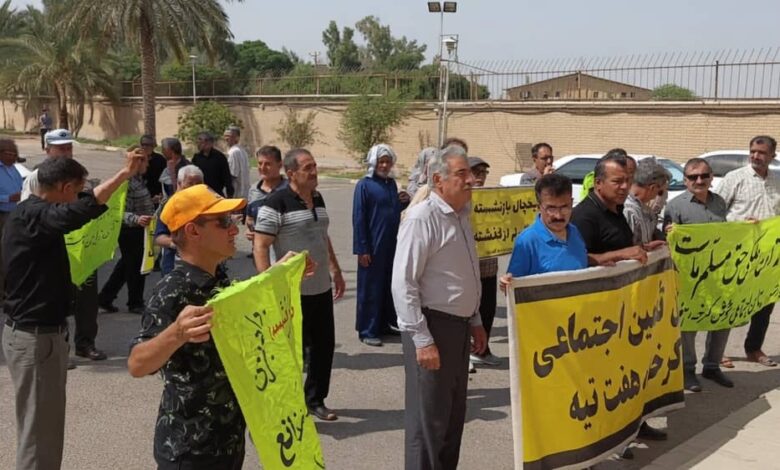
Protests, surging hyperinflation risks, and armed security clashes are putting unprecedented pressure on Iran’s clerical regime. On Sunday, August 2, 2026, retirees across Tehran, Mashhad, Kermanshah, and Shush gathered to denounce severe economic hardship, corruption, and dwindling purchasing power. Despite extreme heat exceeding 50°C in Shush, Social Security retirees took to the streets, chanting: “Only in the street will our rights be achieved,” and “Our enemy is right here, they lie by saying it’s America.” Demonstrators in Tehran further demanded the release of imprisoned trade unionists, declaring, “Bread, work, freedom; a dignified life is everyone’s right.”
The unrest is rooted in a severe domestic economic crisis acknowledged even by state-aligned figures. In an interview published Saturday, August 1, 2026, by the state-run ILNA news agency, regime economist Hossein Raghfar described Iran’s current economic condition as “very unfavorable,” warning that ongoing foreign exchange policies could push the economy into full hyperinflation. On the same day, the state-run Tosee Iranian newspaper reported that “living costs doubled from December to July,” with housing inflation hitting a 19-month high. Furthermore, the state-run website Nabz-e Gheimat reported on August 1, 2026, that a 30-egg tray surpassed 850,000 tomans in Tehran, calling it “one of the most shocking market events in recent years.” Analysts quoted by the state-run Khabar Online news site attributed the inflation primarily to “political uncertainty and the ‘neither war, nor peace’ situation.”
"Iran is engulfed in a severe socio-#economic crisis, driven by geopolitical adventurism, systemic mismanagement, and hyperinflation," @MansoreGolestan writes.https://t.co/kNJLoCPPdC
— NCRI-FAC (@iran_policy) July 21, 2026
Compounding the public’s distress is systemic state embezzlement revealed in official government audits. Zabihollah Khodaeian, head of the General Inspection Organization, admitted that 20,676 individuals and corporate entities hold nearly 94 billion euros in unreturned foreign currency commitments. This capital was funneled through “trustees”—an offshore broker network set up by the regime to circumvent U.S. sanctions. Khodaeian publicly conceded that “some trustees committed treason,” noting one broker absconded with 200 million euros. Reacting to the report, Gholamreza Dehghan Naserabadi, a member of Parliament’s Energy Commission, publicly stated that “collusion and corruption behind this issue are very extensive and this matter is very fishy.”
Security Casualties Mount Amid Deepening Social Crises
Beyond labor demonstrations, violent friction between armed individuals and state security forces is expanding. On Sunday, August 2, 2026, the Ministry of Intelligence-affiliated Mehr News Agency reported that three law enforcement officers were killed during an armed clash in Shadegan. State media reported that the officers were ambushed while attempting to conduct an arrest raid against what it called “arms smugglers.”
"Driven by absolute #economic desperation and fueled by the glaring vulnerabilities of a fractured elite, the impending uprising is rapidly positioning itself to be a decisive confrontation for the Iranian people," @MasumehBolurchi writes.https://t.co/VoD9GfR3IK
— NCRI-FAC (@iran_policy) July 3, 2026
This follows separate violent incidents in southeastern Iran. On Thursday, July 30, 2026, official state media reported that armed individuals operating from three vehicles opened fire on a police checkpoint in Iranshahr, killing an officer. A day earlier, on Wednesday, July 29, 2026, state media affiliated with the Islamic Revolutionary Guard Corps (IRGC) Qods Force reported that another officer was shot dead while commuting to work in the same city.
As living standards continue to plummet due to systemic decisions—such as a 2014 state administrative rule that cut public pensions by 30 to over 60 percent—and tens of billions of euros remain unaccounted for overseas, popular frustration is increasingly intersecting with insecurity. The combination of widespread street actions by retirees and young job-seekers, structural economic decay, and lethal anti-regime clashes signals a volatile and deteriorating state of stability for the clerical establishment.