
John Bercow Backs NCRI’s Democratic Vision, Rejects Monarchy and Dictatorship for Iran
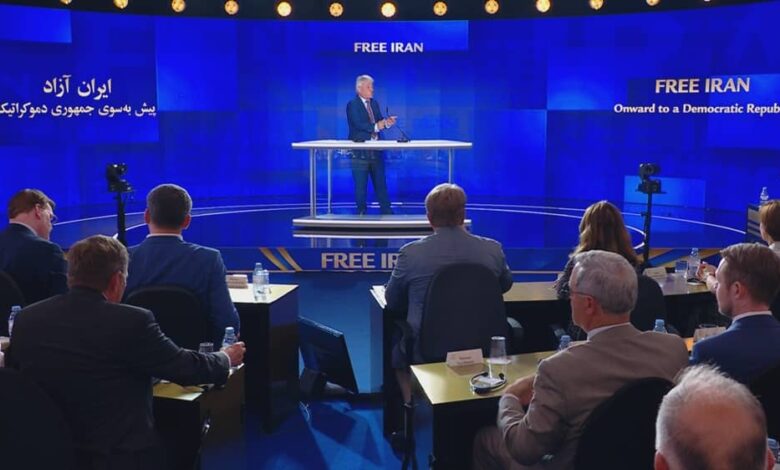
Former U.K. Parliament Speaker John Bercow addresses the 2026 Free Iran World Summit on June 20, 2026
Written by
Shahriar Kia
On June 20, 2026, addressing the Free Iran 2026 World Summit in Paris, former UK House of Commons Speaker John Bercow delivered a powerful endorsement of the National Council of Resistance of Iran (NCRI) while fiercely rejecting both the current clerical regime and a return to the monarchy. Bercow lauded NCRI President-elect Mrs. Maryam Rajavi as a “heroine for humanity” and praised the coalition’s Ten-Point Plan as a premier blueprint for a modern, pluralist, and secular republic.
Reflecting on his 22 years in parliament, Bercow noted that while British lawmakers frequently clashed over foreign policy, cross-party support for the NCRI, the internal MEK Resistance Units, and Mrs. Rajavi remained uniquely steady, compelling, and strong across all major political factions.
Bercow drew a sharp contrast between the NCRI’s progressive, gender-equal movement and what he called the “backward-looking, reactionary, [and] fossilized” alternative presented by Reza Pahlavi. Critiquing Pahlavi’s recent statements defending the tyrannical legacy of his father’s dynastic rule, Bercow asserted that an autocratic hereditary system is utterly unacceptable for a future democracy.
Reiterating that the Western policy of appeasement has failed, Bercow called on the British government and its international allies to officially recognize the NCRI. He emphasized that the regime in Tehran is a “political leper” specialized only in homicide and repression. Vowing continuous parliamentary and international solidarity, Bercow concluded that Western nations must redouble their efforts to help the Iranian people achieve the lasting freedom, justice, and democratic choice they have long been denied.
A full script of John Bercow’s speech follows:
Former UK @HouseofCommons Speaker John Bercow decries France’s decision to ban today’s 100,000-strong Free Iran rally at the request of the regime.
“What a pathetic, abject, pitiful, craven, feeble, submissive surrender on the part of the Paris authorities.”
CC: @FrenchResponse https://t.co/JBhNIViaVi pic.twitter.com/ESmRSE7ZAi
— M. Hanif Jazayeri (@HanifJazayeri) June 20, 2026
Distinguished former prime ministers, foreign ministers, ambassadors, august representatives of the United States military, and above all Mrs. Maryam Rajavi—a champion of liberty, a heroine for humanity, and I think we can agree, my friends, ladies and gentlemen, one and all, one of the bravest people on the face of the planet.
It is a privilege to be invited to be amongst your number, and perhaps I can underline and reinforce the message so brilliantly articulated at the outset, of course, by Mrs. Rajavi, then by Christine, by Charles, and by former Prime Minister Boris Johnson.
What a pathetic, abject, pitiful, craven, feeble, submissive surrender on the part of the Paris authorities! What on earth did they think they were doing?
Whatever the apologia, whatever the rationalization, indeed whatever the motives of those anonymous individuals responsible for this attempted perversion of our weekend’s activities, in practice, they need to know one thing: They weren’t being clever, they weren’t being prudent; they were being utterly stupid and playing the game of the mullahs in Tehran.
I’ve been on those demonstrations in the past, as I know others here have been too, including my former colleague, David Jones. He and I know, and others here assembled know, and Prime Minister Johnson knows, that those demonstrations were the very epitome of peaceful expressions of protest against one of the most despotic tyrannies to be found anywhere in the globe. The notion that they represented a threat is a sick and poor-quality joke.
But you can try to cancel a demonstration. You can cancel a rally, as Boris said. They haven’t cancelled us. We’re here in good spirits, we’re here in good heart, and we’re here in good voice. And you can scrap a demonstration.
And as the regime knows in Tehran, with the worst per capita record of the use of the death penalty anywhere in the world, you can murder a person. You can murder people. You can murder hundreds of thousands of people.
But the one thing you can’t do is murder an idea. You cannot murder an idea!
And the idea of freedom—the idea of freedom has lived in men’s and women’s hearts from the very inception of civilization.
And that idea will always live and be burnished and cherished and will be able to flourish in the breasts of people who want liberty wherever they live, anywhere in the world, in any circumstance, at any time. Because to be human is to want to be autonomous, to want to govern yourself, to want to be free.
Of course, the regime, as Charles so eloquently said and was again underwritten by Boris and Christine and others, is the most shocking, barbaric representation of governance to be found anywhere.
I’ve said it before, but let me say it again, my friends. The Iranian barbarian leadership, specialists only in homicide and in genocide, have never quite got the purpose of government.
John Bercow: You can murder hundreds of thousands of people, but the one thing you cannot do is murder an idea. The idea of freedom has lived in human hearts from the inception of civilization, and it will always flourish in the breasts of those who want liberty. #NCRIAlternative…
— NCRI-FAC (@iran_policy) June 20, 2026
The purpose of government is not to get the people to serve you. The purpose of government is to serve the people.
In Tehran, their whole idea, their whole mission, their whole guiding principle, their whole day-to-day ethos and modus operandi is to murder, to maim, extrajudicially to kill, to incarcerate, to intimidate, to repress, to ban, to subjugate—all with the explicit and obvious, but doomed, purpose of extinguishing hope.
As we all know, if in war you can extinguish your enemy’s hope, you are two-thirds, three-quarters, four-fifths of the way to victory. Our hope, and the hope of the people of Iran, will never be extinguished. We will keep on fighting for the cause of freedom for however long it is necessary for that fight to be conducted.
And again, as has been said, appeasement never works. I say what I’m about to say in the presence of a Churchill scholar in Boris, and he will recognize the historical accuracy and the political potency of the point.
When Winston Churchill was arguing against the appeasement of Nazi Germany, he said to the pathetically inadequate, endlessly prevaricating, soft-of-nerve Prime Minister Stanley Baldwin, “When I look at Stanley sitting on that front bench as Prime Minister, it fills me with anxiety and worse.” Because he said, “When I look at him, I see a leader resolved only to be unresolved, adamant for drift, solid for fluidity, all-powerful to be impotent.”
That’s not leadership, as Churchill knew. It’s the abdication of leadership.
The only difference today is we’re all very clear. We’re not arguing for war. Mrs. Rajavi has never argued for war. She’s never called for military intervention. She’s never supposed the solution to be delivered by boots, persons, or weapons.
We know there has to be an alternative which is configured around, driven by, and achieved through the indomitable will and persistence of the people.
And that leads me, if I may—and I say this in the presence of everybody in this room, but also of our magnificent and endlessly courageous friends in Ashraf 3—we have to remember what the real alternative is. But in order to get to what it is, let’s know what it isn’t.
There are those people who call themselves princes. And when the mood takes them, they have the temerity, the audacity, the effrontery, the brass neck, to call themselves crown princes. Princes over the water, who are going to come riding to the rescue of the people.
I’ve teased Reza Pahlavi before. I don’t want to be too unkind to the fellow. I know he’s got quite a lot of free time. I’m not aware that he’s done a useful day’s work in his life. He’s lived off the fat of the land and resources and riches and largesse acquired hither and yon by one means or another.
And now he thinks, maybe I, after a lifetime with a rather vacuous CV, a rather limited job experience, can come to the rescue of the Iranian people. I have to say to Mr. Pahlavi, “My dear chap, don’t phone us, and you may rest assured that we will not be phoning you.”
Because his is not a credo for democracy and liberation and a pluralist society. His is a backward-looking, reactionary, fossilized, look-to-the-past, aristocratic, and autocratic alternative. But don’t take it from me. I believe people should be judged by their deeds and indeed by their own words.
And I think we need to remind the world, our own governments, our parliaments, our media, of what Mr. Pahlavi said in an interview on the 12th of April this year.
He was asked whether, in trying to be a government-in-waiting and a transitional force to a new Iranian future, his own family background and past might be a detriment. And he replied, and I quote, “I am proud of my heritage, my family’s history, and everything that they have done.” I repeat: “and everything that they have done.”
Ladies and gentlemen, it’s the most natural human impulse for us all to be proud of our heritage, proud of our parents, proud of our family background, proud of our loved ones. There’s nothing objectionable, reprehensible, or exceptionable about that.
John Bercow: Pahlavi aspires to public office while being proud of everything his tyrannical father did as a despot—that is utterly beyond the pale. We stand with the NCRI and the #MEKResistanceUnits, who champion a secular, modern, and pluralist future. #OurChoiceMaryamRajavi… pic.twitter.com/vOfRUMKmTV
— Women's Committee NCRI (@womenncri) June 22, 2026
But remember that last bit: “and everything they have done.”
Mr. Pahlavi, sir, supposed prince, doomed would-be leader, I say to you, sir, if you aspire to public office—the idea that you can aspire to public office in a democracy whilst being proud of everything your egregious, tyrannical father did as a despot over the people of Iran is utterly beyond the pale.
It is not acceptable today, not acceptable tomorrow, not acceptable next week, not acceptable next month, not acceptable next year, not acceptable at any time.
And what we need, as other colleagues have said with eloquence, fire, and passion, is fundamental and irreversible change for the better. Perhaps, my friends, I may be permitted in front of so many distinguished democrats to say this.
First, I’m immensely conscious that in the NCRI, unlike in Pahlavi’s male-dominated movement, you see young, secular, modern, pluralist Iran personified.
They are brilliant people, possessed of talent, determined to succeed, committed to equality, gender and otherwise, passionate about freedom of the media, freedom of association, freedom of choice, wanting a secular state, wanting a non-nuclear republic, wanting an environmental commitment, wanting a genuine free enterprise and mixed economy.
[You] people, Ashraf 3 people, aren’t looking for some sort of reversion to a kind of atavistic, autocratic, feudalist past whereby office is determined by heredity and a kind of institutionalized snobbery. That’s not what you want. What you want is a genuine freedom determined by you.
And you want that choice, and it comes back to that question of democracy.
In Britain, and I think my former colleagues will concur, we had our differences. To be honest, there are people in this hall today, including Boris and I—he is the most senior political figure in the United Kingdom, I as a very secondary figure but as the Speaker of my parliament—we didn’t always agree. But we certainly agree about freedom for the people of Iran.
And the same goes for David Jones and I. We had our differences, but we agree about freedom for the people of Iran.
And all of us, and other colleagues I see from other political parties in the UK and across Europe and beyond, we agree that democracy is not about one person, one vote, once.
Democracy is about one person, one vote, at regular intervals, given the opportunity to choose who represents them, to choose who governs them, and then, after a period, without explanation or apology, if they so choose, to choose a change. That’s democracy.
And the movement that we all support of the National Council of Resistance of Iran and the MEK is a movement that champions that principle, reflected in the Ten-Point Plan, which is as eloquent an expression of a commitment to democracy and freedom and a pluralist society as one could possibly hope to craft or fashion. That is what you all want.
And what I found so interesting in my 22 years in parliament was that we disagreed about so many foreign affairs issues, but on Iran, on the Conservative side, on the Labor side, amongst Liberal Democrats and smaller parties in the House, the support for the National Council of Resistance of Iran, for the MEK Resistance Units, and for Mrs. Rajavi was strong, compelling, insistent, and steady throughout my parliamentary experience. That’s what we want.
Taking away from today, we in Britain must redouble our efforts to get our government to give the National Council of Resistance of Iran the recognition that it deserves.
We don’t want our government to declare war on Iran, to conduct some foolhardy, reckless, expensive, and doomed military adventure.
But what we do want is for our government to treat the government of Iran as a political leper, because that is what it is. It is a pariah state, it is a failed state, and it should be treated accordingly.
We in Britain and in parts of Europe and elsewhere here represented, most certainly the United States, are very fortunate, very lucky, very privileged.
What we want for the people of Iran, and we’ll raise our voices incessantly in support of the cause, is for the people of Iran to enjoy the freedom, the democracy, the justice, and the rule of law which we have so long enjoyed and the people of Iran have too long been denied.
We will never stop campaigning until that goal is achieved.
Thank you very much indeed.