
Iran: Coronavirus Fatalities in 480 Cities Exceed 218,600
Written by
Secretariat of the National Council of Resistance of Iran (NCRI)
In a blatant lie, Hassan Rouhani claimed: From the outset when we noticed the Coronavirus, we immediately informed the public … It is absolutely a lie to say, we did not tell the truth and provided unrealistic statistics to the people because of the elections.
Head of the Medical Organization: Lack of transparency indicates poor management and professional ethics. Coronavirus arrived in December 2019 but was officially made public in February 2020. (Eghtesad news, February 17, 2021)
Health Ministry: Last week, Mazandaran and Khuzestan Provinces had the highest number of COVID-19 hospitalizations. The highest death toll was in Mazandaran and Gilan. (IRNA news agency, February 20, 2021)
Alireza Reisi, the spokesperson for the National Coronavirus Combat Taskforce (NCCT): We are extremely worried about Tehran and Alborz provinces. It could be the calm before the storm. (Mehr news agency, February 20, 2021)
Qassem Janbabaei, regime’s Deputy Health Minister: Coronavirus hospitalizations in Khuzestan Province has increased five to six-fold compared to three or four weeks ago, and we have added more than 150 ICU beds. (State TV, February 19, 2021)
Ahvaz University of Medical Sciences: Ahvaz hospitals’ ICU beds are 100% occupied and hospitals may not be able to respond to COVID-19 patients. (IRNA, February 20, 2021)
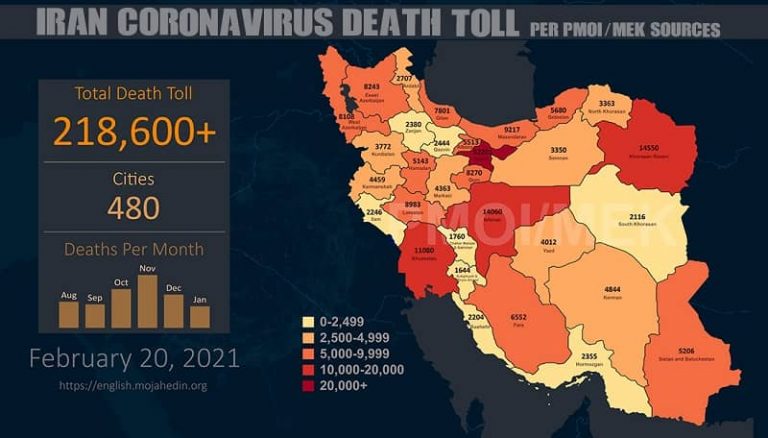
The People’s Mojahedin Organization of Iran (PMOI/MEK) announced on February 20, 2021, that the Coronavirus death toll in 480 cities had exceeded 218,600. The number of victims in Tehran is 52,201, Isfahan 14,060, Khuzestan 11,080, Mazandaran 9,217, West Azerbaijan 8,108, Gilan 7,801, Sistan and Baluchestan 5,206, North Khorasan 3,363, Zanjan 2,380, South Khorasan 2,116, Chaharmahal and Bakhtiari 1,760, and Kohgiluyeh and Boyer-Ahmad 1,644.
Secretariat of the National Council of Resistance of Iran (NCRI)
February 20, 2021