
Mohaddessin: Popular Uprising and Resistance Units Are Key to Change in Iran
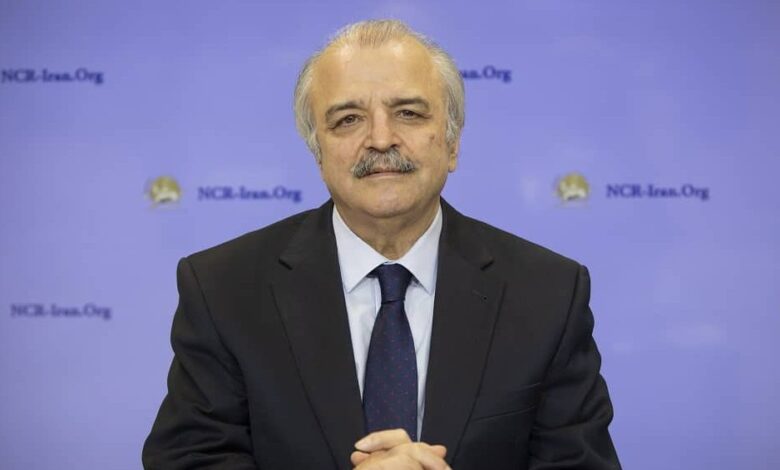
Mohammad Mohaddessin, the chair of the National Council of Resistance of Iran (NCRI) Foreign Affairs Committee.
Mohammad-Mohaddesin-1
Written by
Shamsi Saadati
In an interview with the Romanian outlet Libertatea, Mohammad Mohaddessin, Chairman of the Foreign Affairs Committee of the National Council of Resistance of Iran, says the regime cannot be overthrown by airstrikes alone. Instead, he outlines a two-pillar strategy for change in Iran: widespread popular uprising and organized Resistance Units inside the country.
He describes Iranian society as highly volatile, citing inflation at 75% and unemployment at 25%, and emphasizes that the population seeks freedom and democracy. He also highlights Iran’s geography and strong nationalism as major barriers to any foreign occupation, referencing the negative legacy of the 2003 Iraq invasion.
On the war’s duration, he believes it will not be prolonged but stresses that the regime fears internal collapse more than external pressure. He calls on the European Union to support both a ceasefire and regime change, urging recognition of the Iranian people’s right to overthrow the system.
Reflecting on his own imprisonment and torture under the Shah, Mohaddessin underscores the human cost of resistance, framing sacrifice as the price of freedom and dignity.
The full translation of the interview follows:
Mohammad Mohaddessin, opozant-cheie al regimului din Iran: „E nevoie de sute de mii de soldați pentru a ocupa Iranul” EXCLUSIV
Citiți aici: https://t.co/bdwwtK26LW#stiri #stiriromania #exclusivlibertatea #razboiulisraeliran #stiriiran
— Libertatea (@libertatea) April 14, 2026
The Chairman of the Foreign Affairs Committee of the National Council of Resistance of Iran (NCRI) and one of the key figures of the opposition against the regime in Iran, Mohammad Mohaddessin explains, in an interview with Libertatea, why it is impossible for American troops to reach Tehran, as well as how he sees the future of his country.
Born in 1955, Mohammad Mohaddessin, the son of a prominent ayatollah from Qom, was a student at Sharif University of Technology in Tehran. He joined the People’s Mojahedin Organization of Iran (PMOI/MEK) in 1973. For more than five decades, he has been an opponent of dictatorship in Iran. The Shah’s secret police, SAVAK, arrested him in 1975 for his activities and sentenced him to 15 years in prison. He was tortured and remained imprisoned for four years, until the final days of the Shah in 1979. Since then, he has been one of the highest-ranking political officials of the movement. After Khomeini’s religious dictatorship began its campaign of terror and executions in the 1980s, Mohaddessin, like other dissidents, was forced into exile, settling in Paris.
“We have a very clear and strong strategy to overthrow the regime”
Libertatea: You recently stated that the war being waged by the United States and Israel against the Islamic Republic of Iran will not lead to the removal of the country’s clerical leadership. How can the Iranian regime be defeated without the involvement of the United States and Israel?
Mohammad Mohaddessin: That is a very good question. The reality is that a government like the Iranian regime, in a very large country such as Iran, is extremely difficult, if not impossible, to overthrow through bombing carried out by a foreign country. Of course, bombing by the United States or any other country, as well as sanctions, weakens the regime. But these cannot overthrow the regime. To overthrow the regime, you need soldiers, forces on the ground.
If the United States, for example, wants to overthrow the regime, it needs troops on the ground, as it did in Iraq in 2003. But in the current political context in Iran, in the United States, and globally, it is impossible for the United States to send troops on the ground to overthrow the regime in Tehran.
We have a very clear and strong strategy to overthrow the regime. This strategy has two pillars; it is based on two fundamental elements. First, public uprising—the revolt of the people. Second, the organized resistance movement, the resistance units inside Iran.
Iranian society is a very, very dissatisfied and explosive society. Inflation has reached 75 percent according to official figures, the highest level since World War II. Unemployment is around 25 percent. The Iranian people want freedom; they want democracy. Therefore, a popular uprising is very important and very likely.
I told 🌍 media today: The overthrow of the mullahs’ regime requires a powerful, battle-tested, combat-ready force rooted within Iranian society. Today, that force exists within Iran in a disciplined and organized force: the PMOI Resistance Units, active across all 31 provinces. pic.twitter.com/BcPJdhzLgr
— Mohammad Mohaddessin (@Mohaddessin) March 19, 2026
Libertatea: Why do you believe it is impossible for American troops to reach Tehran?
Mohammad Mohaddessin: Americans can send a commando team to Tehran in a specific operation, as they recently did in central Iran to rescue that pilot. But they cannot occupy Tehran. If they want to occupy Tehran, they must send ground troops from the borders to Tehran.
Tehran is far from Iran’s western borders—500 to 600 kilometers—and far from the eastern borders—800 to 900 kilometers. It is even farther from the southern borders and several hundred kilometers from the northern ones.
Therefore, it is impossible to occupy Iran with a few thousand soldiers. It would take hundreds of thousands of soldiers to liberate Tehran or to occupy Iran, a country with a population of over 92 million people. Iran’s surface area is three times that of France and six times that of the United Kingdom.
You must also take into account that the Iranian people are very patriotic. They are not in favor of their country being occupied. Of course, they welcome and call for support from other countries—the United States or European nations—but they do not want their country to be occupied.
You have the experience of Iraq. The occupation of Iraq had many negative consequences. Even now, Presidents Trump, Biden, and Obama—all of them—after the occupation and invasion of Iraq, criticized it and said it was a very bad experience, a very unfortunate moment in U.S. history, with negative and disastrous consequences for the region.
Even today, everyone in the Middle East and beyond is suffering from the consequences of that invasion.
At today’s press conference in Brussels, I emphasized that:
The EU’s policy of appeasement has been the most significant external factor in sustaining Iran's regime and preventing its overthrow.
We are not asking the EU for money, weapons, or foreign troops. We call for an end to… pic.twitter.com/n13IxjBHio— Mohammad Mohaddessin (@Mohaddessin) March 18, 2026
Libertatea: How do you estimate the duration of the war in Iran?
Mohammad Mohaddessin: Of course, it is very difficult to say what will happen, because unfortunately this is a war in which we have no role. There are so many interests involved that it is hard to predict the outcome.
But I believe it cannot be a long war. It cannot last many months or a year.
What is very important is that this regime has a very simple calculation regarding the war. They say the United States cannot overthrow the regime through bombing—they are very confident about that.
Second, they believe that if they accept U.S. conditions—or even a large part of them (the United States has offered a 15-point plan)—this would lead to internal chaos and weaken the regime from within, opening the way for a strong popular uprising. The regime’s leaders fear this scenario.
They are also under great pressure because of the war. For example, if they abandon their nuclear ambitions, tomorrow people inside the regime—not only the Iranian population, but even insiders—will ask: why did we spend so much money? Why did we suffer for 30 years for this project? Why did we pay such a price?
So chaos would begin within the regime. That is why the Iranian regime is not ready to accept a ceasefire unless it can no longer launch missiles. As long as they have missiles, they will continue.
"Political support for the opposition is far more dangerous to the regime than any number of bombs" @iran_policy chair @Mohaddessin tells @20m: Europe must support NCRI's Provisional Government and recognise the right of the people of Iran to fight for regime change #FreeIran…
— NCRI-FAC (@iran_policy) March 25, 2026
“EU leaders must clearly say they cannot tolerate this brutal regime and this war”
Libertatea: Should the European Union get involved in resolving the war in Iran?
Mohammad Mohaddessin: It should, and it can. The question is how European countries can be involved—through what means and in what form.
In our view, the European Union and major countries such as France, Italy, Germany, and the United Kingdom can play a very positive role. Their main role is to call for a ceasefire and, at the same time, regime change in Iran.
The European Union’s response must contain two elements: we support peace and we support regime change in Iran. EU leaders must clearly say they cannot tolerate this brutal regime and this war.
But if they only say the war must stop, that is exactly what the Iranian regime wants. The right of the Iranian people to change the regime must also be recognized. We want peace and freedom.
Libertatea: You have been a lifelong opponent of dictatorship in Iran and spent four years in prison. What were the hardest moments?
Mohammad Mohaddessin: I was sentenced to 15 years in prison, but during the uprising against the Shah, when his regime was collapsing, all political prisoners, including myself, were released. I spent about four years in prison.
The situation in Iranian prisons under the Shah was exactly what it is today under this regime: a lot of torture, a lot of pressure. Many people were killed, executed without any fair trial.
I was tortured for many months. There was a well-known phrase among the torturers of the Shah’s regime: “Here, in this prison, no one rules—not God, not the prime minister, no one. The real rulers are me, the torturer, the interrogator, and the Shah.”
For me and many other political prisoners, one of the most terrible memories was having to say goodbye to friends who had been sentenced to death and were leaving prison to be taken to the execution site.
Of course, being tortured is terrible, especially when they beat your feet—that was the most painful form of torture. The torturers counted every blow, and with each one you had to decide to endure.
My experience, compared to many others, was much lighter than those who were killed under torture. But still, this is the price of freedom, the price of dignity, the price of your values. You must pay it. If no one pays this price, the situation will not change.
We want our people to have the opportunity to choose their government and their system. This is not just a political platform for us—it is part of our vision, our ideology, as human beings who follow a democratic Islam. In our belief, governing a country without its people means dictatorship.