
Iran Execution Campaign Reaches Week 136 as Iranshahr Prison Joins, Expanding Hunger Strikes to 62 Facilities
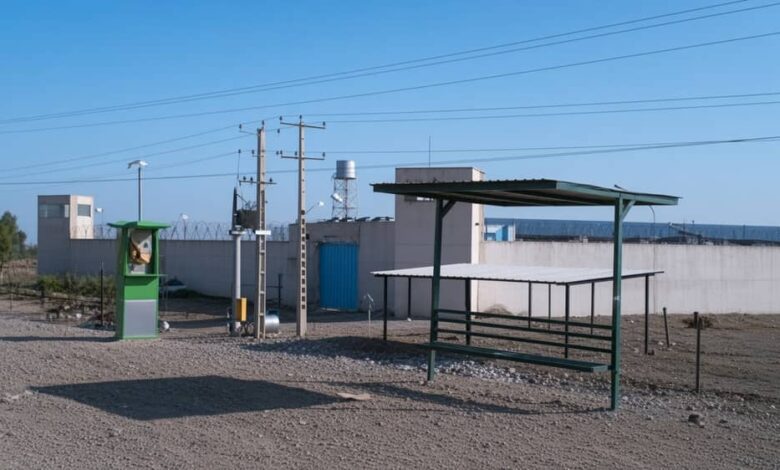
Entrance to a walled prison compound in Iranshahr, southeastern Iran
Written by
Safora Sadidi Mohammadi
The “No to Execution Tuesdays” campaign issued a new statement on September 1, 2026, marking its 136th week of protest and announcing that the movement has now expanded to 62 prisons across Iran with the addition of Iranshahr Prison in Sistan and Baluchestan province.
The campaign’s latest statement contextualizes the regime’s increasing reliance on the death penalty as a tool for suppression amid a deepening national economic crisis: “In conditions where runaway inflation and the unprecedented drop in the national currency’s value have pushed the livelihoods and purchasing power of most segments of society below the poverty line, livelihood crises have expanded day by day… the state resorts to severe suppression of society and prisoners to prevent the protests of an exhausted people. Hence, we witness the daily execution of inhumane death sentences or the issuance of new ones.”
The statement highlighted a recent surge in executions and raised the alarm over imminent threats to political prisoners connected to recent protests: “The oppressive ruling state has executed at least 32 people, including two women, just in the past week of late August. Also, a large number of detainees from the January 2026 uprising have been sentenced to death or are at risk of receiving this sentence; among them, we can mention the issuance of death sentences for 10 defendants in the ‘Shohada Square’ case in Isfahan, political prisoner Leila Abolhassani in Dolatabad Prison in Isfahan, and the confirmation of the death sentence for Ali-Asghar Peighambari in Ghezel Hesar Prison.”
As Iran faces deep economic and social crises, prisoners in 62 prisons nationwide are continuing the #NoDeathPenaltyTuesdays hunger strike for the 136th week. #StopExecutionsInIran https://t.co/QLigj5DIdl
— IRAN HRM (@IranHrm) September 1, 2026
Emphasizing the urgency of collective action, the campaign organizers called on the public and civil society to stand against the rising execution rate: “In such circumstances, resistance and confrontation against the inhumane death penalty are extremely important and necessary. Therefore, this campaign calls on all political, human rights, trade, and civil activists, and all awakened consciences across Iran to confront and stand against the killing machine that continuously and daily takes the lives of people, citizens, and political prisoners on baseless charges.”
According to the statement, coordinated hunger strikes for the 136th week took place on Tuesday, September 1, 2026, across both male and female wards in the following 62 prisons:
Tehran & Alborz: Evin (Men’s & Women’s Wards), Ghezel Hesar (Units 2, 3 & 4), Karaj Central, Fardis Karaj, Greater Tehran, Qarchak, and Khorin Varamin.
Isfahan & Central: Asadabad Isfahan, Dastgerd Isfahan, Arak, and Choobindar Qazvin.
Fars, Kohgiluyeh & Boyer-Ahmad: Adelabad Shiraz (Men’s & Women’s Wards), Shiraz Military Prison, Firozabad Fars, Yasuj, Dehdasht, and Gachsaran.
Shahin Zoghi-Tabar Sentenced to New Prison Term in Evin #IranHumanRights;@UN_SPExperts;@drmaisato;@profbensaul;@volker_turk;@UNHumanRights ;@AmnestyIran;https://t.co/dM2bpGNd4m pic.twitter.com/efxJFy8D8o
— Iran Human Rights Society (@iranhrs_en) August 30, 2026
Khuzestan, Bushehr & Lorestan: Sheiban Ahvaz, Sepidar Ahvaz (Men’s & Women’s Wards), Ramhormoz, Behbahan, Khorramabad, Borujerd, and Borazjan.
Sistan & Baluchestan, Kerman & Yazd: Zahedan (Men’s & Women’s Wards), Iranshahr, Bam, Kahnuj, Kerman, Yazd (Men’s & Women’s Wards), and Tabas.
Gorgan & Khorasan Provinces: Mashhad, Sabzevar, Gonbad-e Kavus, Nishapur, Central Birjand, and Gorgan.
Caspian Coast (Gilan & Mazandaran): Rasht (Men’s & Women’s Wards), Rudsar, Haviq Talesh, Ezbaram Lahijan, Qaemshahr, and Noor.
Kermanshah, Ilam & Chaharmahal and Bakhtiari: Dizelabad Kermanshah, Ilam, and Borujen.
Northwest & Kurdish Regions (Azerbaijan, Kurdistan & Qom): Ardabil, Tabriz, Urmia, Salmas, Khoy, Naqadeh, Miandoab, Mahabad, Bukan, Saqqez, Baneh, Marivan, Sanandaj, Kamyaran, Ahar, and Langarud Qom.