
Iran’s Economy Is Running Out of Its Future
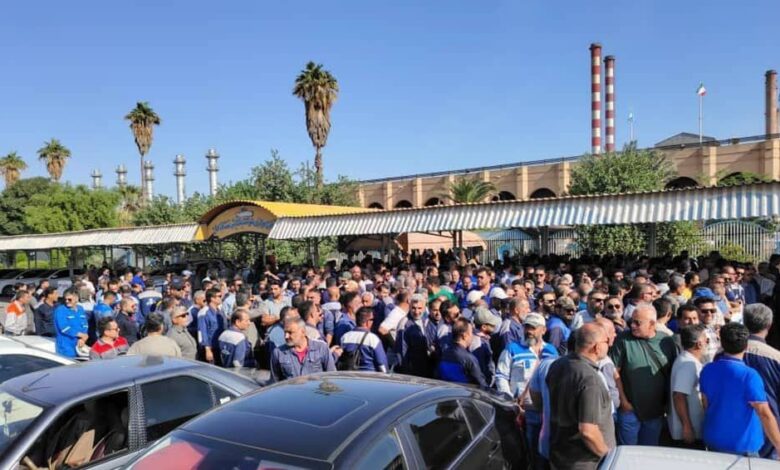
Contract workers at Abadan Refinery protest unfulfilled promises and demand job security – October 18, 2025
Written by
Mansoureh Galestan
Iran’s economic crisis is no longer merely a matter of inflation, sanctions or declining oil revenue. New evidence from Iranian government decisions, corporate financial statements and domestic newspapers points to a more damaging development: the country is increasingly struggling to replenish the resources required to keep its economy functioning.
The latest warning comes from the government’s own foreign-exchange policy.
According to Boltan News, an October 21 directive from the Ministry of Industry and the Central Bank removed 2,816 import-tariff lines from access to the official currency exchange center. Another 1,677 lines retained secondary access, while only 66 received first-priority treatment.
The imports have not been banned, but thousands of categories must now rely on alternative foreign-exchange financing. For manufacturers already facing severe currency shortages, the consequences could include higher costs, delayed imports and reduced production.
This is economic rationing on a substantial scale, and it exposes the government’s diminishing room for maneuver.
You Cannot Shoot Hunger! Iran’s economic collapse and the ultimate failure of repression.
Factories Are Producing Less, Not Recovering
The industrial figures are equally troubling.
According to the Iranian newspaper Khorasan, Iran Khodro’s production fell approximately 22% during the first six months of the current Iranian year, from 263,000 to 205,000 vehicles.
Yet its nominal operating revenue increased by 55%.
The explanation was largely higher prices, not increased productivity. Despite charging consumers more, the company recorded a net loss of approximately 7.9 trillion tomans.
Its debts exceeded 370 trillion tomans, including substantial obligations to customers awaiting vehicle deliveries.
Even more revealing, financial expenses had risen 163%, consuming approximately 90% of gross profit.
These figures illustrate the weaknesses of an industrial system in which price increases cannot compensate for declining production, heavy debt and costly financing.
Saipa and Pars Khodro also reported substantial operating losses.
The regime’s industrial policies have not solved the underlying problems. The government has repeatedly relied on price adjustments and administrative interventions, while manufacturers remain burdened by financing constraints and production inefficiencies.
Hospitals Reveal a Deeper Crisis
The consequences extend beyond factories.
In a detailed Etemad investigation, Ali Jafarian, senior adviser to the regime’s health minister, acknowledged that sanctions, disrupted imports and the removal of preferential foreign exchange had made replacing essential medical equipment increasingly difficult.
He estimated that an MRI machine could become seven times more expensive following changes to currency support.
More importantly, he acknowledged that existing medical-service tariffs were insufficient to finance equipment replacement.
This exposes a critical weakness: hospitals may continue operating while losing the financial capacity to maintain their future services.
The same report documented shortages of diagnostic kits, surgical supplies and imported medical components. State officials claimed that essential treatment had not suffered a nationwide breakdown, but they acknowledged serious procurement and financial difficulties.
The Playbook That Forced Iran’s Regime to Stop Its War Machine — Still Works Today
The Government Is Deepening Existing Vulnerabilities
External pressure has clearly intensified the crisis. The naval blockade has disrupted oil exports and restricted access to international trade. But Iran entered this emergency with structural problems created by years of domestic economic mismanagement.
As Jahan-e Sanat noted in its discussion of economist Masoud Nili’s research, longstanding policies—including artificially low energy prices, distorted interest rates and dependence on oil revenue to stabilize the exchange rate—had already undermined economic efficiency.
These vulnerabilities are now colliding with extraordinary restrictions on foreign trade.
The government’s responses demonstrate the dilemma: restricting access to foreign exchange may conserve scarce resources, but it can also raise industrial costs and discourage investment. Allowing prices to rise may relieve corporate financial pressure, but it further damages household purchasing power.
Meanwhile, Hamdeli reported warnings from parliamentarian Hossein Samsami that changes to import financing could trigger another wave of price increases. His projected increases of 40–50% remain forecasts, not established outcomes.
Iran’s deepening economic crisis demands accountability for the regime’s failures and solidarity with the Iranian people in their struggle for freedom, dignity, and a better future. #Iran #EconomicCrisis #FreeIran
— Manoocher Aria (@aria_manoo82810) October 24, 2026
The Cost of Economic Survival
The most serious danger is not necessarily an immediate collapse. It is the progressive deterioration of Iran’s productive foundations.
Factories operating below capacity, companies accumulating debt, hospitals postponing equipment replacement and businesses struggling to replenish inventories are all warning signs.
The available evidence does not yet prove that Iran’s total capital stock is shrinking. But it demonstrates mounting obstacles to maintaining and renewing productive assets.
That distinction makes the regime’s predicament particularly serious.
Even if the blockade ends, restoring foreign trade alone will not eliminate accumulated debts, replace deteriorating equipment or reverse years of underinvestment.
The clerical dictatorship faces a crisis far deeper than declining oil revenues. Decades of economic corruption, chronic mismanagement and misplaced priorities have hollowed out the country’s productive foundations while forcing ordinary Iranians to bear the cost. Ultimately, the regime must confront the consequences of its own policies: a population whose livelihoods, opportunities and economic security have been systematically eroded. The greatest challenge to its survival may come not from external pressure, but from the very people who have paid the price for its failures.