
As War Returns and Infrastructure Collapses, Iran’s Desperate Public Knows Who to Blame
Iranian regime cuts essential cash subsidies for three million people
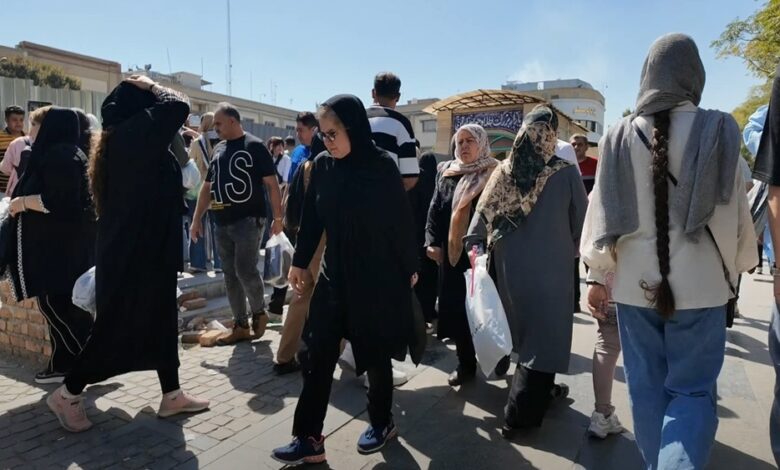
Ordinary Iranians on a crowded city street, August 2025
Three-minute read
Written by
Mansoureh Galestan
On July 15, 2026, a fresh wave of U.S. airstrikes battered southern Iran, hitting the port city of Bushehr and a military base in Iranshahr. The attacks mark a rapid escalation following the formal resumption of hostilities on July 7, which shattered a fragile maritime cease-fire and initiated a full naval blockade. For ordinary Iranians, who survived a brutal 40-day conflict just two months ago, this latest escalation is not merely a geopolitical dispute; it is a direct assault on an already exhausted society.
As the bombs fell, the regime was occupied with stage-managing a delayed state funeral for Ali Khamenei, assassinated in February. Rather than tending to a panicked populace, officials used the televised ceremonies to consolidate the absolute rule of his son, Supreme Leader Mojtaba Khamenei. Against a backdrop of scripted mourning, regime loyalists gathered in Tehran’s Mosalla on July 15, 2026, chanting, “the command is only Mojtaba’s command.” The choreographed display served as a calculated muscle-flexing campaign by the regime’s warmongering faction—closely aligning itself with Mojtaba—to send a sharp, warning shot to its rivals in the ongoing internal power struggle.
This profound disconnect was evident on July 14, 2026, when the regime’s parliament convened under an emergency “red alert” in Tehran. While lawmakers screamed for “revenge,” behind the bravado lay severe panic. Parliament had been closed for five months under the guise of security, leading hardline MP Hamid Rasaee to accuse leadership of dragging the legislative body to “the lowest depths of humiliation”. Deputy Speaker Ali Haji-Babai admitted that gathering 259 lawmakers was “a very big risk” they were taking with their lives.
https://x.com/iran_policy/status/2042475722829099053
A Sociology of Despair and Rage
The regime’s paranoia is fueled by its own internal data showing that the populace has reached a psychological breaking point. A confidential report compiled in May 2026 by presidential social advisor Ali Rabiei—subsequently leaked—reveals that the state’s internal metrics confirm an unprecedented crisis. Rabiei’s report shows that 64 percent of Iranians are gripped by “anger and rage,” a 12 percent surge from December 2025, while half the country suffers from hopelessness and 48 percent endure depression.
This collective fury is rooted in systemic deprivation. According to the state’s own leaked findings, 82 percent of Iranians struggle to secure basic food, and 75 percent cannot afford medical care. This misery is compounded by ecological collapse. On July 13, 2026, southern Iran claimed eight of the ten hottest temperatures on Earth, with Bostan hitting 51.6 degrees Celsius. In Abadan and Bandar Abbas, residents endure 50-degree heat alongside chronic water shortages and blackouts while bombs explode nearby.
The public knows exactly whom to blame for these conditions. World Bank data reveals that the regime flared nearly 30 billion cubic meters of natural gas last year—wasting 65 percent of domestic consumption—while citizens were left without power. “They are taking the Leader’s revenge out on the people of Iran,” an Abadan resident lamented. A dockworker in Bandar Abbas echoed this sentiment: “We want comfort and welfare, just like other people… Death has no cost for the people here”.
https://x.com/iran_policy/status/2048844691106419114
The Retributive State and Academic Defiance
To suppress this domestic powder keg, the regime has deployed its judiciary as an instrument of pure terror. Tehran Prosecutor Ali Salehi announced on July 14, 2026, that all cases related to the recent war and protests had been fast-tracked, resulting in definitive death sentences. This judicial violence triggered immediate defiance: on July 13, 2026, inmates at Karaj’s Ghezel Hesar prison started a hunger strike, protesting the execution of prisoners who turned to crime purely “out of poverty”.
This spirit of resistance continues to thrive on university campuses. Hundreds of students at Alzahra, Sharif, and Beheshti have faced arbitrary suspensions, expulsions, and intimidating anonymous phone calls. At Tehran University, students face disciplinary tribunals for “creating chaos,” often based on files fabricated by the regime’s Basij militia. Yet, the youth refuse to yield, and their academic defiance continues to undermine the regime’s security apparatus.
Ultimately, the state’s military chest-thumping cannot hide its total loss of domestic legitimacy. The leaked Rabiei report admits that a staggering 72 percent of the population demands fundamental change or an outright overthrow of the regime. As temperatures soar, the blockade tightens, and the war escalates, Iran’s society has crossed the threshold of fear. The country is no longer merely in crisis; it is a pressurized chamber where citizens have identified their captors and are bracing for the final, inevitable rupture.