

Two More Security Personnel Killed in Southeast as Wage Basket Hits 91.3 Million Tomans
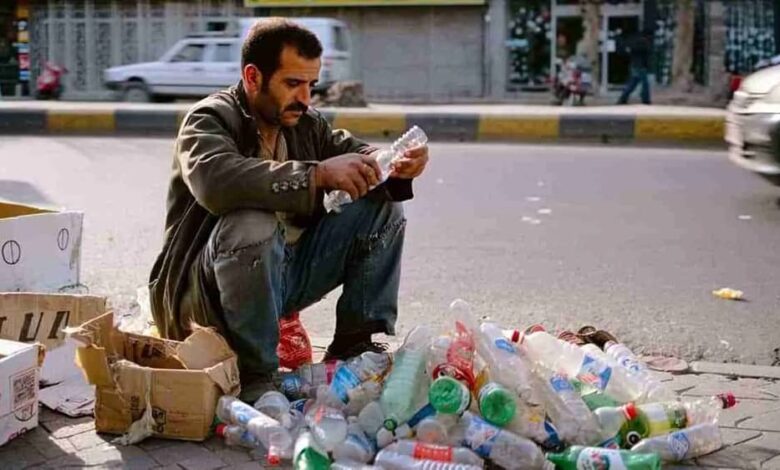
Man crouching on a city street in Iran, sorting through a pile of discarded plastic bottles to scrape together a basic livelihood
Written by
Mansoureh Galestan
Two regime security personnel were killed in separate attacks in Mehrestan, Sistan and Baluchestan, on October 14, extending a run of armed clashes that has continued despite repeated announcements by Tehran that security networks in the province had been dismantled.
Tasnim confirmed that an SSF officer died after gunmen attacked a police vehicle in Mehrestan. The outlet’s initial report emphasized that the attackers withdrew after an exchange of fire; a subsequent report acknowledged that one of the wounded officers died in hospital. Only minutes later, Tasnim confirmed a second killing: Afsaneh Aghila, commander of the Shahideh Afzal women’s Basij district in Mehrestan, was shot outside her home.
The significance lies in the sequence, not the regime’s characterization of the attackers. On October 13, fighting had continued for hours around Taftan and Korin, with reports of heavy weapons, military reinforcements and combat drones. Armed groups also claimed operations around Chabahar. October 14 then brought two more fatalities in Mehrestan. Over less than two weeks, senior or locally important security figures have been killed in Faryab, near Zahedan and now Mehrestan. The geography of the confrontations has also widened from border areas toward Zahedan, Nikshahr, Chabahar and other population centers.
https://x.com/iran_policy/status/2107204251344675310
Even Tasnim’s own follow-up acknowledged that the two deadly Mehrestan attacks had returned attention to the security situation in southern Sistan and Baluchestan and raised questions about the methods and support networks behind armed operations. The harder fact is that successive arrests, executions and declarations that armed cells have been destroyed have not stopped new attacks.
Central Bank declares “resilience” as wages collapse
The security deterioration coincided with a striking contradiction in the regime’s economic messaging. Central Bank governor Abdolnaser Hemmati told the IMF and World Bank meetings in Bangkok on October 14 that suggestions Iran’s economy is collapsing are “nothing more than an illusion,” claiming the economy has demonstrated “very good resilience” despite war, sanctions and external pressure.
Inside Iran, however, figures published by KhabarOnline a day earlier describe a much harsher reality for wage earners. Faramarz Tofighi, a former Supreme Labor Council member, calculated the monthly subsistence basket for a working-class household at 91.3 million tomans using the wage committee’s methodology and Statistical Center figures. He said the statutory minimum wage, which covered approximately 15 days of household expenses when it was approved in March, now covers only eight days. The estimated subsistence basket has increased by about 50 million tomans in six months. Tofighi argued that adding two, three or even five million tomans to wages would no longer address the underlying problem because living costs are rising much faster.
Parliament is also acknowledging the erosion. On October 13, a member of the Majles Budget and Planning Committee said salaries may need to be increased again in the second half of the year if resources can be found, explicitly tying any adjustment to the government’s revenue position. Other MPs have similarly acknowledged that previous wage increases have failed to keep pace with prices and that purchasing power continues to fall.
The contrast with Hemmati’s declaration is therefore substantial. The Central Bank is defending the survival of the macroeconomic system, while regime officials are describing a wage structure incapable of financing even one-third of a month’s basic household needs. The question for political stability is not whether the state can avoid a formal economic “collapse,” but what happens as ordinary income becomes increasingly detached from the cost of subsistence. The erosion of household purchasing power is already producing recurring labor, pension and livelihood protests.
Transport costs expose another pressure point
Pressure is also building in the freight sector. The deputy head of the truckers’ trade association said operating expenses have risen far faster than official freight rates, with costs up by roughly 40% while freight tariffs increased only 26.5%. He said tire prices have risen approximately 200–220% since September last year, alongside increases in oil, spare parts and repairs.
More revealingly, the association said truckers can receive official allocations for tires through the government system only to find that there is no product available for delivery. Its argument was that another freight-rate increase would simply transfer costs elsewhere; unless the price and supply of essential inputs are controlled, higher nominal revenue does not solve drivers’ underlying problem.
That is politically relevant because road freight is one of the sectors capable of transmitting an economic shock rapidly across the country. Higher trucking costs feed directly into food, industrial and retail prices, while shortages of tires and parts can reduce transport capacity itself. It adds another constituency to workers, retirees and small businesses already absorbing the consequences of inflation and supply disruption.
October 14 therefore brought two different forms of pressure into sharper view. In the southeast, armed attacks continue despite expanding security operations and repeated assertions of control. In the economy, the regime claims “resilience” while its own wage and industry figures show household and operating costs racing far ahead of income. The developments each day describe an increasingly volatile social environment in which security setbacks and economic grievances are accumulating faster than the regime is claiming it is addressing them.