
Pezeshkian Warns Fuel Reform Could “Upend Society” as Security Forces Tighten Grip on Markets
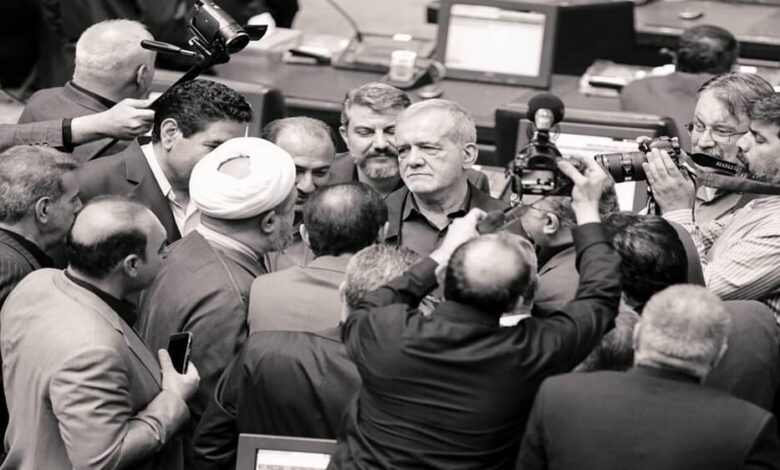
Hardline cleric and MP Hamid Rasaee (white turban, left of center) argues with the Iranian regime’s president Masoud Pezeshkian as journalists and fellow lawmakers crowd around them in Parliament
Written by
Farid Mahoutchi
The Iranian regime’s president Masoud Pezeshkian gave one of the clearest indications yet of the regime’s fear that economic decisions could trigger wider social instability. Speaking on October 12 at the opening ceremony of the academic year at Shahid Beheshti University, he acknowledged that heavily subsidized gasoline prices are economically unsustainable but warned against changing them abruptly. “Everyone knows” gasoline cannot realistically be sold for 1,500 tomans a liter when transportation alone costs roughly 4,000–5,000 tomans, he said. But an immediate intervention, Pezeshkian warned, could “upend the whole society.”
The gasoline warning came amid sharpening infighting inside the establishment. Nobonyad, aligned with the Paydari faction, attacked both Parliament Speaker Mohammad-Bagher Ghalibaf and Pezeshkian, citing a poll it said showed public trust in parliament had fallen below 10% and blaming the chamber’s failure to confront what it called the government’s “ineffective ministers.” The outlet also argued that parliament’s months-long suspension had further damaged its standing.
MP Amir-Hossein Sabeti sharpened that attack by questioning the official security justification for keeping parliament closed. He noted that while the Majles had been suspended “under the pretext of security,” Ghalibaf, SSF chief Ahmad-Reza Radan and other senior figures regarded as potential assassination targets continued to appear publicly at events and before the media.
"At a time when Mojtaba #Khamenei and the upper echelons of Iran’s ruling establishment are urging regime insiders to avoid public feuding, rival factions are doing precisely the opposite," writes @MehdiOghbai.https://t.co/8mLnu5CPU6
— NCRI-FAC (@iran_policy) September 16, 2026
Basic goods move deeper into the security sphere
The government is simultaneously shifting responsibility for shortages and price pressure onto the market itself. On October 12, the Ministry of Industry, Mine and Trade placed 55 categories of goods under anti-hoarding enforcement, including staples such as wheat, flour, oil, meat, chicken, eggs, rice and dairy products, as well as medicine, infant formula and diapers. Tasnim claimed that the measure is intended to prevent withholding and disruption of supply.
The list reaches well beyond food. Medicines and pharmaceutical raw materials, disposable medical supplies and infant formula are included, as are diapers, tires, automobile parts, mobile phones, tablets, laptops, household appliances and solar-power equipment. Steel products, aluminum, zinc, lead, detergents and high-consumption petrochemicals are also covered.
Tehran Economic Security Police chief Mehdi Afshari said on October 12 that enforcement against smuggling and the alleged hoarding of food, fuel and medicine has intensified “especially since the war,” with police patrols expanded accordingly. Nour News reported that the force is also using overt and covert patrols in currency markets. The pattern is politically revealing: instead of changing course, authorities are increasingly casting merchants, traders and informal market actors as security problems to be policed.
When Mojtaba Khamenei forbids the "#IranWar or negotiation” binary, both camps defy him within days. The new Leader’s word is no longer final. The pillar that once capped factional war is fracturing.
Analysis by @MehdiOghbaihttps://t.co/l4x1BQDA5V— NCRI-FAC (@iran_policy) September 1, 2026
Army mobilization follows a week of attacks in the southeast
The deployment of more than 51 Army Ground Forces combat and support units across Iran’s borders is being presented by the regime as defensive readiness, but its timing is significant. Ground Forces commander Ali Jahanshahi said armored, mechanized, artillery, missile, drone and engineering formations had been moved from the northwest and west to the southeast and the Makran coast. The mobilization follows a series of armed attacks in Sistan and Baluchestan that have exposed persistent security problems in the province.
In the days before the deployment was publicized, gunmen attacked an Army minibus near Nikshahr, killing one serviceman and wounding three, while a roadside bomb near Zahedan killed Nosrat Eftekhari, the provincial police command’s deputy for cultural and social affairs. State media also reported earlier attacks on police targets around Golshan/Jalq and Zahedan.
The regime describes these incidents as terrorism and says foreign adversaries are encouraging armed groups in the southeast. Whatever the attribution, the concentration of Army units in precisely the areas where security forces have recently been hit suggests that the buildup is not only about external defense; it also expands the coercive capacity available to contain armed unrest and reassert control in an increasingly contested region.
The broader picture is of a leadership with narrowing room for maneuver. Economic decisions are increasingly judged through the lens of political stability, while internal disputes over responsibility are becoming harder to contain and security forces are being positioned more heavily where the regime has recently faced armed challenges.
That combination matters because repression can suppress symptoms without resolving the underlying pressures. Price controls, anti-hoarding schemes, tighter policing and troop deployments may buy time, but they do not restore purchasing power, rebuild trust or settle factional disputes. The more the regime substitutes coercive management for effective governance, the more each new economic or security shock risks feeding the next rather than being contained in isolation.