
How Iran’s 1988 Massacre Authored a Blueprint for Today’s Shadow War
Written by
Dr. Masumeh Bolurchi
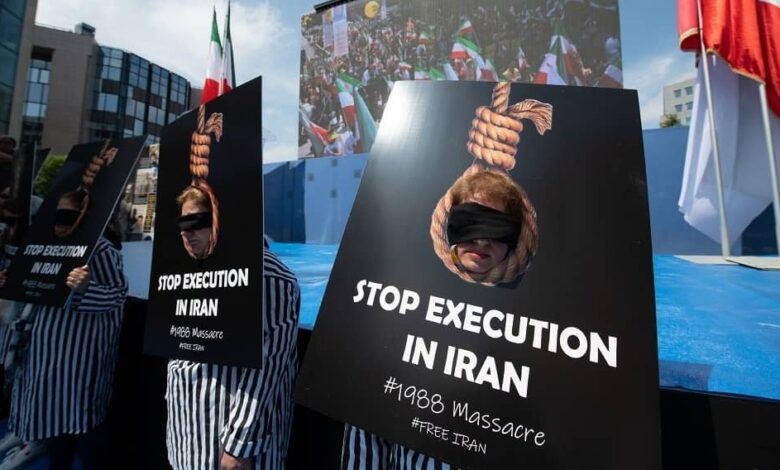
NCRI supporters stage a protest against executions in Iran, highlighting the legacy of the 1988 massacre and calling for accountability and justice
NCRI supporters stage a protest against executions in Iran, highlighting the legacy of the 1988 massacre and calling for accountability and justice
Four-minute read
Today, as the threat of foreign bombardment dominates international headlines, the Islamic Republic of Iran is quietly accelerating a different kind of war. Hidden behind the fog of regional conflict, the regime is currently executing political prisoners at a staggering rate. It is a grim, calculated distraction: draw the world’s eyes to the skies, while the true threat to the ruling clerics—the millions of Iranian citizens demanding freedom—is systematically suffocated underground.
To understand this brutal calculus, one must look back thirty-eight years to a summer when the regime wrote its ultimate blueprint for survival. The playbook we see today was drafted in the blood of the 1988 prison massacres.
The Myth of a Reactionary Purge
For decades, Tehran has peddled a convenient fiction to justify the massacre of more than 30,000 political prisoners within the space of just a few months during the summer of 1988, the overwhelming majority of whom were members and supporters of the People’s Mojahedin Organization of Iran (PMOI/MEK).
The official narrative claims the executions were a frantic, wartime reaction to a cross-border offensive launched on July 25, 1988, by Iran’s National Liberation Army (NLA), known as Operation Eternal Light.
But the historical chronology demolishes that alibi.
https://x.com/A_Jafarzadeh/status/1417181064343302146
On July 18, 1988, Supreme Leader Ruhollah Khomeini accepted United Nations Security Council Resolution 598, ending eight catastrophic years of war with Iraq. He famously called the ceasefire “drinking from a poisoned chalice.” Within twenty-four hours—a full week before Operation Eternal Light even began—the first political prisoners were already being marched to the gallows inside Evin Prison.
The machinery of death had not been sparked by a sudden border skirmish. It had been meticulously engineered months in advance.
The Bureaucracy of Death
Documents and survivor testimonies reveal a chilling bureaucratic buildup that began in the autumn and winter of 1987. Special committees composed of Intelligence Ministry interrogators and prosecutors fanned out across Iran’s carceral geography. They were not conducting standard reviews; they were auditing a hit list.
Every political prisoner was subjected to forced interviews and handed a questionnaire demanding answers to four lethal questions:
Identity: What is your name and charge?
Time: What is the length and remainder of your sentence?
Allegiance: What is your current position toward your organization?
Compliance: Will you appear on state television to condemn your group?
https://x.com/RookmakerDorien/status/1831013120904700090
Those who refused to capitulate—specifically those who insisted on identifying themselves as members of the Mojahedin rather than using the regime’s mandated slur, Monafeqin (hypocrites)—were quietly flagged. These “red lists” compiled in the dead of winter became the execution rosters of the summer.
Simultaneously, a massive logistical shuffling of human lives was underway. Hard-core resisters were transferred to high-security wards in Evin. Prisoners whose sentences had legally expired, but who remained incarcerated were shipped to Gohardasht. In smaller provincial towns, where sudden mass disappearances would alert tight-knit communities, prisoners were moved to larger cities to sow confusion among their searching families.
By the spring of 1988, the pretense was dropped. In Evin, interrogators bluntly told female detainees: “This is our final reckoning with you—either full cooperation or a final determination.” In Tabriz, a Sharia judge casually walked into a political ward and promised, “We will settle all your cases soon.”
The Fatwas of Distraction
When Khomeini issued the fatwa that set the 1988 prison massacre in motion, its intended target was neither vague nor broadly defined. The decree explicitly named the People’s Mojahedin Organisation of Iran (PMOI/MEK), denouncing its members as “Monafeqin” and ordering that all prisoners across the country who remained “steadfast in their support” for the organisation be treated as enemies of God and “condemned to execution.” It did not require proof that an individual prisoner had participated in armed combat, collaborated with Iraq, committed a new offence, or even taken part in any activity while imprisoned.
https://x.com/Maryam_Rajavi/status/1688541268681318400
Continued loyalty to the PMOI/MEK was itself made sufficient grounds for execution, including for prisoners who had already been tried and were serving their sentences. The fatwa further established three-member bodies composed of a religious judge, a prosecutor and an Intelligence Ministry representative, instructing them not to “hesitate,” show mercy or concern themselves with details, but instead to be “most ferocious against infidels.” Although the decree invoked “classical warfare” and alleged collaboration with Iraq’s Baathist government, it made no reference to Operation Eternal Light. As the U.S. State Department confirmed in 2020, the so-called Death Commissions responsible for the enforced disappearance and extrajudicial execution of thousands of political prisoners began their work on 19 July 1988.
A Crime Against Humanity, On the Record
The regime’s internal purge devoured anyone who dared to speak the truth. Grand Ayatollah Hossein Ali Montazeri, Khomeini’s designated successor, wrote anguished letters warning the leadership that they were committing “the biggest crime in the history of the Islamic Republic.” For his conscience, Montazeri was stripped of his succession, placed under house arrest, and erased from the regime’s future.
The message was unambiguous: complicity was the price of political survival. The massacre became the dark glue binding the clerical regime’s factions together.
https://x.com/iran_policy/status/1821637508058243172
Today, that dark glue still holds but is fracturing at an unprecedented pace. The men who sat on those Death Commissions have risen to the very summit of the Iranian government, including the current head of the judiciary and the justice minister. Yet, the veil is finally lifting. In his final report as UN Special Rapporteur on human rights in Iran, Professor Javaid Rehman formally categorized the 1988 killings as “atrocity crimes” constituting crimes against humanity—specifically murder, extermination, torture, and enforced disappearance.
The graves at Khavaran may remain unmarked, but the regime’s true fears are highly visible. When Tehran uses today’s wartime tensions as a smokescreen to hang dissidents in 2026, it is answering the very questions it tries to suppress. The ruling clerics know that their survival is not threatened by foreign adversaries in the skies above. Their existential dread is rooted deep underground, in the buried truths of 1988, and in the millions of beating hearts demanding justice today.