
Massive Execution Surge in Iran Triggering Demands for Urgent UN Action By 309 Global Experts
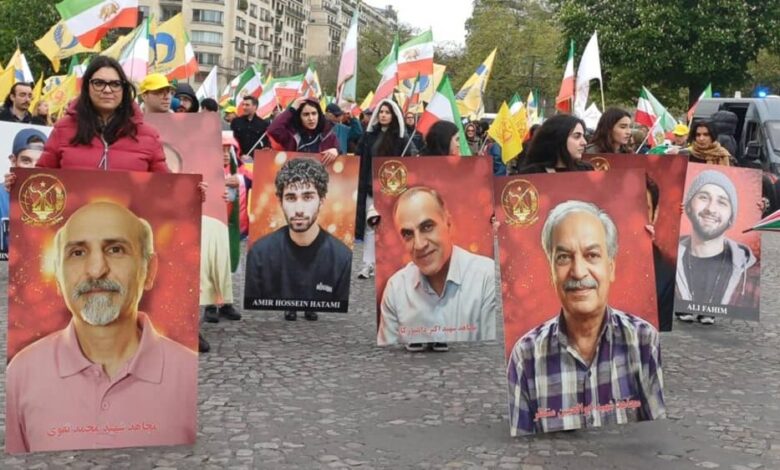
Supporters of the NCRI hold large portraits of executed political prisoners and dissidents during a demonstration, honoring those who lost their lives to state repression— May 2026
Written by
Dr. Masumeh Bolurchi
More than 300 prominent international legal experts, human rights defenders, and Nobel laureates have issued a joint open letter published by Justice for the Victims of the 1988 Massacre in Iran (JVMI) to United Nations Secretary-General António Guterres, raising the alarm over an unprecedented surge in executions in Iran and warning of an emerging pattern of atrocity crimes.
The signatories—including former UN officials, international court presidents, and leading global jurists—warn that Iranian authorities are exploiting recent regional instability to carry out a coordinated, bloody campaign of political repression.
A Forty-Year High in State Terror
According to the open letter, the scale of executions has reached levels not witnessed in nearly forty years. Rights experts highlight that the Iranian regime has used the outbreak of regional hostilities on February 28, 2026, as a smokescreen to intensify mass arrests, torture, and state-sanctioned killings while simultaneously cutting off internet access to suppress domestic dissent and mask information flow to the outside world.
International observers note a highly systemic approach to the current wave of killings:
Targeting Dissidents: Since March 19, 2026, dozens have been arbitrarily executed following summary trials. At least eight political prisoners have been executed solely due to their affiliation with the opposition People’s Mojahedin Organisation of Iran (PMOI/MEK), with at least 11 others currently facing imminent execution on identical grounds.
Mass Arrests: Data compiled by the UN Independent International Fact-Finding Mission on Iran (FFMI) estimates that more than 50,000 protesters have been arrested.
Judicial Overreach: Capital charges such as moharebeh (“enmity against God”) and baghi (“armed rebellion”) are being systematically weaponized. The letter notes that the regime’s Prosecutor General declared all protesters guilty of moharebeh, while the Head of the Judiciary explicitly instructed judges to show “no mercy” in protest-related cases.
A call to stop executions, Now! @AtlanticClubBG https://t.co/EqmZkHul6O
— Dr. Solomon Passy 🇺🇦 (@PassySolomon) May 18, 2026
Deep-Rooted Impunity
The international coalition stresses that this current wave of killings is directly linked to Iran’s long-standing culture of impunity. The letter draws a direct line to the notorious 1988 massacres, during which some 30,000 political prisoners were extrajudicially executed or forcibly disappeared—crimes that the UN Special Rapporteur on Iran concluded in 2024 constitute ongoing crimes against humanity and genocide.
The signatories declared their formal solidarity with internal resistance efforts, specifically referencing the “No to Executions” campaign within Iranian prisons and the broader domestic movement calling for an end to the current system of governance in favor of a democratic republic.
High-Profile Global Coalition
The appeal brings together an extraordinary cross-section of global legal and political heavyweights. Among the 300+ signatories are:
Nobel Laureates: Oleksandra Matviichuk (Peace, 2022), Jody Williams (Peace, 1997), Oscar Arias Sánchez (Peace, Former President of Costa Rica), and several laureates in science and economics.
International Jurists & UN Officials: Sang-Hyun Song (Former President of the ICC), Joachim Rücker (Former President of the UN Human Rights Council), Mogens Lykketoft (Former President of the UN General Assembly), and Javaid Rehman (Former UN Special Rapporteur on Iran).
Legal Leaders: Mark Ellis (Executive Director, International Bar Association) and Cherie Blair (Founder, Cherie Blair Foundation for Women).
The letter has been copied directly to top international stakeholders, including UN High Commissioner for Human Rights Volker Türk, the current UN Special Rapporteur on Iran Dr. Mai Sato, and the FFMI.
More than 300 legal experts, human rights defenders, and Nobel laureates have issued a joint open letter to @antonioguterres & @volker_turk, raising alarm over a sharp escalation in executions in Iran and warning of an emerging pattern of atrocity crimes.https://t.co/dgisfhmvFz pic.twitter.com/p1hmhxcpbG
— Justice for the Victims of 1988 Massacre in Iran (@jvmifoundation) May 18, 2026
Demands for International Accountability
Rejecting international silence as a mechanism that “only reinforces impunity,” the global experts are urging UN Member States to take immediate, tangible diplomatic steps:
Accountability Mechanisms: Establish an international accountability mechanism to enable effective investigations into crimes under international law, utilizing universal jurisdiction to prosecute perpetrators.
Conditional Engagement: Condition all future diplomatic and economic engagement with Iran on a verifiable halt to executions and measurable human rights improvements.
Immediate Relief: Demand that Tehran immediately and unconditionally release all political prisoners and restore unhindered internet access to the general population.