
Fuel Crises, Halting Oil Exports, and Rising Inflation Push Iran Toward Unrest
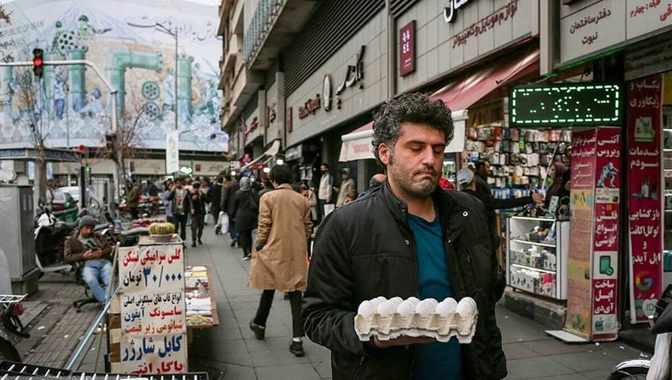
A man carries a tray of eggs through a Tehran market as staple food prices surge, pushing basic items beyond the reach of many households — December 2025
Written by
Amir Taghati
Three-minute read
The clerical regime in Iran is currently navigating one of the most severe economic and political crises in its history. Faced with staggering 80% inflation and a paralyzed domestic infrastructure, the state is increasingly cornered by the consequences of its own disastrous policies. According to an August 19, 2026, report by the state-run Jamaran News, the ongoing economic pressures and the continuous loss of purchasing power pose the greatest threat to national security. The outlet warned that the “accumulation of internal dissatisfactions” is a more pressing danger than external pressures, cautioning that unless public trust is repaired, the nationwide protests of January 2026 could repeat. They stressed that this current crisis must be “the last warning, not the first chapter of a repetition.”
Central to the public’s mounting fury is the chaotic management of fuel. In cities like Kerman, citizens face massive queues, restricted smart fuel cards, and black-market gasoline soaring to 110,000 tomans per liter. Iranian lawmakers are openly expressing panic over the security implications of these sudden policy shifts. On August 19, 2026, Member of Parliament Meybodi sharply criticized the government’s approach, stating, “In the matter of gasoline, they are unfortunately using trial and error again… The bitter experience of 2019 proved to us that overnight decisions made without people’s participation not only do not solve the problem but can turn it into the most acute security issue in the country.”
The regime’s officials appear entirely disconnected from the realities on the ground. Another MP, Haji Deligani, warned on August 18, 2026, about the complete absence of state executives in the public sphere, asking, “How many ministers have gone among the people in the squares and streets so far?” He pointedly added, “With this situation, with this 80% inflation, how can people manage with low income… It seems that the decision-makers around our managers, ministers, and president do not have accurate information from the street level.”
“On the morning after the ceasefire, every exhausted and exasperated mind, long numbed by the #IranWar, will turn instinctively toward the search for real change and the practical means to bring this regime to an end.” https://t.co/8Tmh0Sl0Kc
— NCRI-FAC (@iran_policy) April 9, 2026
Brutal Crackdowns, Executions, and Escalating Repression
To offset the explosive social situation, the regime has dramatically accelerated its domestic suppression apparatus, targeting both the streets and the universities. At Sharif University of Technology, the administration has expanded disciplinary actions, resulting in the expulsion of ten students. The state-affiliated Student News Network (SNN) confirmed on August 19, 2026, that “the expulsion order of 13 insulting students from the March 2026 incidents has become final,” following earlier confirmations by Mehr News on August 16, 2026, and Fars News on June 20, 2026. These expulsions heavily target students involved in protests or active on social media, underscoring the state’s zero-tolerance approach to dissent.
The violence extends far beyond university campuses, manifesting in lethal force against citizens. On August 20, 2026, Pouria Naderi, a 29-year-old protester from the 2022 uprisings and a follower of the Yarsan faith, was fatally shot by intelligence forces in Kermanshah. Naderi had been out on bail and had refused to attend further summons, leading to a brutal ambush that resulted in his death. Concurrently, the regime’s reliance on capital punishment remains relentless. In Khorramabad, crowds gathered outside the central prison on August 20, 2026, desperately attempting to halt the imminent execution of a young prisoner, Mohammadreza Rezaei, who was abruptly transferred to solitary confinement the day before.
“The Iranian regime is confronting its most severe economic crisis in years, with basic food prices doubling in months, the national #currency in freefall and the government forced to let citizens buy essentials on credit backed by future subsidies,” writes @MansoreGolestan.…
— NCRI-FAC (@iran_policy) April 29, 2026
The Failure of Diplomacy and the Oil Export Collapse
Faced with fierce internal factionalism, Foreign Minister Abbas Araghchi used an August 18, 2026, interview to direct desperate messaging toward hardline rivals within the regime who fiercely oppose negotiations—including factions aligned with Mojtaba Khamenei. By framing the recent Islamabad negotiations from March 13 to June 15, 2026, as a hard-won triumph, Araghchi sought to convince his internal foes that those advocating for talks have the regime’s survival at heart, aiming to secure vital breathing space to push for more sanctions relief and ease crushing economic and social pressures. He heavily emphasized President Masoud Pezeshkian’s unwavering loyalty to the late Supreme Leader and his “stubborn support” for the negotiating team when the Americans initially demanded complete surrender. However, this defensive posturing masks the undeniable collapse of the regime’s global strategy.
The reality of Iran’s diplomatic and economic isolation was laid bare by the Central Bank Governor, Abdolnaser Hemmati. Speaking on state television on the evening of August 19, 2026, Hemmati admitted that Iran’s oil exports have entirely stopped due to the renewed US naval blockade. “The difference between us and countries like Qatar and Iraq is that they have access to their reserves, but our reserves have been blocked by the Americans,” Hemmati confessed, adding that no frozen assets were released under the Islamabad memorandum.
“As #IranProtests spread from main avenues to individual blocks, Tehran’s reliance on neighborhood militarization reveals an isolated dictatorship fighting for survival against its own populace,” writes @HakamianMahmoud.https://t.co/3AFUQwTkPr
— NCRI-FAC (@iran_policy) August 16, 2026
The clerical regime finds itself trapped in a terminal cycle. From the catastrophic drop in oil revenues—depriving the state of $4.8 billion in just two weeks—to an enraged populace standing in fuel lines and organizing against state executions, the systemic failures are glaring. The regime’s attempts to utilize shock-therapy economics, combined with violent crackdowns on dissenting students and citizens, offer no permanent stability.
As economic ruin collides with unbroken civil resistance, the ongoing crisis within the clerical establishment is rapidly evolving from a latent vulnerability into an inescapable systemic reckoning.