
Hunger Strike in 56 Prisons Marks 117th Week of “No to Executions” Campaign in Iran
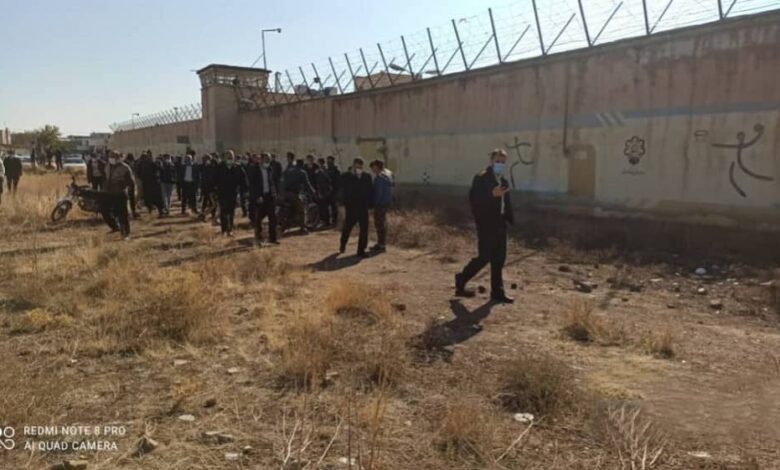
Security forces inspect the outer perimeter of Chubindar Prison in Qazvin, north-central Iran
Written by
Safora Sadidi Mohammadi
Political prisoners across Iran launched a coordinated hunger strike in 56 prisons on Tuesday, marking the 117th consecutive week of the “No to Executions Tuesdays” campaign, as concerns grow over an accelerating wave of executions.
In a statement issued on the same day, the campaign warned of a sharp increase in death sentences and executions, declaring: “We hold the 117th week of the campaign while just yesterday the ruling authorities executed two more political prisoners.”
The campaign described the executions as part of a broader effort to suppress dissent, stating that authorities are attempting to justify them by linking detainees to foreign actors: “They desperately try to accuse these prisoners of espionage and links to Israel to justify executions under wartime conditions.”
It added that such accusations are “baseless” and have instead “further intensified public anger.”
🚨 Iran News Alert
Images of 12 detainees recently identified by the Iranian opposition. According to these reports, they are under immense pressure.
Amid a broader escalation in executions and pressure on political prisoners, concerns continue to grow over their fate. https://t.co/oHVUThmFAY pic.twitter.com/4A2zRPvfQP
— SIMAY AZADI TV (@en_simayazadi) April 21, 2026
Violent raid on political prisoners in Ghezel Hesar Prison
The statement also revealed new details about a violent crackdown inside Ghezel Hesar Prison, one of the country’s largest detention facilities. According to the report, on the night of March 29, dozens of prison forces carried out a raid on Ward 4, targeting political prisoners—many of whom were members of the campaign.
“They attacked the ward in a brutal and inhumane manner, beating prisoners and transferring all of them to solitary confinement.”
The campaign stated that six prisoners were subsequently executed: “They were hanged while their legal process had not yet been completed, without a final meeting with their families and in complete secrecy.”
The statement identified those executed as including Vahid Bani Amerian, Pouya Ghobadi, Akbar Daneshvar Kar, Babak Alipour, Mohammad Taghavi, and Abolhassan Montazer.
Political prisoners in 56 prisons mark the 117th week of the #NoDeathPenaltyTuesdays hunger strike against executions and systematic repression in Iran.
At least 12 political prisoners were executed in secrecy from March 21 to April 20; dozens remain in solitary confinement at…— IRAN HRM (@IranHrm) April 21, 2026
Executions carried out without notice, families denied information
The campaign further reported additional executions carried out under similar conditions. It stated that four detainees from the January 2026 protests were also executed “in complete secrecy and without prior notification,” naming them as: Amirhossein Hatami, Mohammad Amin Biglari, Shahin Vahedparast, and Ali Fahim.
According to the statement, authorities have refused to return the bodies of those executed: “The authorities have not handed over the bodies to their families, subjecting them to psychological torture.”
The campaign also cited figures indicating that at least 12 political prisoners were executed in April alone, describing it as a systematic escalation.
Prisoners across 56 Iranian prisons hold 117th week of ‘No to Executions Tuesdays’ following 52-day blackout https://t.co/XB65lxbQrI
— People's Mojahedin Organization of Iran (PMOI/MEK) (@Mojahedineng) April 21, 2026
Campaign warns of systematic use of executions to suppress unrest
The statement links the surge in executions to broader political conditions, arguing that authorities are using the current environment to intensify repression.
“At a time when war and its consequences dominate the situation, the authorities carry out systematic executions to create fear and prevent uprising.”
It added that many detainees from recent protests remain in solitary confinement: “Dozens of young prisoners are being held in isolation… and their lives are in serious danger.”
The campaign emphasized that the demand to end executions reflects a wider social sentiment, describing it as “the public demand of the people of Iran.”
117th Week of #NoToExecutionTuesdays
After 52 days of blackout, the campaign resumes in 56 prisons across Iran“Yesterday, two political prisoners — Hamed Validi and Mohammad Masoumi Shahi — were executed.”
“At least 12 political prisoners have been executed since the start of… pic.twitter.com/X8td9aaERx— SIMAY AZADI TV (@en_simayazadi) April 21, 2026
Call for action as protests continue inside prisons
Marking the 117th week of coordinated action, the campaign confirmed that prisoners in dozens of facilities—including Evin, Ghezel Hesar, Greater Tehran, and Adelabad—are participating in the hunger strike.
It called on international organizations to intervene: “We call on all human rights institutions and international bodies to take urgent and practical action to save the lives of political prisoners under death sentences.”
At the same time, it urged continued protest despite restrictions: “We ask all activists… not to be intimidated and to protest in any possible way against these executions.”
The statement concluded with a message underscoring the persistence of the movement: “The future belongs to those who have paid the price for freedom.”