
Reza Pahlavi’s Berlin Visit Draws Sharp Rebuke from German Leaders and Iranians
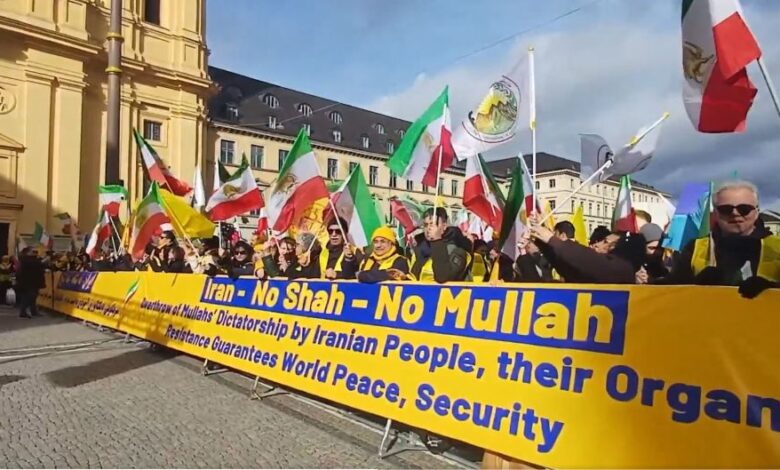
Iranian Resistance Calls for Democratic Republic at Munich Security Conference: No to Shah, No to Mullahs
File photo
Written by
Mahmoud Hakamian
On April 23, 2026, Reza Pahlavi, the son of Iran’s deposed dictator, descended on the German capital for a carefully staged press conference and private meetings with some Bundestag lawmakers. Far from the desired photo-ops, the visit stands as a stark reminder of how remnants of the old monarchy, backed by certain Western political currents and amplified by Tehran’s divide-and-rule tactics, continue to obscure the genuine popular demand for a secular democratic republic.
The backlash was swift and authoritative. On April 21, twenty-one of Germany’s respected voices — including former UN Human Rights Council President Ambassador Dr. Joachim Rücker, Prof. Dr. Horst Teltschik (longtime Munich Security Conference chairman and adviser to Chancellor Helmut Kohl), former Bundestag members Leo Dautzenberg, Martin Patzelt, Thomas Lutze and Sandra Weeser, and prominent academics and human-rights figures — published an uncompromising open letter to Bundestag President Julia Klöckner and all faction leaders. The document, now circulating in German media, delivers a devastating indictment: granting Pahlavi any platform risks “legitimizing an authoritarian political model and undermining the genuine democratic aspirations of the Iranian people.”
The signatories refuse to indulge Pahlavi’s revisionist nostalgia. He has repeatedly declared himself “proud” of his family’s record without once condemning the ethnic massacres, one-party dictatorship, systematic torture, political repression and omnipresent surveillance imposed by his father’s secret police, the SAVAK. As the letter rightly notes, welcoming such a figure is “an insult to the millions of Iranians who overthrew the dictatorship of the shah” in 1979. In February 2026, Pahlavi went further, branding a Kurdish political alliance fighting for a secular, democratic Iran as “separatists” and openly suggesting the army should suppress them after regime change — rhetoric that mirrors the repressive playbook of both the Pahlavi monarchy and the current theocratic regime.
…Reza Pahlavi im Bundestag? Keine gute Idee. @JuliaKloeckner #Iran pic.twitter.com/UblN8OmRIf
— Joachim Ruecker (@jrstoc) April 21, 2026
Even more alarming is Pahlavi’s repeated calls for foreign military intervention and bombing campaigns against Iran, which would inflict heavy civilian casualties. The letter warns that such positions raise grave questions under international law and national sovereignty. His so-called “transitional phase” is equally authoritarian: executive, judicial and legislative powers would be concentrated through personal appointments under his own authority, bypassing popular vote and institutional pluralism. Most dangerously, Pahlavi has signaled readiness to cooperate with “security elements” of the clerical regime — especially the Islamic Revolutionary Guard Corps (IRGC), the very force responsible for mass executions and the crushing of protests. Far from overthrowing the executioners, he risks empowering them.
The German federal government, to its credit, has refused to play along. Foreign Minister Johann Wadephul and the Foreign Office have explicitly stated there will be no official meetings, describing Pahlavi as nothing more than a “private person” whose future for Iran must be decided by Iranians themselves. Yet some Bundestag members — including Armin Laschet, chair of the foreign-policy committee — proceeded with private sessions, giving the monarchist camp the photo opportunities it craves.
Eilmeldung:
Empörung in Deutschland über Pahlavi-Besuch: 22 Persönlichkeiten und Diaspora-Gruppen warnen vor Legitimierung
Berlin (ots) · Eine Gruppe von 22 deutschen Persönlichkeiten hat sich gemeinsam mit mehr als zwei Dutzend deutsch-iranischen Gemeinschaften im ganzen Land…— Dowlat Nowrouzi (@DowlatNowrouzi) April 21, 2026
Reza Pahlavi defends all of the Shah’s dictatorial actions
Iranian voices inside Germany have been even more outspoken in their outrage. More than two dozen German-Iranian community organizations — representing thousands of exiles who fled the Shah’s tyranny and later the mullahs’ — issued parallel statements sharply condemning the visit. Groups including the Gesellschaft von Deutsch-Iranern (chaired by Hossein Yaghoubi), Verein „Junge Stimmen“ (spokesperson Sania Kohansal), the Union Exil-Iranischer Gemeinschaften in Deutschland (chaired by H. Ghiassi-Maasser), and Kurdish associations warned Bundestag members that any engagement with Pahlavi risks legitimizing “a deeply divisive figure who does not represent the aspirations of the Iranian people.” They stressed that Pahlavi’s refusal to distance himself from SAVAK’s crimes and his recent praise for his father’s record constitute a direct insult to the millions who toppled the monarchy in 1979.
Kurdish-Iranian organizations, in particular, voiced bitter memories of genocidal policies and ethnic massacres under Reza Pahlavi’s father and grandfather, rejecting any notion that the monarchy could ever guarantee pluralism or minority rights. On social media, Iranian exiles amplified the message with raw urgency. Activist Nazli declared: “Berlin must cancel all invitations to Reza Pahlavi. Iran does not need another crown, another war, or another dictatorship.”
The events of April 23 lay bare a deeper truth: more than four decades after the 1979 revolution, the Iranian people’s struggle for freedom is still under the threat of being hijacked — this time by a combination of nostalgic monarchists, opportunistic Western actors and the regime’s own cynical propaganda. While Pahlavi’s entourage celebrates photo-ops in the Reichstag corridors, the real voice of Iran — the millions who have risked everything chanting “Death to the Dictator” or “Death to the oppressor, be it the Shah or the leader” — continues to be sidelined.
Herta Däubler-Gmelin: It is concerning to see political powers attempting to reinstitute the former Shah’s son, especially given his recent press statements praising his father's rule. As someone who remembers the Shah’s era well, I recall the brutal reality of the SAVAK security… pic.twitter.com/bvZMNPZSUu
— NCRI-FAC (@iran_policy) April 22, 2026
Berlin’s decision to limit the visit to private meetings is a small but necessary rebuke. Yet the episode should serve as a warning to European parliaments and governments: engaging with figures who refuse to break cleanly with dictatorship only prolongs the suffering of the Iranian people and delays the democratic transition they have already paid for in blood. The path forward is not a restored throne in Washington or London, but the sovereign will of Iranians themselves — expressed through the organized resistance that has consistently rejected both the Shah and the Supreme Leader.