
Iran Protests Spread Across Seven Provinces as Retirees and Oil Workers Demand Economic Justice
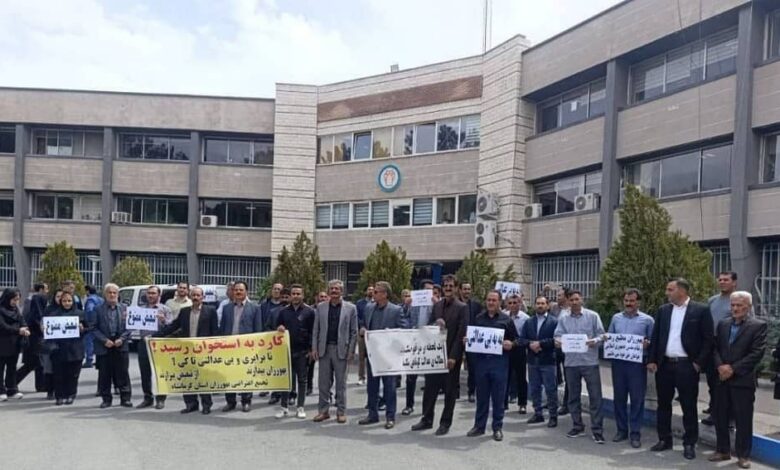
Health workers and rural clinic staff protest in Kermanshah, western Iran, over discrimination, injustice, and mismanagement by the Ministry of Health – April 13, 2025
Written by
Sedighe Shahrokhi
Protests erupted across Iran on Sunday, April 13, 2025, as retirees from the Social Security and Steel Pension Funds, alongside oil industry workers, held simultaneous rallies in at least eight cities spanning seven provinces. Demonstrators denounced the regime’s failure to raise pensions in line with inflation, condemned the collapse of pension funds, and called out the empty promises of both the government and parliament.
In Ahvaz, southwest Iran, retirees of the Social Security Organization marched in the streets to protest low pensions and worsening living conditions. In Shush, also in Khuzestan Province, pensioners staged a protest to demand higher pensions and access to basic services. Protesters chanted slogans such as, “Only the streets will bring us our rights,” and “Until we get our rights, we will not rest.”
In Kermanshah, western Iran, Social Security retirees resumed protests, chanting, “The enemy is here, they lie saying it’s America,” directly blaming the regime for their deteriorating conditions. They also shouted, “Free imprisoned workers” and “The national treasury is a playground for thieves.”
April 13—Shush, southwest Iran
Retirees of the Social Security Organization hold protest rally, reiterating their demands for higher pensions and basic services.#IranProtestspic.twitter.com/V2AYWQnU2Z— People's Mojahedin Organization of Iran (PMOI/MEK) (@Mojahedineng) April 13, 2025
In Isfahan, central Iran, steel retirees marched again this week to reiterate demands for decent pensions and basic necessities. Their chants included, “The bankrupt government is the enemy of retirees,” as they condemned the regime’s refusal to honor its commitments.
In Qaemshahr, in northern Mazandaran Province, steel retirees gathered in front of the Steel Retirement Fund office to protest the government’s failure to adjust pensions according to soaring prices. Similarly, in Tehran, retirees rallied in front of the Steel Fund’s local office to protest unfair pension policies and the regime’s refusal to tie pensions to actual living costs.
In Gachsaran, southwest Iran, contract workers of the Gachsaran Oil and Gas Company rallied in front of the main office to protest the regime’s refusal to address demands for permanent employment and the elimination of exploitative subcontractors. Their banner read, “Endless promises won’t deceive us anymore!”
April 13—Isfahan, central Iran
Retirees of the steel industry resume weekly protest rallies to reiterate demands for higher pensions and basic needs.
Protesters chant, "The bankrupt government is the enemy of retirees."#IranProtestspic.twitter.com/fRvdKs2lXC— People's Mojahedin Organization of Iran (PMOI/MEK) (@Mojahedineng) April 13, 2025
In Sari and other cities in Mazandaran, steel retirees demanded immediate payment of overdue pensions and warned that the government’s “empty promises” would no longer be tolerated.
The protests followed weeks of growing mobilization by pensioners and workers, and came just days before a planned rally by retired oil workers in front of the Ministry of Petroleum in Tehran on April 16. Organizers have declared that they will not back down, stating, “Our rights will be claimed in the streets, not through appeasement.”
In a separate incident, a report from a local human rights outlet confirmed that regime military forces violently arrested at least 15 Baloch civilians, including four women, on April 12 in the Ladiz district of Mirjaveh, southeastern Iran. The detainees, many of whom have lived in the area for years without national ID documents, were reportedly accused of being “Afghan nationals” and taken to an unknown location. Eyewitnesses described the arrests as aggressive and said most of those detained were local villagers.
April 13—Qaemshahr, northern Iran
Retirees of the steel industry resume weekly protest rallies in front of the offices of the Steel Retirement Fund in Mazandaran to reiterate their demands for higher pensions according to the rising costs of living.#IranProtests pic.twitter.com/UkLqHz1XF0— People's Mojahedin Organization of Iran (PMOI/MEK) (@Mojahedineng) April 13, 2025
Despite years of promises, regime authorities have failed to deliver on economic reforms or pension justice. As living conditions worsen, retirees and workers are returning to the streets with renewed resolve, amplifying their demands in a country where public dissent is often met with repression. With over 3,700 labor-related protests recorded across Iran last year alone, the latest unrest underscores the growing urgency of economic collapse under the clerical regime.