
Maryam Rajavi: Jesus Christ, the Harbinger of Justice and the Eternal Beacon of Hope for the Salvation of Humanity
Written by
Staff Writer
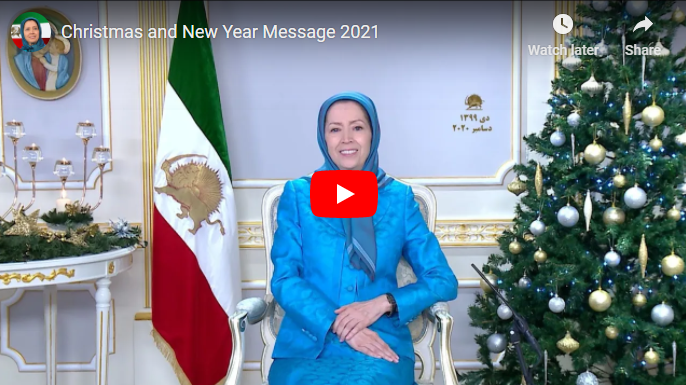
Christmas Message
Fellow Christian compatriots,
Followers of Jesus Christ around the world,
Merry Christmas to all of you. My heartfelt prayers for a speedy recovery of all those who have been infected with the Coronavirus in Iran and in other countries, and for the rapid eradication of this virus.
Merry Christmas to all.
This time symbolizes the period when the world’s eyes were opened to Jesus Christ (PBUH), who would become the messenger of unity and liberation, the harbinger of justice and the eternal beacon of hope for the salvation of humanity.
This auspicious time was borne out of the tremendous suffering of the Virgin Mary.
Mary sacrificed immensely for Christ (PBUH) and braved poisonous slanders, leading her to become a model of emancipation for all future generations.
As she said herself: “From henceforth all generations shall call me blessed.” (Luke 1:48)
The birth of Christ shines bright in the sky, like a star, bringing the downtrodden the good news of Mary giving birth and promising a world of love and justice.
Christ’s message guides struggle against religious dictatorship
But “the Son of Man did not come to be served, but to serve, and to give his life as a ransom for many.” (Mark 10:45)
This description of Jesus, son of Mary, serves as a guiding light for the Mojahedin (PMOI/MEK) and the courageous Resistance Units, and all the Mojahed and combatant prisoners in Iran who have risen to overthrow the most evil enemy of God and his people, namely, the mullahs’ religious dictatorship.
Christ’s message guides the impoverished but conscious youths who are eager to rise up again to overthrow the mullahs.
And it is a message that guides all those who make sacrifices to save the deprived and the homeless from the Coronavirus.
Although this year, Christian families are deprived of seeing and being with each other because of the pandemic, and although this Christmas is intertwined with the loss of a number of our friends and nearly 200,000 of our compatriots in Iran, there is still hope and joy in the future of enchained humanity.
May health, happiness, joy, and excitement fill the lives of the oppressed thanks to the momentous birth of Jesus Christ.
May the Iranian Resistance, the uprising of the people of Iran, and the struggles of the Mojahedin and “toilers for justice” bring freedom and liberty to Iran.
“Blessed are those who are persecuted because of righteousness, for theirs is the kingdom of heaven.”
Praise be to Jesus Christ
Hail the Blessed Virgin Mary
Maryam Rajavi’s #Christmas Greetingshttps://t.co/ffBjO8WquF
— Maryam Rajavi (@Maryam_Rajavi) December 24, 2020
#MerryChristmas to all of you. My heartfelt prayers for a speedy recovery of all those who have been infected with the #Coronavirus in #Iran and in other countries, and for the rapid eradication of this virus.https://t.co/cwYaGHEpgV
— Maryam Rajavi (@Maryam_Rajavi) December 24, 2020