

Iran’s Economic Ruin, Internet Blackout, and the Regime’s Digital Iron Fist
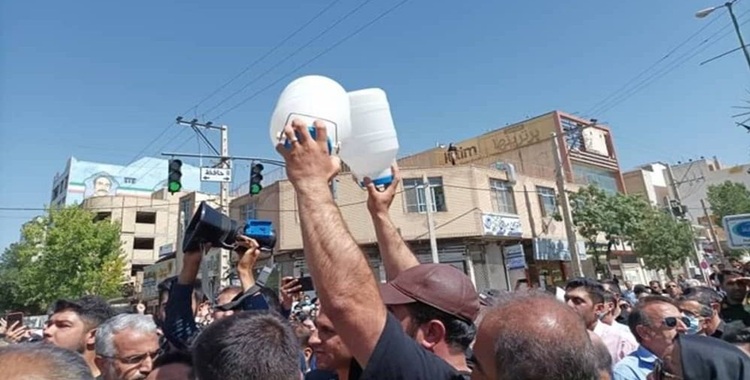
Residents of Shahr-e Kord, western Iran, rally with handwritten signs and chants demanding drinking water solutions and accountability from local officials, August 16, 2022
Written by
Amir Taghati
In the shadow of a devastating war and under the weight of one of the longest internet shutdowns in modern history, Iran’s clerical regime is confronting a perfect storm of economic disintegration, grassroots protests, and international isolation. For the fourth consecutive day, railway technical workers in Lorestan’s Doroud took to the streets on May 4, 2026, demanding the return of the Travers company to full state control and the resolution of five years of contractual limbo for some 7,000 employees.
This localized revolt mirrors a nationwide implosion documented in official statistics and independent reporting alike. Meat consumption per Iranian household has plummeted from 2.8 kilograms per month in 2011–12 to just 1.25 kilograms in 2024–25, according to the latest data from Iran’s Statistical Center—less than half the previous level. FAO estimates for 2025 confirm the broader protein crisis: red-meat consumption fell 7 percent to 724,000 tons, while chicken consumption, long a cheaper substitute, also declined slightly to around two million tons. “Iranian families can no longer afford even chicken,” the reports note grimly.
Labor Unrest and Economic Freefall
The energy sector, already strained before the war, has entered what officials themselves call “a hard year.” Esmail Sagheb-Isfahani, deputy to President Pezeshkian and head of the Energy Optimization Organization, admitted on May 6: “If I want to speak honestly with the people, to the same extent that damage has been inflicted, we face a hard year ahead.” He confirmed that restoring pre-war energy capacity will take 18 to 24 months, while power shortages—already severe—have worsened. Minister of Energy Abbas Aliabadi could not guarantee the country would pass the year without blackouts, citing nearly 5,000 MW of damaged generation capacity.
"The Iranian domestic landscape is currently defined by a profound socio-economic rupture, as the nation grapples with the catastrophic aftermath of a forty-day #IranWar on top a four-decade confluence of systemic corruption, plunder and negligence," writes @MansoreGolestan.…
— NCRI-FAC (@iran_policy) May 4, 2026
Housing and currency crises compound the misery. In major cities, 50 to 70 percent of household income now goes to rent, according to economist Ghadir Mahdavi of Allameh Tabataba’i University. Roughly 55 percent of tenants lack “affordable housing.” In Yazd’s historic Hassanabad neighborhood alone, more than 20,000 people live as “god-neshin”—pit-dwellers—in abandoned brick-kiln tunnels and substandard underground spaces, according to Fereydoun Baba’i Eqdam of the Urban Regeneration Company.
The rial’s collapse reached a new nadir on May 4, 2026 when the dollar breached 190,000 tomans before security forces intervened, restricting official exchange and disrupting price-reporting websites. Industrial damage from the war is staggering: Economy Minister Madanizadeh revealed that 3,000 industrial units were affected, including 500 completely destroyed.
"Iranian state media and insiders reveal a regime that possesses no real internal strength, economic resilience, social capital, or diplomatic cards left to play. It is openly counting on political turmoil inside the #UnitedStates and the global headache of disrupted shipping and…
— NCRI-FAC (@iran_policy) May 4, 2026
Women Hit Hardest as Unemployment Soars
Official unemployment figures, already at 7.6 percent pre-war (two million jobless), is now estimated at 15–20 percent after another two million lost work. Large firms—steel, auto, petrochemical—have slashed production; startups and SMEs report 40–60 percent workforce cuts. Even Digikala, Iran’s largest online retailer, conducted mass layoffs. Women have borne the brunt of the employment shock. An independent report by the news site Avish states that “women are the first victims of layoffs and job insecurity.” In the informal sector, the gender pay gap reaches 40 percent for identical work. Female university graduates face twice the unemployment rate of male peers.
To stifle dissent amid this collapse, the regime has imposed a digital blackout now in its 68th day as of May 5, 2026, with 1,608 hours of disrupted global internet access recorded by NetBlocks. Citizens have spent roughly 70 percent of 2026 so far without normal connectivity. The economic toll: approximately $5.2 billion, according to Donya-ye Eghtesad. Even regime insiders concede the policy’s cost. MP Amir-Hossein Sabeti admitted the Supreme National Security Council ordered the shutdown “because many nuclei of rebellion… were seeking to destabilize the country.”
"Iran’s economy is spiraling under the combined weight of a prolonged #digital blackout, collapsing agricultural output, a collapsing currency, and a near-total halt in oil exports, according to multiple domestic and international reports compiled in recent days,"…
— NCRI-FAC (@iran_policy) May 2, 2026
Repression Intensifies Behind the Blackout
Deputy Communications Minister acknowledged that full disconnection is “the most expensive scenario for the economy,” while the head of the ICT Guild’s internet commission warned of daily losses of 3–5 trillion tomans and accelerated layoffs. Judiciary authorities in Hamadan confiscated assets of 40 individuals labeled “traitors to the homeland” and “key figures in the enemy-collaboration network,” claiming the proceeds would rebuild war-damaged hospitals and schools. Similar seizures hit others in Semnan under the new “Law on Intensifying Punishment for Espionage and Cooperation with the Zionist Regime.”
In prisons, female political detainees from the January 2025 uprising endure dire conditions. Shiva Esmaili and Elaheh Fouladi received six-month additional sentences for protesting the death of Somayeh Rashidi in Qarchak prison. In Yazd and Mashhad’s Vakilabad, dozens of women protesters are held in substandard quarantine wards alongside common criminals, suffering poor ventilation, sewage odors, and medical neglect. The torture death of Hesam Alaeddin—arrested for selling phones and owning Starlink equipment—has been reported under heavy security.
Amid global outrage and criticism of a wave of executions in Iran, Gholam-Hossein Mohseni-Eje’i unleashed a furious tirade on April 30, 2026, broadcast live through Mizan News Agency and vowed to proceed with the regime's #HumanRightsViolations.https://t.co/OuB5IBjW4j
— NCRI-FAC (@iran_policy) May 1, 2026
Nuclear Ambitions and Regional Isolation
On the international front, the regime’s nuclear ambitions and regional adventurism have drawn unified condemnation despite its dangerously weakened military position. At the NPT Review Conference in New York, EU and Western representatives declared that “Iran must never acquire nuclear weapons.”
Also, the EU, Canada, UK, France, Germany, Saudi Arabia, Bahrain and others condemned Iran’s missile and drone attacks on the UAE as “unjustified” and “a clear violation of international law.”
On the Strait of Hormuz, however, the regime’s rhetoric stays defiantly bellicose. Parliament Speaker Qalibaf claimed “the new Hormuz equation is being stabilized,” while Foreign Minister Araqchi called Washington’s project a “project of impasse.”
The regime’s continued warmongering stems from deep fragility. Fearing that any sign of backing down would ignite its explosive domestic society and expose weakness to an outraged region and world, Tehran doubles down on belligerence abroad while intensifying repression at home.
While the regime continues to prove its aggressive behavior through defiant rhetoric and crackdowns, Iran’s angry society and the global community are responding with mounting domestic protests, growing international isolation, and unrelenting pressure. With meat off the table, rents devouring incomes, factories shuttered, the internet dark, and protests spreading, the clerical establishment’s grip on power rests on ever-thinner ice.
Iran’s Economic Ruin, Internet Blackout, and the Regime’s Digital Iron Fist