

How Iran’s Clerical Regime Rebuilt SAVAK into a Global Repression Machine
Written by
Mohammad Sadat Khansari
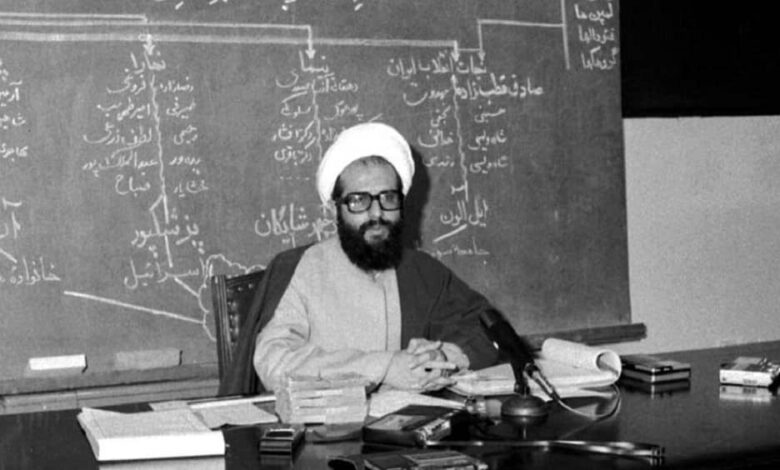
Mohammad Mohammadi Reyshahri, the first Minister of Intelligence of the Iranian regime, sits in front of a blackboard displaying a chart outlining the ministry’s targets
Four-minute read
The fall of the Shah in 1979 was widely seen as the end of SAVAK, Iran’s dreaded secret police. However, rather than dismantling this notorious organization, the clerical dictatorship absorbed its core structure and expertise, turning it into one of the most feared intelligence services in the world. Official Iranian sources, along with historical investigations, reveal that SAVAK’s anti-espionage and foreign intelligence units were repurposed to serve the new regime. This report examines how Iran’s ruling clerics leveraged former SAVAK operatives to create a surveillance state that continues to target dissent at home and abroad.
SAVAK’s absorption into the clerical dictatorship
Iranian state television aired a revealing segment on February 2, 2025, in which Iman Goudarzi, a documentary filmmaker, stated: “SAVAK had eleven divisions; only one was dismantled after the revolution. The rest remained intact and pledged allegiance to Imam Khomeini before the fall of the Shah.”
This claim corroborates multiple sources suggesting that the clerical dictatorship did not purge SAVAK but instead repurposed its foreign intelligence, counterintelligence, and technical surveillance units.
In an interview published by Donya-e-Eqtesad on March 6, 2023, a former high-ranking SAVAK counterintelligence officer revealed: “The revolutionaries approached us and asked for our expertise. They wanted to know how to maintain national security without relying on Western intelligence. The counterintelligence unit once focused on Soviet spies, was restructured to handle ‘domestic enemies’ under the new order.”
The current MOIS was built
on the backbone of the Shah’s brutal SAVAK. Former high ranking SAVAK officials were the first to fill the ranks of the infamous Iranian Ministry of intelligence which has carried out countless terror attacks across the world. #Iran #IranRevolution… pic.twitter.com/o1qbTBkNrB— Facts on Iran (@FactsOnIran) June 16, 2023
Similarly, in a report by ISNA on October 13, 2019, early Ministry of Intelligence (MOIS) members admitted to recruiting SAVAK personnel: “Many of us knew that without a centralized intelligence system, the revolution would collapse under external threats. So, we reached out to former SAVAK operatives, particularly from the anti-espionage unit.”
A former MOIS official Saeed Hajjarian said in 2019: “We initially functioned as multiple competing intelligence units. It was only after 1984 that MOIS became the dominant force, absorbing SAVAK’s best assets.”
Despite MOIS’s dominance, Iran’s intelligence operations remain fragmented. Former Iranian Minister of Intelligence Mohammad Reyshahri (1993) noted: “Many intelligence functions were still controlled by IRGC Intelligence, making it difficult to create a unified strategy.”
This fragmentation continues to allow different factions within the Iranian regime to use intelligence services for political purges and factional disputes.
Domestic Surveillance & Torture
The clerical dictatorship’s intelligence services retained and refined the brutal interrogation and torture methods originally pioneered by SAVAK. This continuity was exemplified by figures like Javad Azadeh, a professional interrogator whose reputation for cruelty spanned both the Shah’s and the Islamic Republic’s security apparatus. During the Ahmadinejad era, Azadeh resurfaced in Iran’s intelligence circles, applying his expertise in extracting forced confessions. As an Italian report noted in 2009, his methods left no room for failure: “Javad’s techniques knew no limits. He ensured that spies, mullahs, and rebels all broke under his hands. No temperament, no matter how resilient, could resist him.”
THREAD
For more than four decades, the clerical regime in #Iran has consistently blackmailed other nations and considered #extremism as "leverage". 1/9https://t.co/ieaaOkZb6y pic.twitter.com/W9u5BJHXqs— NCRI-FAC (@iran_policy) September 6, 2022
Shah’s Intelligence Machinery to Hunt Dissidents
The transition of SAVAK was a calculated decision at the highest levels of the regime, including the former Supreme Leader Ruhollah Khomeini himself, who ensured that key intelligence officers were not only spared but reassigned to critical positions within the Ministry of Intelligence and Security (MOIS) and the Islamic Revolutionary Guard Corps (IRGC) Intelligence Organization.
According to Darius Rejali’s 1994 study on torture in Iran, the new regime’s intelligence apparatus, often referred to as SAVAMA, was established as a direct replacement for SAVAK. Rejali cites former Iranian President Abolhasan Bani-Sadr, who stated that SAVAMA was “mostly staffed by old SAVAK officials” and primarily engaged in external espionage (Rejali, 1994, p. 131-132). However, this was only part of the story. While some sources questioned its formal existence, media reports at the time suggested that SAVAMA was deeply involved in international assassinations, with a 1993 UN Human Rights Commission report explicitly accusing it of orchestrating the killings of political dissidents abroad (APS Diplomat Recorder, 11 July 1994).
One of the earliest and most telling instances of this continuity was the arrest of Mohammad Reza Saadati, a prominent member of the People’s Mojahedin Organization of Iran (PMOI), in May 1979. This operation, executed by former SAVAK operatives now operating under the regime’s command, demonstrated how quickly the new regime repurposed its predecessor’s expertise to suppress ideological opponents. As historical records show, SAVAK’s counterintelligence officers were instrumental in orchestrating the detention, interrogation, and elimination of PMOI members, using the same tactics they had previously employed against Marxist groups and nationalist dissidents under the Shah.
The head of the Foreign Intelligence and Movements Dept. in #Iran regime's Intelligence Ministry (MOIS) is Reza Amiri Moghaddam. He is in direct contact with Intelligence Minister Mahmoud Alavi. #FreeIran2018 #ExpelIranDiplomatTerrorists pic.twitter.com/WNbep1FmWZ
— Mohammad Mohaddessin (@Mohaddessin) August 8, 2018
By 1993, a UK parliamentary report accused the regime in Iran of orchestrating assassinations across Europe, the United States, the Philippines, Pakistan, India, and Turkey. These operations mirrored SAVAK’s pre-revolutionary tactics of eliminating opponents abroad.
In recent years, Iranian intelligence has been linked to attempted kidnappings and assassinations of dissidents in France, the Netherlands, Denmark, and the United States (US State Department, 2023).
SAVAK-trained operatives also played a key role in establishing the regime’s transnational assassination program, which targeted opposition figures abroad. Many of the extrajudicial killings of dissidents in the 1980s and 1990s, particularly in Europe and the Middle East, were carried out with methodologies perfected by SAVAK’s assassination squads before 1979. These included targeted killings, forced disappearances, and the use of diplomatic cover to execute operations in foreign countries.
SAVAK’s Legacy in Iran’s Modern Intelligence State
The Iranian regime has combined SAVAK’s operational expertise with modern-era security strategies to build one of the world’s most ruthless intelligence networks.
While the Shah relied on Western training and equipment to operate SAVAK, the clerical dictatorship has ensured that its intelligence capabilities continue to grow through alliances with autocratic regimes worldwide. Meanwhile, the ideological justification for repression has shifted from defending the monarchy to defending a fundamentalist state—yet the methods remain the same.
As Saeed Hajjarian aptly put it: “We did not replace SAVAK. We repurposed it.”
How Iran’s Clerical Regime Rebuilt SAVAK into a Global Repression Machine