As Tehran Weakens, Iranian Authorities Turn Inward With Threats, Checkpoints and a Show of Force
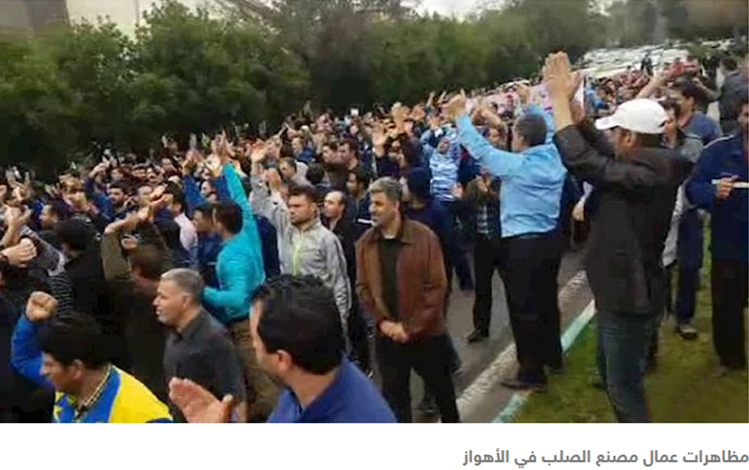
Security forces confront residents during unrest in Torbat-e Jam, northeastern Iran, as authorities move to suppress protests amid rising economic pressures — January 16, 2023
Written by
Farid Mahoutchi
Iran’s rulers, visibly weakened by war, the reported death of Ali Khamenei, and the loss of senior commanders, are sharpening their rhetoric not only against foreign enemies but against their own population. The message coming from the state is increasingly clear: this is not only a military confrontation abroad, but a moment in which any public dissent at home will be treated as a security threat.
That posture was laid out on March 6, 2026, when police commander Ahmad-Reza Radan said border forces were fully equipped, “ready and finger on the trigger,” and prepared to crush any “plot” at the borders or inside the cities. He also said police and Basij forces were active in urban areas and that those accused of disturbing public opinion online were being dealt with “decisively.” On the same day, Sadegh Amoli Larijani called on military and police forces to act with “greater authority” so that no opening for the regime’s enemies would remain.
The harder line is unfolding at a moment of unusual vulnerability for the state. On March 10, Iranian authorities announced funeral ceremonies in Tehran for some of the senior commanders and officials killed in the war, including Abdolrahim Mousavi, Mohammad Pakpour, Ali Shamkhani, Aziz Nasirzadeh and Mohammad Shirazi. The public staging of those funerals is meant to project continuity and resolve. But it also underlines the scale of the losses the regime has sustained.
Facing an increasingly explosive society, the Iranian regime has ramped up its rhetoric to signal a “firm” crackdown on any signs of #IranProtests. Judicial and military officials are currently using the pretext of regional conflict to justify aggressive internal suppression,…
— NCRI-FAC (@iran_policy) March 6, 2026
Crackdown on celebration
The clearest example came in Fardis, near Karaj, where two brothers, Ahmad Reza Feyzi, 15, and Amirhossein Feyzi, 19, were reportedly shot dead after they and their father honked their car horn to celebrate news of Ali Khamenei’s death. According to accounts, security forces opened fire on the family car and kept shooting even after it stopped. The episode captures the regime’s reflex at this moment: public joy at the weakening of the system is being met with live bullets.
In parallel, the intelligence ministry said on March 10 that it had arrested a foreign national and 30 alleged spies, “mercenaries” and operational agents in recent days, underscoring how broadly the regime is framing internal danger. Reuters also reported that the arrests were presented through state media as part of an expanding internal security campaign.
The crackdown is extending beyond the street. Amnesty International said on March 9 that Iranian authorities were refusing to release arbitrarily detained prisoners despite the dangers posed by nearby air strikes, and that some detainees had been transferred to undisclosed locations or places close to potential military targets. At the same time, the internet blackout imposed after the war began has remained in place, further isolating the public and limiting scrutiny. Recent outside reporting has described fears inside Iran that the post-Khamenei order will become even more security-driven.
Iran’s ruling theocracy is facing a convergence of crises that repression cannot solve: collapsing purchasing power, widening social anger, and growing international penalties linked to the regime’s crackdown. In recent days, reports from inside the country describe coordinated…
— NCRI-FAC (@iran_policy) February 16, 2026
Desperate defiance
The regime’s show of defiance was sharpened after Masoud Pezeshkian tried to calm the region. He apologized to neighboring states hit by regime attacks and said the leadership had decided Iran should stop striking neighboring countries unless attacks on Iran came from their territory. He also framed the issue as one for diplomacy, not wider regional escalation.
That line was quickly undercut by the military establishment. Armed forces spokesman Abolfazl Shekarchi said any country facilitating attacks on Iran would remain a legitimate target, while other regime bodies insisted strikes would continue against bases and facilities used by the United States and Israel. The point was not just to correct Pezeshkian. It was to erase any impression of retreat, project strength to foreign enemies, and prevent a morale collapse among the regime’s own forces, proxies and loyalists.
In the aftermath of the #IranProtests and the ensuing crackdown, Iran’s clerical leadership is escalating a familiar two-track response: expanding arrests and judicial pressure at home while urging mass public displays of loyalty to project control.https://t.co/b05fLI15kX
— NCRI-FAC (@iran_policy) February 10, 2026
A Capital Under Intimidation
At street level, the picture appears even more telling. International media have described Tehran as a capital gripped by fear and emptied by flight. France 24 reported that airstrikes had severely disrupted daily life and that perhaps 3 to 4 million people had left the city, seeking refuge in villages, Caspian coastal areas or smaller towns less likely to be hit. Shops were closed, traffic had largely vanished, and armed checkpoints had become one of the city’s defining features. Drivers who remained were reportedly being stopped, asked for identification and ordered to open their trunks.
Agence France-Presse, in a report on tightening wartime controls, said the authorities had flooded the streets with checkpoints and security forces while also cutting internet access, leaving Iranians trapped “between bombs and their government.” It said celebrations over Khamenei’s death were quickly suppressed. Residents quoted by AFP described a city under direct intimidation: one said the Revolutionary Guards had sealed off main roads with armed personnel and heavy machine guns “to frighten people”; another said plainclothes agents were everywhere and armed; a Tehran engineer said security forces were roaming the streets, checking mobile phones and harassing civilians.
Even the rhetoric of other state officials points in the same direction. Parliament speaker Mohammad-Bagher Ghalibaf said Iran was “certainly not seeking a ceasefire.” Judiciary spokesman Asghar Jahangir said the authorities would not allow anyone to “take advantage” of the current situation. Government spokeswoman Fatemeh Mohajerani said the selection of a third supreme leader had restored cohesion. The repeated emphasis on firmness, order and cohesion suggests not calm control, but acute concern over instability at home.
As Iran confronts mounting domestic unrest and growing international isolation, the regime’s supreme leader Ali #Khamenei has overseen an escalating crackdown that now reaches beyond street protesters and into the regime’s own political ranks.https://t.co/B22CZuVeMZ
— NCRI-FAC (@iran_policy) February 9, 2026
Fear of Another Uprising
Taken together, the threats from senior officials, the rush to demonstrate continuity after a leadership shock, the public infighting over military policy and the militarization of Tehran all point to the same conclusion: a regime under exceptional strain is turning its coercive machinery inward. The harder it tries to project strength, the more clearly it reveals its anxiety.
What Iran’s rulers appear to fear is not only foreign attack, but the possibility that war, succession turmoil and visible weakness could create an opening for what they have spent years trying to prevent: another nationwide uprising.