
Iran’s Officials Clash and Sound Alarms as Crises Deepen, Unrest Feared
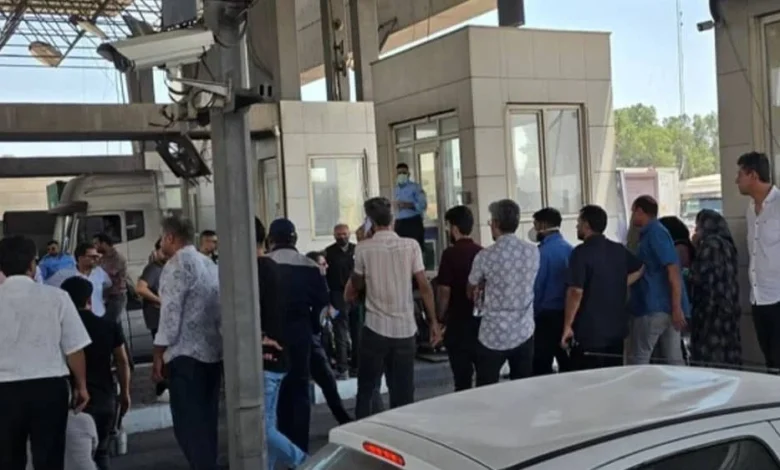
Families of victims of the Rajaee Port explosion in Bandar Abbas demand transparency, accusing authorities of withholding information about the dead and missing, May 3, 2025
Written by
Farid Mahoutchi
Iran’s leadership is showing mounting signs of alarm over deepening economic and social crises, with warnings of potential unrest surfacing across state-aligned media and official statements. Rather than acts of compassion, these warnings appear aimed at distancing officials from mounting mismanagement—and at pressuring the regime’s Supreme Leader Ali Khamenei to intervene before a feared social explosion.
In a May 3 editorial, Javan, a newspaper affiliated with the Islamic Revolutionary Guard Corps (IRGC), raised alarms over negotiations under Western pressure, while implicitly acknowledging the regime’s fears of societal volatility. “From day one of Trump’s presidency, the U.S. launched both negotiations and threats together… Most domestic analysts believed that America’s maximum pressure campaign aimed at fostering social rebellion and confrontation between the people and the regime,” the editorial stated.
While framed as an accusation against the U.S., the editorial’s focus on potential “social rebellion” reflects the establishment’s own anxieties over instability. Javan warned of a trap to “draw us into negotiations with initial leniency, then, after prices collapse, push toward our red lines to blame the system—so that prices then surge and, in their imagination, an internal social problem is created.” The editorial called for “heightened vigilance” and insisted: “We must seriously emphasize that we will not continue negotiations under ongoing threats and sanctions.”
Blast in Bandar Abbas Exposes #Iran’s Regime Panic and Incompetence Amid Fears of Uprisinghttps://t.co/xwruHZO4Lp
— NCRI-FAC (@iran_policy) May 3, 2025
Meanwhile, Kayhan, a paper that receives its editorial guidelines from Khamenei’s office, expressed similar unease. On the same day, it asked pointedly: “What plan does the government have besides negotiation?” while warning that renewed focus on talks risks sidelining alternative paths. “The 14th government must choose: either the failed path of relying solely on negotiations, or presenting a homegrown plan to run the country,” Kayhan wrote—effectively pressuring the regime’s leadership to abandon diplomatic overtures in favor of internal solutions.
Amid these warnings, parliament has intensified efforts to target individual ministers, in what analysts describe as politically motivated moves to shift blame. According to Ham Mihan, 41 members of parliament have signed a motion to impeach Minister of Roads and Urban Development Farzaneh Sadegh.
The newspaper reported that although few had criticized Sadegh’s performance previously, some extremist MPs seized on the recent explosion at Rajaei Port as a convenient pretext to initiate impeachment proceedings. “It’s as if they believe: if they cannot reach other ministers, they’ll settle for Sadegh,” Ham Mihan wrote, describing the impeachment drive as part of a broader attempt by the ultraconservative Paydari Front to weaken the government. The article argued that this effort aims to portray the government as unstable and undermine its capacity to pursue negotiations with the United States, calling it a political maneuver rather than a response to ministerial failures.
#Iranian Officials Voice Deep Fear Over Growing Social Tensions and Possibility of Uprisinghttps://t.co/NYjgVFrYGf
— NCRI-FAC (@iran_policy) April 20, 2025
Hossein Shariatmadari, Khamenei’s representative at Kayhan, escalated attacks on the administration, citing the central bank’s admission that an American-hosted Telegram channel influences the national currency. “Some are so incompetent that even riding a camel, a dog will still bite their leg! Is it really impossible to take tough, deterrent action against the currency dealers who obey this channel’s orders? Certainly not. This negligence and inaction is unforgivable,” he wrote, placing blame for the currency crisis squarely on Pezeshkian’s government.
Other officials have also raised stark warnings. Parliamentarian Yasser Arabi, speaking on state TV on May 1, warned that local conflicts over scarce resources are already brewing: “I warn the judicial and security authorities: local conflicts between people are forming, and unfortunately, the greedy ones are sitting on the sidelines, watching.” Arabi described how corruption and illegal land grabs were depriving farming communities of water, leading to desperation. “Despite repeated official complaints and legal steps, nothing effective has been done,” he said, accusing senior officials of “inaction and fear of enforcing the law,” which he claimed is leading to the “death of two critical counties.” He cautioned that these land and water disputes risk spreading: “Conflicts in higher, more fertile lands will soon dry up your orchards too.”
In parallel, the economic crisis is deepening. Parliament member Salman Es’haghi warned that eliminating state subsidies would cause medicine prices to soar by 30 times, worsening an already critical shortage of more than 500 essential drugs. ‘If this path continues… the cost of treatment will increase 30-fold. Today, 80% of treatment costs are paid out of pocket by patients; this 30-fold increase will be added on top of that,’ Es’haghi warned, calling the situation a brewing crisis that threatens to overwhelm Iran’s healthcare system and further strain the population.
#Iran's Regime Infighting Escalates Amid #Economic Crisis and International Tensionshttps://t.co/QaeyKbnTc7
— NCRI-FAC (@iran_policy) February 19, 2025
Adding to the regime’s visible distress, the state-aligned newspaper Arman Melli acknowledged an unfolding power crisis: “One of the main problems with the recent blackouts is the lack of transparency. No official schedule has been published, and no responsible authority is answering public questions. Everything proceeds in silence and confusion.” The paper reported multiple blackouts in urban areas even before the summer heat, raising fears of a full-blown crisis in the coming months.
Across these statements and reports, Iran’s officials and state media appear not only deeply alarmed but increasingly intent on shifting blame for the worsening situation, whether onto foreign powers, lower-level bureaucrats, or individual ministers, while urgently calling for top-level decisions to avert what they fear could be an uncontrollable uprising.