
Who is Alireza Zakani, Corrupt Militiaman Turned Tehran Mayor
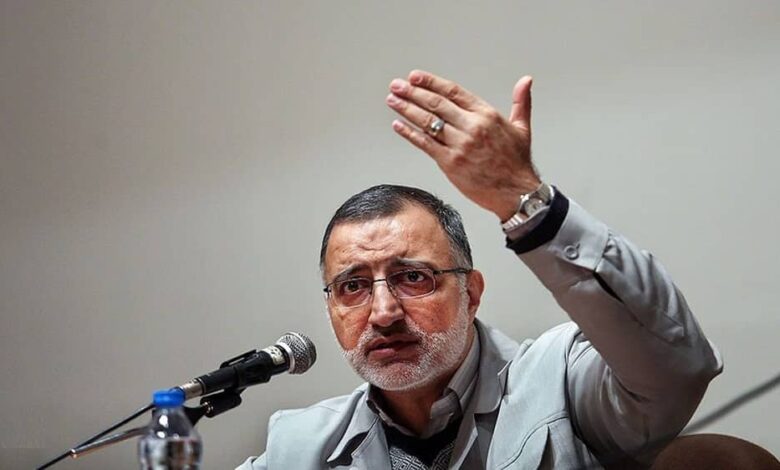
From the Battlefield to Politics (1981 – 2002)
Written by
Mahmoud Hakamian
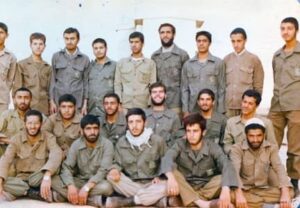
Born on March 3, 1966, in Tehran, Alireza Zakani entered the public eye at the young age of 15. In 1981, amid the early months of the Iran-Iraq War, Zakani joined the war front as a member of the Basij militia. Over six years, he participated in fifteen operations and sustained injuries that left him 50% disabled by the regime’s standards. His military career spanned various roles in the irregular warfare headquarters, including intelligence and operations units, where he eventually became the deputy commander of the Mohammad Rasul-Allah division. Along with three other divisions, the unit is responsible for preserving the regime’s security in light of any danger posed in the capital.
From 1998 to 2002, Zakani led the Student Basij Organization, a period many regime officials describe as a golden era for the organization. His involvement in suppressing the student protests during the July 1999 Tehran University dormitory attacks further solidified his extremist credentials and loyalty to the ruling establishment.
Political and Media Ventures (2003 – 2013)
Zakani’s transition from military to political life included a stint as a media personality. He founded the news website Jahan News and the weekly magazine Panjereh. He also served on the press court jury for two terms, influencing the direction of Iranian journalism.
In 2013, Zakani attempted to enter the presidential race but was disqualified by the Guardian Council. This pattern repeated in 2017, underscoring his ambition to secure the second-highest seat of power in the regime.
Alireza Zakani (center), wearing a kaffiyeh around his neck. Photo is taking during the Iran-Iraq War
Personal Life and Public Perception
In 2017, Branch 9 of the Tehran Criminal Court sentenced Alireza Zakani to one year in prison for “spreading false information” following a complaint by the Ministry of Oil. He also has a final conviction for which he was sentenced to one year in prison, converted to a fine of 5 million tomans, a ruling that was upheld by the Supreme Court.
Zakani’s personal life has not been free from scrutiny. His daughter’s education and childbirth in Switzerland, leading to his grandchild’s dual citizenship, sparked debates about his adherence to the values he publicly champions. These incidents, coupled with his political and administrative controversies, have painted a complex picture of a figure deeply embedded in the regime’s power structures yet often at odds with its bureaucratic and ethical norms.
Political Ambitions (2015 – 2017)
Alireza Zakani, who represented Qom in the 11th term of the Islamic Consultative Assembly (Iranian regime’s parliament, also called Majlis) until August 14, 2021. He also served as the head of the Parliament’s Research Center from July 22, 2020, to August 14, 2021.
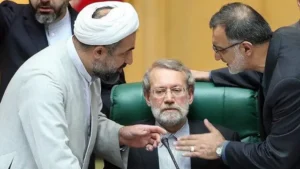
Then-MP Alireza Zakani (right) arguing with MP Hamid Rasaee (left) with then-Parliament Speaker Ali Larijani (center) listening
After the Joint Comprehensive Plan of Action (JCPOA) was agreed upon by Tehran and the P5+1 countries in 2015, Zakani chaired the special parliamentary commission tasked with reviewing the deal. His leadership was marked by inviting key nuclear, political, and economic officials to provide insights and question the details of the agreement with international bodies like the International Atomic Energy Agency (IAEA).
In 2021, Zakani registered as a candidate for the 13th presidential election. This marked his third attempt to run for president and this time his candidacy was approved by the Guardian Council. However, two days before the election, he withdrew in favor of Ebrahim Raisi due to behind-the-scenes directives. In return, on September 2, 2021, he was appointed to the powerful and lucrative position of Mayor of Tehran, a role he has held since.
Mayor of Tehran, corruption and suppression (2020 – Present)
Zakani’s political fortunes saw a significant turn when he was elected as the 47th Mayor of Tehran in 2020. His tenure has been rife with controversies:
Waste Management Mafia: The continuation of a waste management scheme, initially started under former mayor Mohammad Bagher Ghalibaf, exploited cheap labor, including child labor. This issue drew widespread criticism and highlighted the exploitation within municipal contracts.
Land Allocation to Mahan Air: Documents revealed that the Tehran municipality, under Zakani’s leadership, allocated 33,000 square meters of prime land to Mahan Air for developing a recreational and tourism center, raising concerns about transparency and favoritism.

Tehran Mayor Alireza Zakani during a visit to China- early 2024
Missing Municipal Funds: In 2021, Ahmad Sadeghi, head of the Transparency Committee of Tehran City Council, reported a discrepancy of 17 trillion tomans in the municipality’s accounts. The missing funds led to questions about financial mismanagement and corruption under Zakani’s administration.
Massive Corruption Scandal: A 20 trillion toman corruption case within the municipality further tarnished his administration’s reputation. City council members demanded a detailed report.
2022 Protests: In April 2022, Zakani’s policies, including gender segregation in parks and forming women’s suppression brigades, were perceived as measures to curb public dissent, particularly following the 2022 uprisings.
Chinese Contract Dispute: In early 2024, a contract between Tehran Municipality and Chinese companies for electric bus imports sparked significant debate. Allegations of opacity and inefficiency led to tensions within the city council, with some members threatening to impeach Zakani.
Park Destruction for Mosque Construction: Plans to demolish parts of Qeytariyeh Park in Tehran to build a mosque in April 2024 faced a public outcry, adding to the growing discontent with Zakani’s leadership.
Controversial Visit to Belgium: Zakani’s trip to Belgium in June 2023 provoked widespread protests. Belgian Foreign Minister Hadja Lahbib eventually formally apologized for the decision to host Zakani, reflecting the international dimension of his controversial status.
Anti-MEK Exhibition: In February 2024, by orders from intelligence agencies, Zakani organized an exhibition against the People’s Mojahedin Organization of Iran (PMOI/MEK). The regime aimed to undermine the organization’s reputation among the people, alongside the ongoing sham trial against it. Despite 45 years of similar efforts and billions of dollars spent, apparently, the regime remains unsatisfied with the results.
Controversial Stances and Key Moments
In Zakani’s record, certain statements and controversies stand out, clearly illustrating his ideological mindset and tendencies.
In a televised debate on January 23, 2019, organized by the regime to boost the profiles of election candidates, Alireza Zakani faced off against Mostafa Tajzadeh, former Minister of Interior during Mohammad Khatami’s presidency.
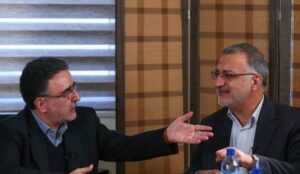
Alireza Zakani (right) debating with former Interior Minister Mostafa Tajzadeh (left) in June 2019
Tajzadeh said, “When the story about the chain murders came out, your friend Mr. Kazemi was involved. Who is supposed to reveal the truth about these serial killings, Mr. Zakani? Who opposed it and said we should remain silent and let us handle it differently? They proposed it to Mr. [Mohammad] Khatami and presented a scenario, similar to the Mashhad scenario. They said we would find two hypocrites [MEK members] and show them as the perpetrators and say they were the ones behind the killings. Using the same confession tactics they know all too well. Then we would execute them but promise that it wouldn’t happen again and clear the Ministry of Intelligence’s file.”
The Mashhad case refers to the bombing at the Imam Reza shrine on June 20, 1994, orchestrated by Iran’s Intelligence Ministry (MOIS) to tarnish the reputation of the MEK. Following the bombing, several individuals were arrested and falsely accused. Similarly, in the early 1990s, following the murders of Christian priests, the MOIS coerced three women into falsely confessing on state television that they acted under MEK orders.
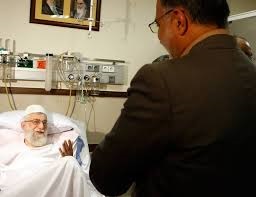
Alireza Zakani (right) visiting Supreme Leader Ali Khamenei (left) in hospital
In August 2019, Zakani appeared on state television, presenting himself as a critic of systemic corruption. He revealed some of the theft and wealth accumulation within the regime’s elite. He claimed the MOIS had asked him to declare a recently arrested individual as honest and non-corrupt. Zakani named Akbar Tabari, the deputy to former Judiciary Chief Sadegh Larijani, as corrupt. Tabari belonged to a rival faction targeted by Khamenei, who aimed to weaken his former boss through legal persecution. However, Zakani emphasized the incorruptibility of the Supreme Leader: “The supreme leader shines like the sun, and even his enemies admit there isn’t a single grey spot in his record or that of his family.”
On June 20, 2019, during an interview with Channel 3 of the state television network, Zakani addressed questions about a $25 million theft in the oil company. He dismissed the amount as trivial, stating, “This talk of $25 million and such sums, they are petty cash. Put them aside, put them aside! This is not real money. The sums I want to name are the real issue, the kind that genuinely deprives the people and affects the country’s operations.”
Who is Alireza Zakani, Corrupt Militiaman Turned Tehran Mayor