
Former US Ambassador Sam Brownback: Regime Change in Iran is Crucial for Peace in the Middle East
Written by
Farid Mahoutchi
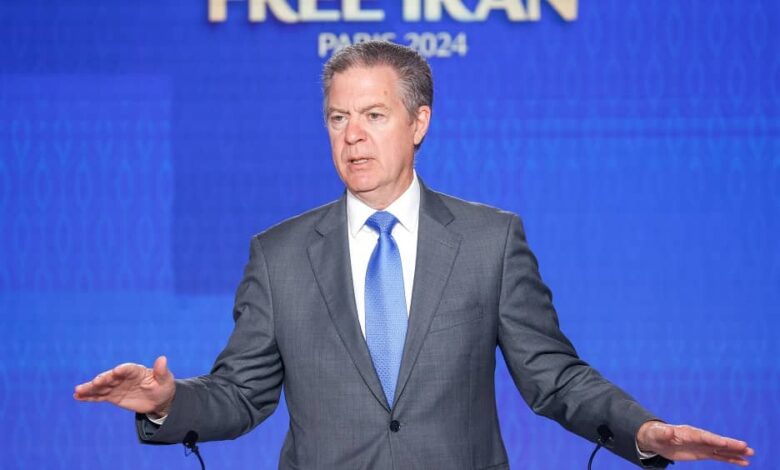
On July 1, at the Free Iran 2024 World Summit in Paris, Senator Sam Brownback, former US Governor and former Ambassador at Large for International Religious Freedom, addressed the audience with a passionate speech emphasizing the necessity of regime change in Iran to achieve peace in the Middle East.
Senator Brownback highlighted his long-term commitment to this cause, referencing his collaboration with the late Senators Joe Lieberman and John McCain. He stressed that the current regime in Iran, led by the ruling mullahs, is an obstacle to peace in the region and asserted that only regime change by the Iranian people can pave the way for a free Iran.
He urged the West, particularly the United States, to support these efforts by applying maximum economic and political pressure on the Iranian regime. The former Senator also touched on the lack of religious freedom in Iran, contradicting the Quran’s principle of no compulsion in religion, and called the current Iranian elections a farce, manipulated by a few ruling mullahs. He reaffirmed that the free world must support the Iranian people’s desire for change and expressed optimism about the eventual success of these efforts.
Excerpts of Senator Brownback’s speech follow:
Thank you, thank you, it’s a pleasure to join you, Madam Rajavi, very good to see you and to be with you. I’ve worked on this topic since I was in the United States Senate, I worked with Joe Lieberman and John McCain on this topic, they both are deceased and I’m still working on it, I’m going to continue to work on it, we’re going to see it through to completion and there will be a free Iran.
And let’s put the cards really out on the table here if we can. Look, you are not going to get peace in the Middle East with these ruling mullahs in power in Iran, it won’t happen. It will not happen with this crew that’s running Iran now. The only route forward is regime change by the people of the ruling mullahs that are in Iran today, that’s what has to happen.
Former US Senator @SamuelBrownback: "You are not going to get peace in the #MiddleEast with these ruling mullahs in power in Iran. The only route forward is regime change by the people of the ruling mullahs."#FreeIran2024 #MaryamRajavi4FreeIran https://t.co/g0v5gzGsFT
— NCRI-FAC (@iran_policy) July 1, 2024
If we’re going to get anywhere close to peace in the Middle East and we need, I believe in the West, the United States needs to support these efforts of regime change by the people in Iran. We must put maximum economic pressure on the Iranian regime, we need to put maximum political pressure on the ruling mullahs.
And I want to also say from a person, if you’re a person that’s a person of faith, if you’re a Muslim, remember the Quran says there is no compulsion in religion, and yet the Iranian regime puts forth compulsion on religion every day upon the people all the time. That’s what’s taking place in this regime. There is no religious freedom in Iran. There is none there. That is a hallmark of a free society is to have religious freedom.
The world, except Russia and China’s leaders, needs regime change by the people in Iran to end this night of terror, to end this night of wrong. The free world must support a free Iran. Iran having elections now is a farce. This isn’t a free election. This is a few ruling mullahs picking candidates to put in front of the people and say come vote the people have smelled it out and they’re not participating in this election and they shouldn’t.
The days of dictatorship in Iran are coming to an end. The people of Iran will be free. The West and the entire free world must support the tools for regime change by the people and support groups like yours that are bringing this change forward. That fire of change is burning now in Iran.
As one of the prior speakers says, you cannot predict when these changes will happen, but you can predict that they will happen because of these factors that are taking place now. This change will happen. Let’s push it forward.
God bless you all.