

Geneva UN Conference Warns of Execution Surge in Iran, Highlights Resistance Behind Bars and Across Society
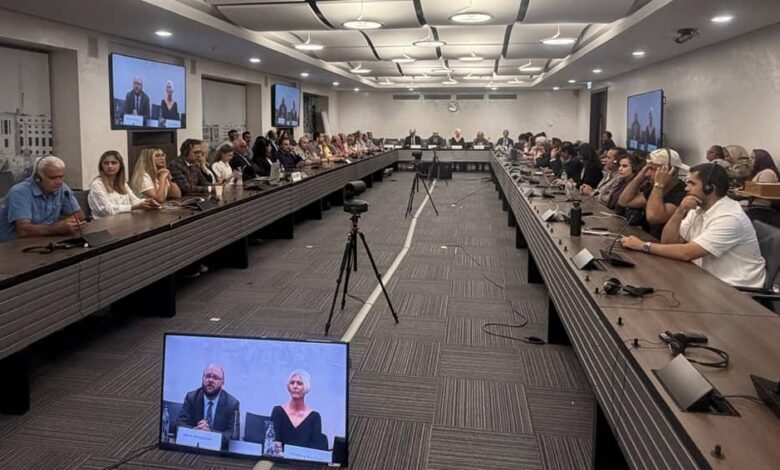
Participants listen to speeches at a conference on Iran’s human rights situation, held in Geneva on 28 September 2026 alongside the 63rd session of the UN Human Rights Council
Written by
Shamsi Saadati
GENEVA — Political figures, legal experts and human-rights advocates meeting at the United Nations in Geneva warned that Iran is undergoing a sharp escalation in executions and domestic repression, with political prisoners, lawyers, journalists, students and civil-society activists facing increasing pressure. The September 28 conference, held as a side event at the UN Human Rights Council, focused on the death penalty, shrinking civic space, impunity for past atrocities and the growing use of national-security charges against political opponents. Speakers also drew attention to what they described as an enduring and increasingly organized resistance inside Iran, pointing to prisoners who continued protesting under death sentences, women challenging repression and opposition networks persisting despite decades of executions and imprisonment.
Swedish human-rights expert, Dr. Henrik Hermansson, who moderated the conference, said the space for independent civil society inside Iran was already severely restricted and was rapidly contracting further. He warned that contact with foreign journalists, NGOs or UN bodies and the sharing of information deemed sensitive could expose Iranian citizens to severe punishment. He also cited legislation that, he said, would require prior Intelligence Ministry authorization for contacts with international organizations and UN mandate holders. At the same time, Dr. Hermansson said executions were increasing rapidly while lawyers, trade unions, journalists, medical professionals and civil-rights defenders were being targeted. “Domestic oppression is rising rapidly,” he said, calling on the international community to intensify efforts to ensure that Iranians could still make their voices heard. UN special procedures have separately raised concerns in 2026 over executions, arbitrary detention, torture allegations and fair-trial violations in Iran.
Mrs. Maryam Rajavi, President-elect of the National Council of Resistance of Iran, sent a video message to the conference, linking the growing use of executions to the authorities’ fear of renewed uprisings and an organized opposition. She said that more than 50 people had been executed on political grounds in recent months and more than 100 others remained under death sentences, describing the situation as the most serious political execution campaign since the 1988 massacre.
“The rise in executions is closely linked to the rise of resistance and popular uprisings, revealing the regime’s fear of the Iranian people and their Resistance,” Mrs. Rajavi said. “On the one hand, Iran has witnessed repeated uprisings. On the other hand, a new generation of courageous and selfless young people has turned toward the PMOI.”
Mrs. Rajavi argued that the scale of repression itself had failed to extinguish either public rebellion or organized opposition. After citing successive waves of protests, arrests and killings, she declared: “Yet this killing machine has failed to stop the people’s uprisings and the organized Resistance.” She also referred to the experiences of PMOI members and supporters over several decades and quoted former French anti-terrorism investigating judge Marc Trévidic on what he described as political pressure exerted by Tehran against its opponents in France during the early 2000s.
The NCRI President-elect presented that endurance as extending beyond opposition to the current authorities to a defined political program for the future. “Our Resistance of more than four decades against the ruling religious fascism seeks to establish a democratic republic where no one would enjoy any privilege because of his or her religion or heritage,” Mrs. Rajavi said. “We are committed to respect international conventions, freedom of speech, assembly, and parties, gender equality, full independence of the Judiciary, and recognition of the principle of presumption of innocence, the right to defense and the abolition of the death penalty.”
Message to the UN Human Rights conference, Geneva
Proposing an international mechanism to hold the Iranian regime accountable#HumanRights violations in Iran have intensified in recent months. These violations include the daily executions of prisoners, particularly members of… pic.twitter.com/Fe5kLxmhXA— Maryam Rajavi (@Maryam_Rajavi) September 28, 2026
The NCRI President-elect concluded by proposing a four-part international accountability mechanism: referral of the Iranian regime’s human-rights situation, including the 1988 massacre, to the UN Security Council; independent international access to Iranian prisons; prosecution of officials accused of crimes against humanity under universal jurisdiction; and making an end to executions a condition in political, economic and international relations with Tehran. “On behalf of the National Council of Resistance of Iran (NCRI), I would like to propose an international mechanism to hold the Iranian regime accountable for its human rights violations,” she said.
Christina Blacklaws, former president of the Law Society of England and Wales and a council member of the International Bar Association’s Human Rights Institute, gave one of the conference’s starkest accounts of the commitment displayed by political prisoners facing execution. She said broad charges such as moharebeh, baghi and efsad fel-arz were being used to criminalize dissent and alleged political affiliation, while defendants were denied fair-trial guarantees, independent lawyers were excluded and confessions were obtained under torture. “The purpose is not justice. It is intimidation,” she said.
Blacklaws highlighted six political prisoners secretly executed after being transferred from Ghezel Hesar Prison between March 30 and April 4. Videos smuggled from the prison yard, she said, showed the prisoners singing resistance songs in their final days. One of them, electrical engineer Pouya Ghobadi, was among prisoners whose previously written manifesto was released after their death sentences were confirmed. Blacklaws recalled that they said they had effectively been executed “hundreds of thousands of times in Iran’s history” and would nevertheless “stand firm again.”
“Those brave men, that’s the human reality behind the statistics,” she said.
She also discussed Arghavan Fallahi, a young woman sentenced to death on a charge of baghi based, according to Blacklaws, on alleged support for the PMOI. Blacklaws said no evidence of violent conduct had been presented and that Fallahi had been denied a lawyer of her choice. She described the case as emblematic of a young political prisoner being punished “not for a proven act of violence, but for what she would not renounce.” UN special procedures have independently reported Fallahi among prisoners at imminent risk of execution while raising concerns about arbitrary detention, enforced disappearance and violations of fair-trial guarantees.
🚨 Geneva Conference Highlights Human Rights Abuses in Iran
On September 28, a conference on Iran’s human rights situation was held in Geneva on the sidelines of the 63rd session of the UN Human Rights Council, bringing together human rights lawyers, jurists, experts and… pic.twitter.com/MxaAoa3hbn
— SIMAY AZADI TV (@en_simayazadi) October 2, 2026
Blacklaws drew a direct connection between these cases and the unresolved legacy of the 1988 massacre. “This pattern is not new. It is 1988 happening again,” she said, arguing that the absence of accountability had made renewed political executions conceivable. She urged sponsors of the UN General Assembly’s forthcoming Iran resolution to strengthen provisions dealing with impunity, political death sentences and independent investigations.
Her closing remarks again focused on the resilience shown inside the prisons. Addressing prisoners in Evin, Ghezel Hesar, Qarchak and elsewhere, Blacklaws said: “You are not invisible. Your names are spoken in this room. The songs sung in prison yards, the messages smuggled out, the Tuesday hunger strikes now in their 140th week, the sit-ins at Ghezel Hesar—these have been heard.” She added: “You’ve already shown a courage that no gallows can erase.”
Azadeh Alami, representing the Association of Iranian Women in France, situated women’s current defiance within what she described as half a century of organized resistance. She argued that reducing women’s resistance to opposition to compulsory dress obscured a much deeper political struggle. Women and female students who had opposed the Shah, she said, remained at the forefront after the 1979 revolution and thousands later joined resistance to religious fundamentalism despite executions and imprisonment.
Alami said that despite executions and pervasive surveillance, “the consensus of fear has shattered,” with civil disobedience now entrenched in streets and universities. She described women’s demands as encompassing legal equality, accountability for torture, social justice and the right to determine their country’s political future. “Their resistance is not limited to contesting imposed clothing,” she said. “We are witnessing one of the most profound and genuine political struggles of our time.”
She urged the international community to maintain diplomatic pressure, demand an immediate halt to executions and protect women human-rights defenders. “Our duty is not merely to observe,” she said, “but to relentlessly relay their voices and demand firm action in the face of their oppressors.”
Former Geneva mayor Rémy Pagani said the authorities were responding to economic hardship and growing social dissatisfaction through what he called “preventive repression,” attempting to neutralize unrest before it reached the streets. He pointed to increasingly expansive judicial terminology being used against journalists, students, activists and ordinary citizens and said repression had even reached members of the security forces who publicly complained about their economic conditions.
Pagani called for urgent investigations by UN special rapporteurs into forced confessions, arbitrary detention and threats against dissidents, as well as scrutiny of measures targeting women and students at universities. He also advocated universal jurisdiction and targeted sanctions against officials responsible for abuses. “We cannot content ourselves with watching. We must act,” he said. Pagani concluded by urging participants to become “the voice of resistance, justice and freedom for the Iranian people.”
Former Norwegian environment minister Ola Elvestuen broadened the discussion beyond executions, arguing that environmental degradation had itself become a human-rights crisis. He cited groundwater depletion, subsidence, air pollution, dust storms, energy shortages, desertification and damage to agriculture as factors placing growing pressure on ordinary Iranians. Elvestuen argued that the environmental crisis could not be separated from political priorities and governance, saying that deteriorating living conditions were intensifying public discontent.
“The dire environmental situation in Iran [is] part of and the result of the regime’s repression and mismanagement,” he said. Elvestuen concluded that Iran required “a rights-based democratic change” both to secure basic liberties and to give Iranians the freedom to address the country’s environmental problems themselves.
Alfred de Zayas, former UN Independent Expert on the promotion of a democratic and equitable international order, recalled visiting Ashraf 3 in Albania and speaking with survivors of the 1988 massacre. He said he had discussed “the movement of Maryam Rajavi” with his successor, George Katrougalos, and had provided him with extensive documentation relating to Iran and the unresolved massacre case. De Zayas said he expected further efforts to press for investigation of the 1988 killings.
He also expressed explicit support for the NCRI President-elect’s political program. “I am very much in favor of Rajavi’s 10-point plan, and I would very much hope that sooner rather than later Iran will re-establish a democratic system in which everyone will have freedom of expression, freedom of assembly, freedom of association, etc.,” de Zayas said. At the same time, he rejected foreign military attacks on Iran and argued that accountability should apply to all actors responsible for violations against civilians.