
Systemic Collusion and Chaos: The Fatal Crises Engulfing the Iranian Regime
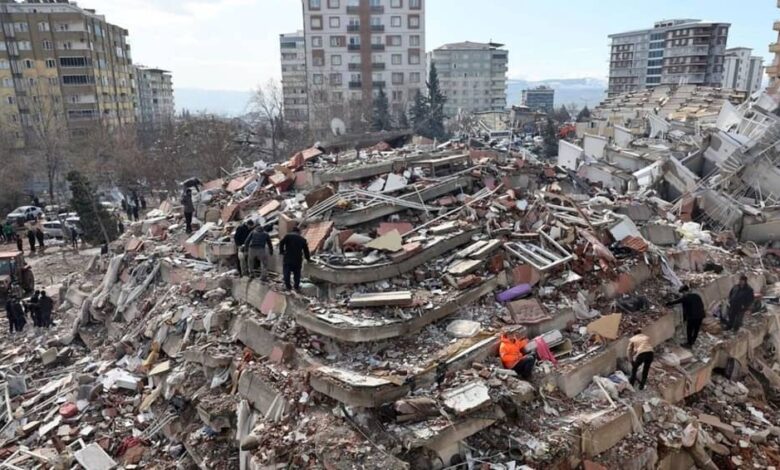
The aftermath of severe urban destruction following a major earthquake in Iran, where the collapse of a multi-story building into concrete rubble mirrors expert warnings that over 60 percent of the country’s structures are unsafe
Written by
Mahmoud Hakamian
The internal fabric of the Iranian regime is fracturing across multiple structural fault lines. A comprehensive analysis of state media, parliamentary transcripts, and economic indicators from late May and early June 2026 reveals an establishment trapped in a multi-layered crisis where geopolitical paralysis, macroeconomic collapse, and intense factional infighting are reinforcing one another. The ruling elite is increasingly paralyzed by a fierce rift between factions desperate to negotiate a way out of crippling sanctions and hardline military factions demanding regional escalation, leaving the country’s leadership dangerously gridlocked.
A source close to the regime’s negotiating team confirmed to Khabar Online that while the final text of a proposed agreement with Washington is being debated in Tehran, the regime has frozen its response due to deep-seated historic mistrust and fear of American non-compliance. In sharp contrast, IRGC-affiliated media outlets declared the talks a diplomatic trap on June 2, 2026.
The IRGC faction is demanding immediate military deterrence over diplomacy, proposing a unified military doctrine connecting the Strait of Hormuz to the Litani Strait as interconnected red lines. These threats include the immediate annexation of the United Arab Emirates and closing the Bab-el-Mandeb strait to mirror the maritime blockade of Hormuz. High-ranking parliamentary officials, including Ali Nikzad, have publicly declared that the Strait of Hormuz is the regime’s true atomic bomb, while MP Hamid Rasaee openly called for extending missile ranges to collapse the White House onto the heads of US Presidents.
Power Dynamics in Iran and #MojtabaKhamenei’s Inner Circlehttps://t.co/eTfcnFH14Z
— NCRI-FAC (@iran_policy) June 3, 2026
Inflation and Digital Extortion
The regime’s regional military campaigns are directly triggering catastrophic domestic inflation, completely erasing any financial gains from oil revenues and devastating the local population. Majlis member Samsami admitted on May 31, 2026, that the regime’s aggressive maneuvers to seize control of the Strait of Hormuz have directly caused severe domestic inflation. He noted that instead of benefiting from rising global oil prices, the economic backlash has hit the Iranian dinner table, changing what should be a source of national wealth into a direct crisis for ordinary citizens.
The Statistical Center of Iran reported a staggering monthly consumer price index jump of 8.8 percent in May 2026 alone, with the annual inflation rate reaching 53.9 percent and point-to-point inflation hitting 77.2 percent. Following the removal of preferential currency subsidies, essential food items have become entirely inaccessible, marked by a 266 percent surge in cooking oil, a 175 percent increase in red meat, and a 137 percent spike in milk. These numbers reflect an economic reality where basic nutrition is quickly becoming a luxury for the average household.
While citizens starve, the regime’s internal internet censorship has spawned a predatory digital black market. The monthly cost of basic anti-filtering software for a two-person household has spiked over 7-fold, jumping from 185,000 to nearly 1.44 million tomans. This highly lucrative digital racket is heavily controlled by the IRGC mafia, effectively extracting wealth from the population under the guise of state security while exploiting the public’s desperation to access the global internet.
"As the Iranian regime attempts to project a stance of regional defiance, a toxic combination of severe infrastructure damage, unprecedented #hyperinflation, and a mounting domestic resource crisis is converging to threaten the state’s internal stability," @MansoreGolestan…
— NCRI-FAC (@iran_policy) June 1, 2026
Factional Warfare Hits Cabinet
Masoud Pezeshkian’s administration is facing aggressive legal and political challenges from radical fundamentalists within the Majlis, fracturing state authority in the middle of a wartime footing. MP Hamid Rasaee publicly declared that Pezeshkian’s Acting Minister of Defense is serving illegally under the current constitution. Rasaee argued that the acting minister lacks any legal authority to command or deploy military directives during wartime unless Pezeshkian obtains an extraordinary decree directly from the Supreme Leader, creating an immediate command crisis.
The political battleground has also extended to cyber-policy, where MP Ahmad Rastineh launched an assault on Pezeshkian for establishing a special Internet Management and Steerage Headquarters under Vice President Mohammad-Reza Aref. Rastineh slammed the body as an unconstitutional parallel structure designed to bypass the Supreme Leader’s Supreme Council of Cyberspace, accusing the president of willfully violating the foundational laws of the Islamic Republic to build an independent executive base.
The regime’s Judiciary actively weaponized the Court of Administrative Justice to issue an emergency injunction against the administration. The court stripped Pezeshkian’s new internet council of all legal authority before it could even issue its first directive, illustrating how deeply the state’s judicial and executive branches are warring against each other. This institutional gridlock makes coherent governance impossible, as every policy initiative from the presidency is immediately checked and neutralized by rival hardline state bodies.
"Rather than addressing its crises, the Iranian regime appears to believe it can manage them by winning the battle of narratives, outmaneuvering both domestic and foreign adversaries through #propaganda and deception," writes @MasumehBolurchi.https://t.co/JWTBIR3ZqO
— NCRI-FAC (@iran_policy) May 31, 2026
Crumbling Infrastructure and Threats
Decades of systemic corruption, mismanaged state resources, and decaying infrastructure have triggered massive deficits in water and power production, which the regime is claiming to solve through forced rationing and intimidation. Energy Minister Abbas Ali-Abadi failed to deliver on his high-profile December 2025 promise to bring 11,000 megawatts of renewable energy online by the summer of 2026, managing to construct only a tiny fraction of that goal. This failure ensures that the country faces another summer of rolling blackouts and industrial disruption.
State data reveals that 13 percent of Iran’s entire annual electricity production is completely lost due to a crumbling, outdated transmission grid, a wasted sum equivalent to the entire power consumption of 40 percent of Iranian households. Instead of upgrading infrastructure, the state has launched an intimidation campaign against domestic users, introducing massive utility price hikes ranging from 5 to 45 times the standard rate alongside threats to completely cut off water and electricity to non-compliant households.
Facing rampant rumors of an impending resignation, Pezeshkian used a June 1, 2026, cabinet meeting to plead for survival, ordering state broadcasters to manage public anger and begging the population to endure incoming energy blackouts while vowing to cling to power as long as there is breath left in his body. This systemic rot underscores a deeper crisis: a kleptocratic system that prioritizes its own survival and regional aggression over basic human needs, proving the entire dictatorship is fundamentally incapable of governance and poses the ultimate threat to the survival of the Iranian nation.