
The Geometry of Coercion: Why Dictators Dictate the Terms of Resistance
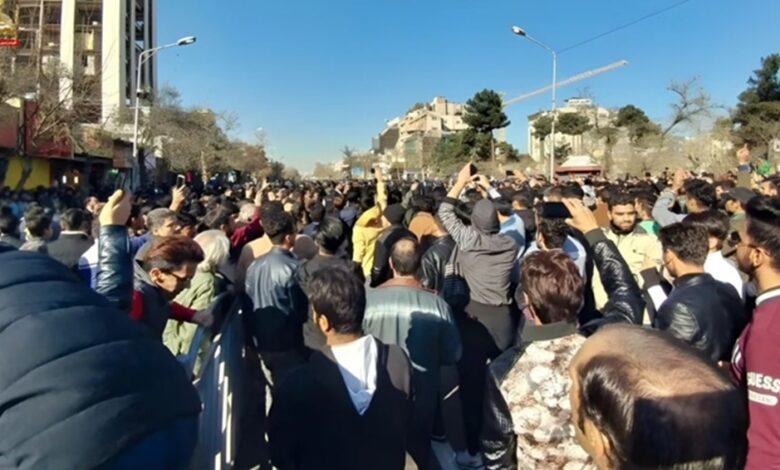
The nationwide uprising in Iran against the religious dictatorship entered its seventh consecutive day on Saturday, January 3, 2026.
Written by
Mohammad Sadat Khansari
In the gray dawn of late May 2026, the gallows of Iran’s judiciary turned once more, cutting short yet another young life. The state’s official media apparatus, operating with its usual sterile dogmatism, announced the execution of Abbas Akbari Feyz-Abadi. Labeling him a “leader of the nationwide riots” in the city of Nain, the regime swiftly convicted him behind closed doors of Moharebeh (“enmity against God”), arson, and armed resistance.
According to their well-worn script, the rulers of Tehran attempted to paint Feyz-Abadi as a reckless adventurist—a chaotic insurgent seeking disruption for its own sake. But beneath the heavy layer of security propaganda lies a profound sociological reality that tyrants desperately seek to obscure: Abbas Akbari was not a man looking for trouble. He was a regular citizen whose professional and civic life was systematically choked until his lungs collapsed under the vacuum of total state repression.
His execution forces us to confront a deeper, more unsettling question that echoes from the streets of Iran to the halls of global academia: Why does a student abandon her classroom to face the lethal crosshairs of the state? Why does a baker, a teacher, or a shopkeeper lay down their tools and take up arms? Why does a teenage girl risk her entire future, her youth, and her very life on the unpredictable asphalt of an uprising?
The Verdict of the Unbroken: Moradi and Younesi Spurn the Hangman’s "Sham Amnesty" https://t.co/3wpAeobfSh
— NCRI-FAC (@iran_policy) May 14, 2026
The Great Sociological Delusion
The dominant narrative pushed by autocrats—and often naively repeated by detached commentators—is that those who revolt are merely driven by youthful angst, ideological fanaticism, or personal recklessness. This is a deliberate lie designed to strip the resistance of its rationality.
Sociological and historical analyses offer a completely different verdict: The oppressed never choose the method of their struggle. It is always the ruling regime that dictates and imposes the terms of engagement.
Human beings possess an inherent, evolutionary bias toward peace, stability, and survival. No one willingly trades a comfortable career, a quiet family dinner, or an academic future for a cold prison cell or a date with the hangman. When a political structure allows for genuine reform, free assembly, independent syndicates, a vibrant press, and real ballot boxes, discontent naturally flows through those peaceful channels.
But when a dictatorship seals every single valve of civil expression; when peaceful marches are met with live ammunition; and when a mother’s cry for justice is treated as treason, the regime itself drafts the blueprint for armed defiance. Tyranny strips the population of alternatives. In this context, radical resistance is not a voluntary “adventure”; it is a tragic, forced necessity—the last remaining defense of a nation’s dignity.
"Addressing the Supreme Leader by implication, he invoked the regime’s own logic: Khomeini had once decreed that anyone who remains 'steadfast' must be executed.
'Know this,' Bani-Amerian replied, 'I am steadfast.'"https://t.co/cE6NRWhPaW
— NCRI-FAC (@iran_policy) May 13, 2026
Half a Century Parallel: From the Shah to the Present
This sociological law is not unique to the current religious autocracy in Tehran. It is the recurring tragedy of modern Iranian history. To understand the plight of today’s youth, one must look back exactly half a century ago to the same week in May 1972, when the military tribunal of the Shah’s dictatorship executed three brilliant young intellectuals: Mohammad Hanifnejad, Saeid Mohsen, and Asghar Badizadegan—the founders of the People’s Mojahedin Organization of Iran (PMOI/MEK).
Like the young men and women filling Iran’s execution wards today, these three individuals were far from reckless agitators. They represented the peak of Iran’s educated elite:
Mohammad Hanifnejad: An exceptionally gifted agricultural engineer graduated from the prestigious University of Tabriz.
Saeid Mohsen: A dedicated civil engineer who used his expertise to build infrastructure and organize relief efforts during devastating earthquakes.
Asghar Badizadegan: A highly respected chemical engineer and a prominent professor at the University of Tehran.
The Transformative Journey of Executed @Mojahedineng Freedom Fighter Shahrokh Daneshvarkarhttps://t.co/zsHgQe24f5
— NCRI-FAC (@iran_policy) May 14, 2026
These men began their political journeys not as underground fighters, but as peaceful reformists within the legal frameworks of the National Front and the Freedom Movement. They genuinely believed that through civic mobilization, legal advocacy, and democratic discourse, they could nudge a despotic monarchy toward constitutional accountability.
Instead of allowing civic space to breathe, the Shah’s dictatorship chose the path of total elimination. The regime banned all independent parties, jailed peaceful advocates, and transformed the nation into a single-party police state run by the dreaded SAVAK.
By closing every door to peaceful change, the Shah left Iran’s brightest minds with a harrowing choice: surrender to historical irrelevance and complicity, or sacrifice their personal lives, their elite careers, and their futures to build an organized resistance.
They chose the latter. The organization they founded, born out of the ashes of crushed peaceful reforms, has withstood over sixty years of relentless execution waves, massacres, and demonization campaigns. Today, it has transformed into the critical nexus for a nationwide resistance network inside Iran and a focal point for international policy on Iranian democracy.
This is the final defense of Iranian political prisoner Vahid Bani Amerian, executed in #Iran on April 4, 2026. His courage and devotion to freedom are heartbreaking and deeply inspiring. #StopExectionsInIranhttps://t.co/GHyDrUXafk pic.twitter.com/Jr0rz63THr
— NCRI-FAC (@iran_policy) April 12, 2026
The Imperishable Fire
The historical irony of tyranny is its absolute inability to learn from its own failures. The Shah believed that by executing Hanifnejad and his peers in 1972, he had successfully decapitated the movement for freedom. Instead, those executions catalyzed the unstoppable public outrage that culminated in the 1979 revolution.
Today, the clerical regime repeats the exact same blunder. They execute the likes of Abbas Akbari Feyz-Abadi, hoping to terrify a restless population into submission. They project a false narrative that those who fight back are outlaws, hoping to isolate them from the broader society.
But a nation’s collective consciousness cannot be rewritten by state decrees. When a baker sees his children starving under economic plunder, when a student sees her classmates murdered for showing their hair, and when an entire generation sees its future auctioned away by a corrupt ruling class, the fear of the gallows evaporates.
The current regime did not learn from the Shah, and they will not learn from sociology. But the law of history remains absolute: when a dictatorship makes peaceful revolution impossible, it makes organized, unyielding resistance inevitable. The fire lit in May 1972 by three young engineers continues to fuel the courage of those standing on the streets of Nain and Tehran today. Tyrants can choose how they oppress, but they can never choose how they fall.