
Iran’s Powder Keg: Society Primed to Explode
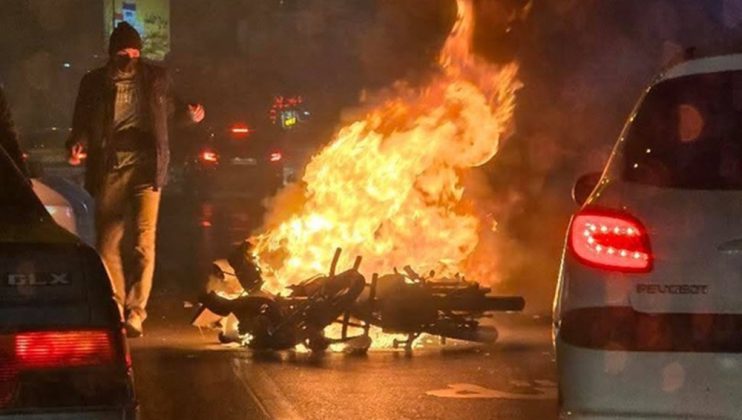
Iran nationwide uprising 2026
Written by
Mehdi Oghbai
Nearly a decade after the nationwide uprising of December 2017 first shattered the illusion of political stability in Iran, the underlying crises that drove millions into the streets remain unresolved—and in many cases have intensified. Poverty, inflation, corruption, environmental collapse, water shortages, ethnic discrimination, institutionalized repression, and the erosion of social trust have combined to create a society operating under permanent tension. Every successive uprising—from 2018 and 2019 to the nationwide revolt of 2022 and the persistent unrest that followed—has left deeper scars inside the ruling system while further radicalizing segments of Iranian society.
What distinguishes the current phase from earlier periods of unrest is not merely the frequency of protests, but the normalization of direct confrontation with the state’s coercive apparatus. Security personnel, Basij militia members, IRGC commanders, intelligence operatives, judiciary officials, and clerics tied to repression have increasingly become targets of retaliatory violence across multiple provinces. These incidents are no longer isolated security events; taken together, they reflect a widening social fracture in which parts of society no longer see the regime’s institutions as legitimate.
The situation becomes even more volatile when an organized Resistance movement is able to channel this accumulated rage toward political direction and regime change. Iranian authorities themselves have repeatedly acknowledged the existence of organized networks and escalating attacks against state forces. The regime’s growing reliance on executions, mass arrests, intimidation campaigns, and extraordinary judicial threats reveals not confidence, but fear: fear that the explosive social conditions that produced the uprisings since 2017 have entered a more dangerous and organized stage.
An #IRGC commander called Karimi stated that 25 percent of the people arrested were members of the paramilitary Basij units, six percent were members of the IRGC and five percent were from relatives of #Iran-Iraq war veterans.https://t.co/O6D392urAs
— NCRI-FAC (@iran_policy) August 6, 2023
Judiciary and Security Alarm Bells
May 9, 2026: Judiciary head Gholam-Hossein Mohseni Ejei declared that any individual who in any way cooperates with the “invading enemy and child-killer” is an “Iran-hater and traitor to the homeland,” vowing extraordinary legal proceedings and surveillance against all such “pedestrians of the enemy” in a war-like situation.
March 10, 2026: State Security Forces Chief Ahmad Reza Radan confirmed the heightened security atmosphere with police and Basij forces deployed around the clock at checkpoints while warning of decisive action against any potential unrest.
January 26, 2026: Head of Parliament’s Security Commission Ebrahim Azizi admitted the protests had escalated to a “fourth level” involving armed action by protesters resulting in over 3,000 killed; Tehran Friday Prayer leader Ahmad Khatami cited a death toll of 2,427 among regime forces.
January 19, 2026: A regime speaker admitted to thousands of deaths and injuries to Basij and police forces due to confrontations with rebellious youth.
According to reports published by Iranian regime media and official sources, at least 50 separate incidents between 2022 and 2026 involved attacks, armed clashes, ambushes, shootings, checkpoint confrontations, and protest-related violence affecting IRGC, Basij, police, intelligence, border-guard, judicial, and other regime-affiliated personnel across Iran. These figures should be understood only as the number of cases acknowledged or reported by regime media, and not as a comprehensive account of all such incidents. The incidents were concentrated especially in Sistan and Baluchestan, but were also reported in Kurdistan, Kermanshah, Isfahan, Fars, Mazandaran, Tehran, Hormozgan, Kerman, and other provinces, reflecting repeated security breaches and confrontations during a period marked by nationwide unrest, border instability, and escalating armed resistance in several regions.
Mr. Hadi Roshanravan from NCRI Security and Counterterrorism Committee explained five stages of the regime's crackdown strategy to quell #IranRevolution2022 https://t.co/4vaMc66lvq pic.twitter.com/UeqiZDiG0M
— NCRI-FAC (@iran_policy) November 22, 2022
Dread and Consequences
The 2022 Iranian uprising inflicted unprecedented casualties on the regime’s security forces, exposing the limits of Khamenei’s repression machine. On the 19th day of the protests, regime Police Chief Hossein Ashtari publicly admitted that 1,800 members of the security forces had already been hospitalized — an average of roughly 90 personnel per day — as defiant youth launched organized counter-attacks instead of retreating.
By the end of the three-month wave, the toll had escalated dramatically: the regime suffered over 200 security-force deaths and more than 7,000 officers beaten and injured in clashes across 246 cities, according to resistance analysis drawn directly from the regime’s own suppressed data. These figures dwarfed the far shorter 2017 and 2019 protests, where the crackdown had quickly contained the unrest within days or a week.
Such heavy losses among police, Basij, and IRGC units triggered visible exhaustion, internal rifts, and defections that further eroded the regime’s control. Security personnel were kept on the streets without sleep for nights on end, as Tehran’s governor himself acknowledged, while many faced pressure from family members and neighbors who had joined the uprising. The sight of a mother publicly grabbing her security-agent son by the collar and pulling him away — with commanders and fellow troops standing by powerless — became a stark symbol of collapsing loyalty at the lower ranks.
At the highest levels, IRGC commanders confessed at a September 22, 2022, Supreme Security Council meeting that they lacked the manpower for a planned massacre, forcing three failed sessions before any decision could be reached.
#Iran’s Top Officials Warn of @Mojahedineng Influence and Looming Revolthttps://t.co/uJxSXN18t9
— NCRI-FAC (@iran_policy) April 18, 2025
Conclusion
The cumulative picture emerging from these incidents is not one of isolated unrest, but of a society undergoing deep political destabilization. Iran’s ruling establishment now faces simultaneous crises: economic decay, collapsing legitimacy, intensifying ethnic tensions, generational radicalization, and the erosion of fear among significant sectors of the population. The repeated targeting of Basij forces, police commanders, IRGC officers, intelligence operatives, clerics, and judiciary figures indicates that the conflict has moved far beyond ordinary protest dynamics.
This atmosphere also explains the regime’s escalating campaign of executions against political prisoners—particularly alleged or accused supporters of the People’s Mojahedin Organization of Iran. From the execution of political prisoners such as Behrouz Ehsani to Hamed Vahidi and others accused of links to organized opposition networks, Tehran increasingly appears determined to use terror and exemplary punishment to prevent the convergence of social rage with organized resistance.
Yet history suggests that mass repression can suppress symptoms without resolving causes. None of the structural grievances that fueled the uprisings since 2017 have disappeared. Instead, they have accumulated. In that sense, Iran today resembles a political powder keg: economically exhausted, socially fractured, politically radicalized, and increasingly primed for another nationwide explosion.