
Iran’s Suffering Cartel
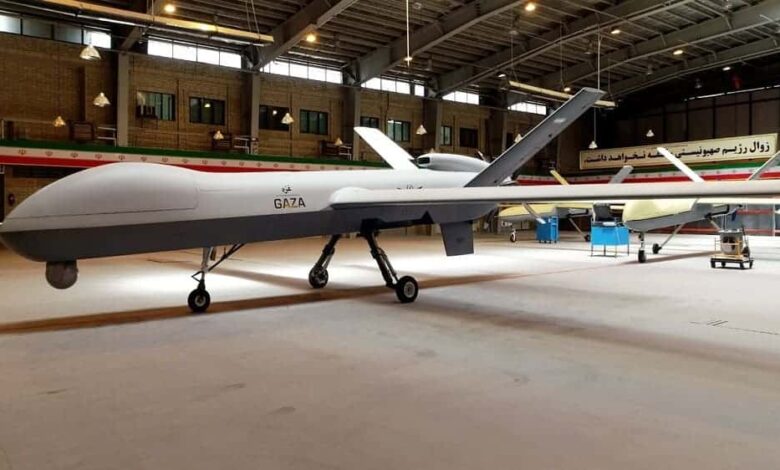
An Iranian-manufactured “Gaza” drone (Shahed-149) on display in a military hangar
Iran’s Suffering Cartel
Written by
In the spring of 2026, after the Supreme Leader Ali Khamenei was killed in the war and much of the regime’s nuclear and missile programs had been damaged, his son and heir, Mojtaba Khamenei, did not sue for peace. His forces kept harassing tankers in the Strait of Hormuz, fired on Gulf shipping, and funneled fresh money to proxies from Lebanon to Yemen. Even gutted, the regime’s first instinct was the same one it has followed for forty-seven years: survival by inflicting pain.
This is not religious zealotry. It is a doctrine older than the regime itself. The mullahs and their Revolutionary Guard do not govern Iran; they extort the world with human suffering. They have one tool, and they have never needed another.
From the beginning the regime understood that misery is leverage. It seized American hostages in 1979, staged bombings in Lebanon, and built a global terror network not to spread the faith but to force concessions. It irritated Iraq into war, then—after repelling the invasion in 1982—rejected Iraq’s ceasefire and full withdrawal. Khomeini dragged the slaughter on for six more years, sending teenage boys into human-wave attacks while executing dissidents at home as “traitors.” The war was never about holy defense. It was about consolidating power through blood.
Scholars still misread the regime as “Islamic extremism” like ISIS or al-Qaeda. The difference is simple: jihadists chase apocalyptic purity. Iran’s rulers chase maslahat-e nezaam—the “expediency of the state.” They suspend Islamic rules when convenient, partner with atheist and communist regimes, and run narcotics networks and ghost fleets to dodge sanctions. Religion is the costume. Deceit is the operating system.
THREAD
For more than four decades, the clerical regime in #Iran has consistently blackmailed other nations and considered #extremism as "leverage". 1/9https://t.co/ieaaOkZb6y pic.twitter.com/W9u5BJHXqs— NCRI-FAC (@iran_policy) September 6, 2022
In a documented conversation, the slain Khamenei told former President Rafsanjani, “If people become prosperous, they will abandon religion.” This wasn’t piety; it was a deliberate strategy of engineered poverty to keep the population dependent and docile.
His family and the bonyads—those untouchable “charitable” foundations—control tens of billions while ordinary Iranians endure hyperinflation and crushed hopes. Mojtaba himself sits atop an offshore fortune estimated in the billions. The elite live like the “decadent” Westerners they denounce. Suffering is not a side effect. It is the strategy.
Every time the world has tried containment—sanctions, limited strikes, nuclear deals—the regime has used the breathing room to scale its pain machine. Domestic terror became regional proxy wars, then global terrorism and narcotics. Today the pain reaches every gas pump and shipping lane. The regime cannot coexist with stability because its only competence is manufacturing instability. It will sign any agreement and immediately weaponize the pause.
There is only one lever left unpulled: regime change. Everything else has been tried and has failed.
"Once an internal oppressor, the clerical dictatorship in Iran has now become a direct menace to international commerce, #energy security and the economic well-being of billions worldwide," writes @MehdiOghbai.https://t.co/tEMs1wu4kl
— NCRI-FAC (@iran_policy) April 23, 2026
The regime’s Achilles’ heel is not merely public discontent, but the existence of organized forces capable of turning that discontent into a nationwide uprising for overthrow. Since 2017, the revolt that has shaken the regime’s foundations has neither died nor dissipated; it has hardened amid economic collapse, daily executions, and wartime hardship. What the regime fears most is its main opposition group, the People’s Mojahedin Organization of Iran (PMOI/MEK) and its Resistance Units, which have spread across cities and provinces throughout Iran and have played a key role in sustaining successive waves of uprising. Young Iranians risk everything to reject the theocracy, but it is this organized Resistance that provides the agency, structure, and direction needed to finish the job. This is the missing link in many foreign analyses: without recognizing the organized force that can mobilize the people for regime change, analysts fail to understand what truly frightens the regime and why it acts with such fear.
Airstrikes can degrade the machine. Only the Iranian people and their organized resistance can destroy its logic.
"While the military and economic stalemate over #Hormuz continues to bleed the global economy, the only path that has ever truly threatened the brutal theocracy is an internal, society-driven unraveling," writes @MasumehBolurchi.https://t.co/g7804cnDe7
— NCRI-FAC (@iran_policy) April 27, 2026
The world must stop pretending this regime can be contained or reformed. Cut every diplomatic, financial, and rhetorical tie. Declare it what it is: not an Islamic republic but a suffering cartel—a criminal enterprise that exports pain because it has never learned to build anything else. Starve its bonyads, its ghost fleets, its criminal networks. Stand unequivocally with the Iranian people and their organized Resistance as the legitimate agents of change.
Forty-seven years of history prove the pattern will not break on its own. The only question left is whether the rest of the world will finally stop feeding the extortionist and start empowering the victims who are ready to end it.