
Why Iran’s Censorship Playbook Is a Global Threat
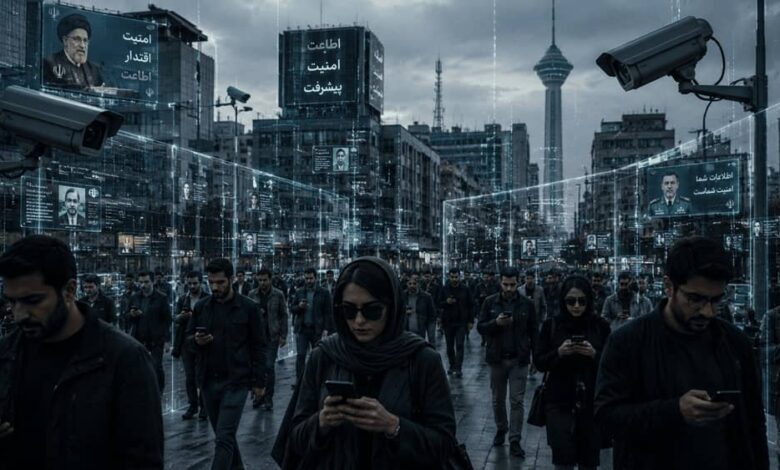
AI-generated illustration depicting the architecture of digital authoritarianism, surveillance, and internet control in Iran
Written by
Dr. Masumeh Bolurchi
The struggle unfolding in Iran is no longer merely a domestic conflict between a repressive regime and a population demanding freedom. It has become a test case for the future of political power in the digital age.
Iran has emerged as a prototype of modern digital authoritarianism: a state systematically testing whether a regime can survive repeated crises of legitimacy by disconnecting society from reality itself.
What began as reactive censorship has evolved into a sophisticated architecture designed not only to suppress dissent, but to fragment collective awareness, isolate citizens from one another, and monopolize the population’s perception of truth. If this model succeeds, it will not remain confined to Iran. It will become a blueprint for authoritarian survival in the twenty-first century and beyond.
The Architecture of Digital Control
The Iranian regime has moved far beyond blocking websites. It has spent years constructing what it calls “digital sovereignty” — a euphemism for informational control.
At the center of this strategy is the National Information Network (NIN), often described as the “Halal Internet.” More than a censorship tool, it is an attempt to redesign the internet itself. By steering citizens toward domestic platforms for banking, messaging, commerce, and entertainment, the regime has created a state-controlled digital ecosystem capable of functioning independently from the global web.
#Iran’s White-SIM Internet: How Tehran Hacks the Feed You Trusthttps://t.co/IUhKVR2wcg
— NCRI-FAC (@iran_policy) November 26, 2025
This allows authorities to sever international connectivity during periods of unrest while preserving internal state infrastructure. During major uprisings, particularly in 2019, 2022 and 2026, the regime demonstrated this capability with chilling precision, plunging millions into digital darkness while maintaining domestic control.
But Iran’s censorship model no longer relies solely on total blackouts. Using Deep Packet Inspection (DPI) and advanced traffic management systems, authorities selectively throttle encrypted messaging apps, VPNs, and social media platforms until they become practically unusable. This form of “soft censorship” is psychologically sophisticated: the goal is not simply to block information, but to make access so frustrating and unreliable that citizens gradually abandon attempts to communicate freely.
At the same time, measures such as the so-called “Protection Bill” seek to criminalize circumvention tools and place internet gateways under direct state authority. Censorship is no longer merely technical — it becomes legal and judicial.
The regime’s strategy extends beyond surveillance into social fragmentation. Protest movements survive through visibility. People act when they know others are resisting too. The objective of internet shutdowns is therefore not merely to silence individuals, but to prevent society from seeing itself.
Modern authoritarianism no longer depends on forcing universal belief. It depends on manufacturing universal uncertainty.
#Iran’s Digital Apartheid: Regime Loyalists Flood the #Internet While the Rest of the Nation Goes Darkhttps://t.co/qFQw7Bi9wc
— NCRI-FAC (@iran_policy) June 20, 2025
The Global Spread of Digital Authoritarianism
The most dangerous aspect of the Iranian model is not its existence, but its apparent effectiveness.
Authoritarian systems no longer innovate in isolation. Every successfully suppressed protest, every disrupted uprising, and every digitally fragmented society becomes a case study for regimes seeking to preserve power without popular consent.
This contagion spreads not only through ideology, but through method. Technologies developed for “cyber-security” or “traffic management” can easily become instruments of political control. Terms such as “digital sovereignty” increasingly serve as justification for subordinating the free flow of information to state authority.
The original promise of the internet was that information could transcend borders and weaken censorship. The Iranian model reverses that promise by rebuilding digital borders around human perception itself.
#Iran's streets are protesting amid a severe Jan 2026 internet blackout. Yet online, defenses of Reza Pahlavi persist — sometimes with intense/vulgar pushback against critics. Bots, expats, regime 'White SIM' tactics to divide opposition? Who runs the narrative? @khansari_m…
— NCRI-FAC (@iran_policy) January 10, 2026
A Threat Beyond Iran
The normalization of the Iranian model poses a profound threat to democracy worldwide.
If governments learn they can survive legitimacy crises through surveillance, digital isolation, and information blackouts, authoritarianism itself will evolve. Future systems of repression may rely less on ideology or mass support and more on controlling the infrastructure through which society communicates, organizes, and understands itself.
The Iranian regime’s most dangerous export may ultimately not be missiles or militias, but a proven blueprint for digitally surviving popular rejection.
Failing to confront this model risks creating a global authoritarian feedback loop in which repressive governments share technologies, legal frameworks, and methods of informational control. The result would not simply be declining internet freedom, but the emergence of a digital dark age in which states increasingly dominate the flow of human perception itself.
#Iran’s Two-Tier Censored Internet Is Getting More Expensivehttps://t.co/ilOwR6Evfe
— NCRI-FAC (@iran_policy) December 2, 2025
Iran and the Future of Freedom
Yet the future is not predetermined.
Iran can still become the opposite of what its rulers intend: not the first successful model of digitally managed authoritarianism, but proof that even sophisticated systems of censorship and surveillance cannot permanently suppress a population determined to reclaim its freedom.
The struggle for a democratic Iran is therefore not only a national cause. It is one of the defining frontlines in the global battle between digital liberty and digital tyranny.
Supporting the Iranian people means supporting technologies that bypass censorship, imposing accountability on those enabling surveillance infrastructure, and recognizing the democratic aspirations of Iranians seeking a secular republic founded on popular sovereignty rather than repression.
A democratic transition in Iran would send a message far beyond its borders: that no amount of surveillance, bandwidth manipulation, or algorithmic repression can extinguish the human desire for dignity and self-government.
Failing to confront the Iranian model will teach tyrants everywhere that shutting down reality works.
Helping the Iranian people achieve freedom will teach the world the opposite: that liberty can still outlast repression, even in the age of algorithms and digital walls.
Why Iran’s Censorship Playbook Is a Global Threat
Written by
Dr. Masumeh Bolurchi
7th May 2026
AI-generated illustration depicting the architecture of digital authoritarianism, surveillance, and internet control in Iran
AI-generated illustration depicting the architecture of digital authoritarianism, surveillance, and internet control in Iran
Three-minute read
The struggle unfolding in Iran is no longer merely a domestic conflict between a repressive regime and a population demanding freedom. It has become a test case for the future of political power in the digital age.
Iran has emerged as a prototype of modern digital authoritarianism: a state systematically testing whether a regime can survive repeated crises of legitimacy by disconnecting society from reality itself.
What began as reactive censorship has evolved into a sophisticated architecture designed not only to suppress dissent, but to fragment collective awareness, isolate citizens from one another, and monopolize the population’s perception of truth. If this model succeeds, it will not remain confined to Iran. It will become a blueprint for authoritarian survival in the twenty-first century and beyond.
The Architecture of Digital Control
The Iranian regime has moved far beyond blocking websites. It has spent years constructing what it calls “digital sovereignty” — a euphemism for informational control.
At the center of this strategy is the National Information Network (NIN), often described as the “Halal Internet.” More than a censorship tool, it is an attempt to redesign the internet itself. By steering citizens toward domestic platforms for banking, messaging, commerce, and entertainment, the regime has created a state-controlled digital ecosystem capable of functioning independently from the global web.
This allows authorities to sever international connectivity during periods of unrest while preserving internal state infrastructure. During major uprisings, particularly in 2019, 2022 and 2026, the regime demonstrated this capability with chilling precision, plunging millions into digital darkness while maintaining domestic control.
But Iran’s censorship model no longer relies solely on total blackouts. Using Deep Packet Inspection (DPI) and advanced traffic management systems, authorities selectively throttle encrypted messaging apps, VPNs, and social media platforms until they become practically unusable. This form of “soft censorship” is psychologically sophisticated: the goal is not simply to block information, but to make access so frustrating and unreliable that citizens gradually abandon attempts to communicate freely.
At the same time, measures such as the so-called “Protection Bill” seek to criminalize circumvention tools and place internet gateways under direct state authority. Censorship is no longer merely technical — it becomes legal and judicial.
The regime’s strategy extends beyond surveillance into social fragmentation. Protest movements survive through visibility. People act when they know others are resisting too. The objective of internet shutdowns is therefore not merely to silence individuals, but to prevent society from seeing itself.
Modern authoritarianism no longer depends on forcing universal belief. It depends on manufacturing universal uncertainty.
The Global Spread of Digital Authoritarianism
The most dangerous aspect of the Iranian model is not its existence, but its apparent effectiveness.
Authoritarian systems no longer innovate in isolation. Every successfully suppressed protest, every disrupted uprising, and every digitally fragmented society becomes a case study for regimes seeking to preserve power without popular consent.
This contagion spreads not only through ideology, but through method. Technologies developed for “cyber-security” or “traffic management” can easily become instruments of political control. Terms such as “digital sovereignty” increasingly serve as justification for subordinating the free flow of information to state authority.
The original promise of the internet was that information could transcend borders and weaken censorship. The Iranian model reverses that promise by rebuilding digital borders around human perception itself.
A Threat Beyond Iran
The normalization of the Iranian model poses a profound threat to democracy worldwide.
If governments learn they can survive legitimacy crises through surveillance, digital isolation, and information blackouts, authoritarianism itself will evolve. Future systems of repression may rely less on ideology or mass support and more on controlling the infrastructure through which society communicates, organizes, and understands itself.
The Iranian regime’s most dangerous export may ultimately not be missiles or militias, but a proven blueprint for digitally surviving popular rejection.
Failing to confront this model risks creating a global authoritarian feedback loop in which repressive governments share technologies, legal frameworks, and methods of informational control. The result would not simply be declining internet freedom, but the emergence of a digital dark age in which states increasingly dominate the flow of human perception itself.
Iran and the Future of Freedom
Yet the future is not predetermined.
Iran can still become the opposite of what its rulers intend: not the first successful model of digitally managed authoritarianism, but proof that even sophisticated systems of censorship and surveillance cannot permanently suppress a population determined to reclaim its freedom.
The struggle for a democratic Iran is therefore not only a national cause. It is one of the defining frontlines in the global battle between digital liberty and digital tyranny.
Supporting the Iranian people means supporting technologies that bypass censorship, imposing accountability on those enabling surveillance infrastructure, and recognizing the democratic aspirations of Iranians seeking a secular republic founded on popular sovereignty rather than repression.
A democratic transition in Iran would send a message far beyond its borders: that no amount of surveillance, bandwidth manipulation, or algorithmic repression can extinguish the human desire for dignity and self-government.
Failing to confront the Iranian model will teach tyrants everywhere that shutting down reality works.
Helping the Iranian people achieve freedom will teach the world the opposite: that liberty can still outlast repression, even in the age of algorithms and digital walls.