
MEP Francisco Assis: Peace Without a Clear Commitment to People-Led Regime Change Will Not Resolve Iran Crisis
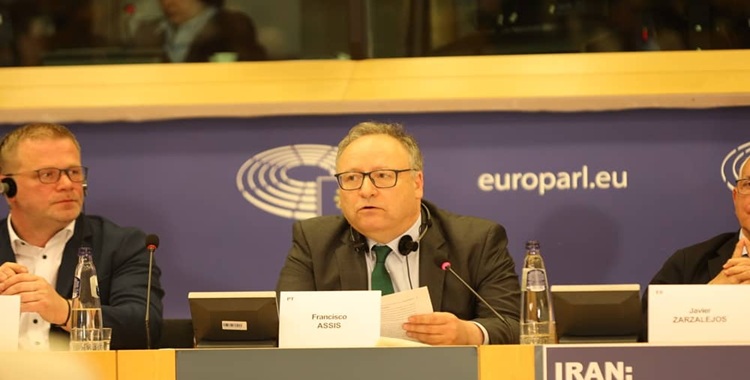
MEP Francisco Assis addresses a meeting at the EU Parliament in Brussels on April 22, 2026
Written by
Shamsi Saadati
On an April 22, 2026, conference, at a conference at the European Parliament in Brussels, MEP Francisco Assis, delivered a stirring condemnation of the Iranian regime’s “culture of death,” highlighting the recent executions of young activists and members of the PMOI. He criticized the “grand silence” of the international community, particularly the European Union and the European Left, arguing that this inaction allows Tehran to continue its domestic war against its own people with total impunity.
Assis warned that the regime exploits regional conflicts to mask its internal fragility and distract from the inevitable revolt of a population seeking freedom. He firmly rejected the notion that foreign military strikes or a return to the pre-1979 monarchy could provide a solution, asserting that only the Iranian people and their organized resistance can achieve a lasting transition to democracy.
Consequently, the Portuguese MEP urged the EU to shift its strategy by recognizing the National Council of Resistance of Iran (NCRI) and Maryam Rajavi’s Ten-Point Plan as the most credible roadmap for peace. To support this change, he called for the designation of the IRGC as a terrorist organization, the closure of regime embassies, and the expulsion of agents used for transnational repression. He insisted that any future international agreements with Tehran must be strictly tied to verifiable improvements in human rights.
A translated version of Francisco Assis’ speech follows:
Francisco Assis: The EU must close the regime's embassies, and expel its agents. We must affirm the right of the Iranian people and #MEKResistanceUnits to work for democratic change and protect themselves against systemic repression. #NCRIAlternative https://t.co/sgw2cHi0YC
— NCRI-FAC (@iran_policy) April 22, 2026
Madam Maryam Rajavi, dear colleagues, ladies and gentlemen, I would first like to deeply deplore the deaths of tens of thousands of Iranian men and women massacred by a regime that has declared war on its own people. I also express my sadness regarding the recent executions of young people aged 18 to 30 arrested during the recent uprisings and of six members of the People’s Mojahedin Organization of Iran. The courage of these young people and the dignity with which they face their executioners is almost inconceivable. We have done everything we can within this parliament to ensure a clear condemnation of these monstrous executions and the culture of death that is the hallmark of this regime. But we are concerned by the silence of the international community, and particularly by the silence of the European Union regarding these recent executions.
And I will go a little further. As a man of the left, of the center-left, I regret the great silence of the European Left in the face of this true human tragedy. The provocative attitude of the regime seems to indicate that it anticipates its fall as an inevitable consequence of American and Israeli military intervention. Under the cover of war, the regime can not only present itself as a victim to the international community but also continue the war against its own people with total impunity, taking advantage of the internet blackout. The regime knows that at the end of the armed conflict, it will once again have to face the revolt and indignation of the population. This is why, contrary to popular belief in Europe, public support for the Iranian Resistance would have the strongest impact on the regime. Political recognition of the Resistance represents a profound threat to Tehran. By continuing to ignore the Iranian people and their organized resistance, Europe has deprived itself of its most effective lever and ally in its policy toward Iran.
From experience, the regime knows that the synergy between mass demonstrations, Resistance Units, and PMOI fighters constitutes a formidable existential threat to its survival. Airstrikes cannot overthrow the regime, but an Iranian resistance can. No level of bombing can substitute for this force on the ground: the force of the Iranian people. I want to clarify my position. It is not for the European Union to choose the Iranian opposition that it likes most and despise the opposition that it likes least. It is even less its place to give in to pressure aimed at promoting the heirs of the pre-1979 monarchy, which was marked by persecution carried out by the sinister Savak secret police, by executions, torture, and the dissolution of political parties.
It is up to the sovereign people of Iran to choose their destiny and what they wish to see at the head of their country through free elections. But why would the regime have mobilized its repressive system against the PMOI over the last decades if it had not identified it as the main threat to its survival? If the PMOI is the regime’s main target, it is because it is the most plausible alternative, the organization with the best chance of overthrowing the mullahs and bringing about real change. This is why the European Union must engage in a dialogue with the National Council of Resistance of Iran as a democratic alternative committed to a transition based on popular sovereignty. As early as 2004, Madam Maryam Rajavi publicly declared that the solution for Iran was neither foreign war nor appeasement, but the third option: democratic change by the Iranian people and their resistance.
MEP from #Portugal Francisco Assis condemns the execution of young protesters and @Mojahedineng members, warning that #EU silence is unacceptable in the face of such atrocities. pic.twitter.com/dnRTUdp6nY
— NCRI-FAC (@iran_policy) May 1, 2026
Contrary to what the vestiges of the mullahs and the Shah seek, she welcomed the ceasefire and expressed the hope that it would lead to the end of the war and open the way to peace and freedom. What role could the European Union play in this crisis? It is essential that calls for peace are not exploited by the regime as a pretext for further appeasement. This is the major risk, I believe, that is before us today. A peace without a clear commitment to regime change led by the people will not resolve the crisis and risks preparing even larger and more destructive wars in the future. The European Union must make any international agreement with Tehran, including any agreement based on the current ceasefire, conditional on verifiable improvements in the human rights situation in Iran.
The European Union must, of course, designate the Islamic Revolutionary Guard Corps as a terrorist organization, as this Parliament has repeatedly requested in the resolutions it has adopted. But the European Union must also close the regime’s embassies and expel its ambassadors, diplomats, and agents acting as instruments of transnational repression and hostile activities of the regime across the entire European Union. But above all, the European Union must affirm the right of the Iranian people and popular Resistance Units to work for democratic change and to protect themselves against the systematic repression exercised by the regime’s security forces. This means, finally, the rejection of artificially manufactured alternatives from the outside and clear support on our part for the Iranian Resistance, for all Iranian resistance fighters, and for the Ten-Point Plan, which is the best plan known for Iran, presented by Madam Maryam Rajavi, because it represents the only credible path toward three essential goals: peace, freedom, and democracy.
Thank you very much.