
Power Struggles Intensify Inside Iran’s Leadership as War and Diplomacy Divide the Regime
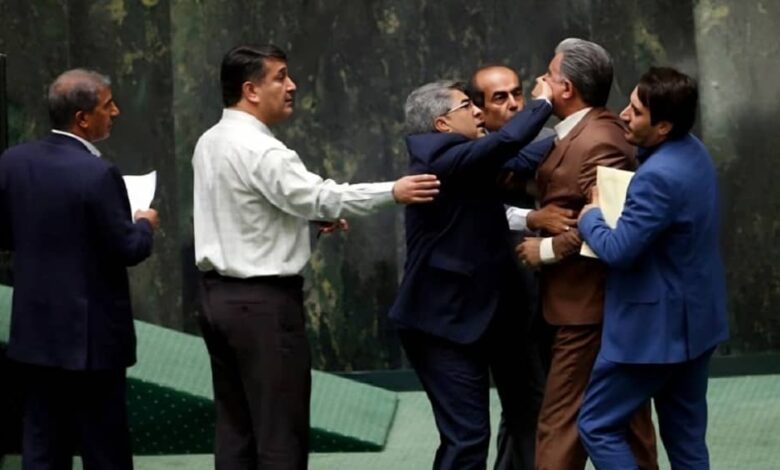
FILE PHOTO: Brawl between MPs in Iran’s parliament (Majlis)
Written by
Mahmoud Hakamian
Deepening internal divisions within Iran’s ruling establishment have come into sharp focus in late April 2026, as officials, lawmakers, clerics, and state media openly clash over war strategy and negotiations with the United States.
Reports published by state-affiliated outlets describe an increasingly fragmented political environment, with competing factions advancing contradictory positions on both diplomacy and military escalation.
Parliament Pushes Maximalist Demands
An April 28 report by Khabar Online warned that members of parliament have become “loudspeakers for hardliners,” accusing them of fueling divisions instead of preserving national unity.
Among the most striking proposals, lawmaker Ebrahim Rezaei said ending the war should be conditioned on “permanent membership in the UN Security Council with veto power.” Other MPs called for removing the nuclear issue from negotiations entirely and limiting talks to “receiving compensation and sovereignty over the Strait of Hormuz.”
MP Sabeti, speaking at a nighttime rally in Tehran in late April, dismissed negotiations outright, stating: “If there is negotiation, we know one thing—its outcome will definitely not be in our favor.” He added that Iran must instead demonstrate in the “field of action and war that we will not surrender,” pointing to missile, drone, and enriched uranium capabilities as deterrence.
These positions highlight a faction within the political system that views any concession as a strategic risk to the regime’s survival.
The central fact of post-Khamenei Iran is that the regime has entered a crisis of command. The state still carries on with #war and oppression, but the one office that could settle every serious dispute is gone.https://t.co/6JH4qQriPf
— NCRI-FAC (@iran_policy) March 8, 2026
Clerical Calls for War and Escalating Internal Accusations
The divide extends beyond parliament into clerical circles. In remarks delivered in late April 2026, Gholamreza Qasemian openly called for renewed conflict, stating: “We are approaching very good moments when this war must begin again… God has willed this war for us.”
In the same speech, he acknowledged intensifying internal tensions, referring to accusations circulating within the system: “Some say Araghchi is a traitor… Ghalibaf is this or that… an agent of Mossad.” He warned that such rhetoric risks undermining cohesion, while insisting that unity depends on absolute loyalty to the regime’s leadership.
The targeting of senior figures such as Mohammad Bagher Ghalibaf and Abbas Araghchi illustrates how factional rivalries have escalated into public campaigns of delegitimization.
On April 26, state newspaper Arman also warned that nighttime gatherings have created opportunities for fringe groups to “exploit the atmosphere” and publicly attack officials and negotiators.
Tehran’s Descent into Chaos and the Myth of Military Strength https://t.co/h06GvzLXYe
— Shamsi Saadati (@ShamsiSaadati) April 26, 2026
Contradictions Within the Negotiating Team
Internal divisions have become particularly visible within the regime’s diplomatic apparatus. On April 23–24, during a visit to Islamabad, conflicting statements emerged from within the same delegation.
While Araghchi said Iran had conveyed its “considerations for ending the war,” adviser Mohammad Marandi stated that “no negotiations with the Trump administration will take place in Islamabad.” The contradiction exposed a lack of coordination at senior levels.
Criticism has also come from within parliament. Lawmaker Mahmoud Nabavian described the negotiations as a “strategic mistake,” arguing that including the nuclear issue “encouraged the enemy” to demand concessions such as removing nuclear materials or suspending enrichment for 20 years.
Other lawmakers said they were excluded from the process entirely. One member of parliament stated that Ghalibaf’s role “does not represent the parliament,” adding that representatives remain unaware of key developments.
"On the morning after the ceasefire, every exhausted and exasperated mind, long numbed by the #IranWar, will turn instinctively toward the search for real change and the practical means to bring this regime to an end." https://t.co/8Tmh0Sl0Kc
— NCRI-FAC (@iran_policy) April 9, 2026
Insiders Warn of Structural Disunity
Meanwhile, some insider voices have framed the crisis as structural rather than temporary. In a statement on April 21, the so-called Reform Front of Iran described diplomacy as “the highest manifestation of modern governance,” urging a move away from “emotional, extremist, and isolationist approaches.”
State-affiliated analyst Mohammad Mahmoudi argued that Iran is effectively “negotiating with one wing,” citing three main obstacles: maximalist objectives, a gap between military and diplomatic decision-making, and the absence of consensus on whether to end the war.
Police chief Ahmad-Reza Radan also warned against polarization, stating in remarks on April 23: “The enemy seeks to create division… we must ensure no duality is created among us.” He stressed unconditional obedience in decisions on both war and negotiations.
Despite these coordinated messages, concern is evident within pro-regime circles. State-aligned analyst Nasser Imani warned that public criticism of the diplomatic team during wartime is “poison,” cautioning that weakening any of the system’s pillars—military, public support, or diplomacy—could destabilize the state.
The Geometry of Regime Change in Iran https://t.co/hWrrOgBB6k
— Ali Safavi (@amsafavi) April 29, 2026
A Regime Divided by Competing Survival Strategies
Taken together, the statements, media reports, and public disputes reveal a system grappling with profound internal contradictions. While officials repeat slogans of unity, the reality reflected on the ground is one of intensifying rivalry and distrust.
At its core, the struggle points to the erosion of the regime’s ideological foundation. Factions that were once bound— or at least held together—by a shared framework now appear to be held together primarily by a single instinct: survival.
Yet even that instinct has become a source of conflict. One faction believes that submitting to foreign pressure would erode the morale of the regime’s base and security forces, leaving it vulnerable to domestic uprising. Another argues that without engaging with foreign powers, the country will face economic suffocation, leading to widespread unrest.
As these competing strategies harden, Iran’s ruling elites are increasingly both colluding and confronting one another—locked in a power struggle that reflects not strength, but a deepening crisis at the core of the system.