
Tehran’s War Posturing Masks Regime Fracture, Economic Strangulation, and Social Fragility
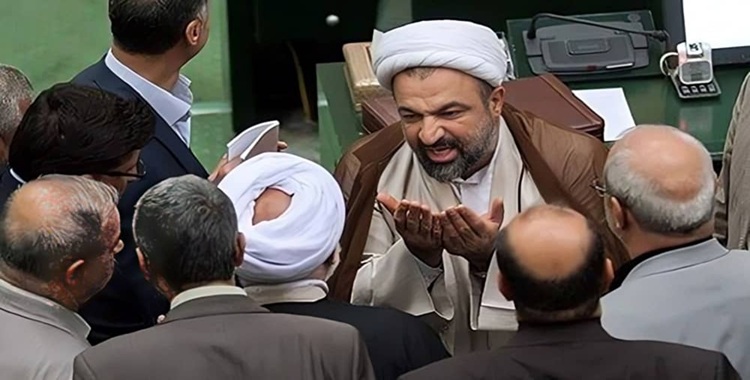
Influencial MP Hamid Rasaee argues with his peers in the Iranian regime’s parliament (Majlis)
Written by
Mehdi Oghbai
In recent weeks, Iran’s leadership has been projecting defiance — proxy extortion threats, vows to keep the nuclear file closed, and boasts about turning the Strait of Hormuz into a toll booth — while simultaneously floating desperate diplomatic feelers. State media and insiders, however, reveal a regime that possesses no real internal strength, economic resilience, social capital, or diplomatic cards left to play. It is openly counting on political turmoil inside the United States and the global headache of disrupted shipping and elevated oil prices to force Washington to ease the blockade.
U.S. Central Command has now stopped 45 commercial vessels attempting to trade with Iran, a figure CENTCOM itself confirmed as of early May. Brent crude has settled around $109 per barrel today after earlier spikes, offering Tehran far less leverage than its warmongering faction had hoped.
Extremists, factions close to the power core, continue maximalist rhetoric. MP Ali Khezrian declared on Mary 1, 2026, the nuclear file permanently off-limits: “The nuclear [file] is no longer negotiable for us from now on; this is explicitly the statement of the Supreme Leader that the nuclear has gone alongside missiles and nano… this file is closed.” He unveiled plans for Houthi proxies to shut the Bab al-Mandab Strait and demand $5–6 million “passage fees” per non-hostile ship. Speaker Mohammad-Bagher Ghalibaf took to X to brag: “Three days have passed and no oil well has exploded. We can extend this to 30 days and broadcast live images of the wells.”
Yet the same outlets report conditional overtures. The regime’s president Masoud Pezeshkian and Abbas Araqchi have signaled readiness for talks if the U.S. drops “provocative actions,” with Tasnim News Agency noting Tehran’s recent 14-point counter-proposal via Pakistani intermediaries demanding full sanctions relief and blockade lift within 30 days.
"Deepening internal divisions within Iran’s ruling establishment have come into sharp focus in late April 2026, as officials, lawmakers, clerics, and state media openly clash over war strategy and #negotiations with the United States," writes @HakamianMahmoud.…
— NCRI-FAC (@iran_policy) April 29, 2026
Public Loyalty Oaths to Mojtaba Khamenei Signal Elite Feuds
The most telling sign of weakness is the regime’s own frantic insistence on unity. Judiciary chief Gholam-Hossein Eje’i and other officials repeatedly stress that every negotiation requires the direct “ezn” (permission) of Mojtaba Khamenei, now routinely referred to as the Supreme Leader. Mohsen Qomi, deputy for international affairs in the Leader’s Office, publicly admitted Mojtaba was wounded in a recent strike but insisted he is “in complete good health” and personally directing both battlefield and diplomatic moves — a rare acknowledgment that only fuels speculation about internal power struggles.
Foreign Ministry spokesman Esmail Baqaei was even more blunt on state television, pleading: “We shouldn’t turn on each other… media is itself part of the war… we must vaccinate the people so they can distinguish right from wrong and not fall on one another.” Khabar Online, a state-affiliated outlet, described the Majlis as effectively paralyzed, with hardline MPs operating via X and TV in a barrage of contradictory statements.
A vicious public media war between Tasnim News (IRGC-linked) and Rajanews (close to the Saeed Jalili) over whether “street power” could support negotiations has escalated into mutual accusations of treachery and psychological operations — a split now openly covered even by regime-friendly outlets.
Hard-core principalists argue that any concession to the West would make the regime appear weak, erode morale among their shrinking domestic base and regional proxies, embolden internal dissidents, and hand propaganda victories to enemies — precisely why they reject compromise so fiercely.
"Amid mounting military and diplomatic pressure, the Iranian regime’s ruling cliques are tearing each other apart over whether to pursue negotiations with the United States, extend the ceasefire, or double down on confrontation," @MasumehBolurchi. #IranWar…
— NCRI-FAC (@iran_policy) May 1, 2026
Economic Siege and Fear of Social Explosion
Regime-aligned analyst Ali Bigdeli openly called the U.S. approach a shift to “suffocating economic siege” that avoids direct combat but starves Iran’s oil revenue and keeps the economy in permanent pressure. Pezeshkian has ordered governors to activate mosques on a neighborhood level for grassroots crisis management — a tacit admission that the leadership fears prolonged hardship could spark unrest.
With its base demoralized, proxies stretched, and economy hemorrhaging, Tehran clings to the hope that global energy pain and American domestic friction will force a diplomatic blink. However, this “no-war-no-peace” situation is a fragile holding pattern with a looming expiration date. Once this geopolitical equilibrium inevitably shatters, the fierce internal power struggles currently swept under the rug and the long-suppressed social demands of an exhausted population will explode into the open. No longer able to hide behind the theater of external posturing, the regime will be forced to confront the systemic fractures and domestic reckoning it has desperately sought to avoid—a crisis entirely of its own making.